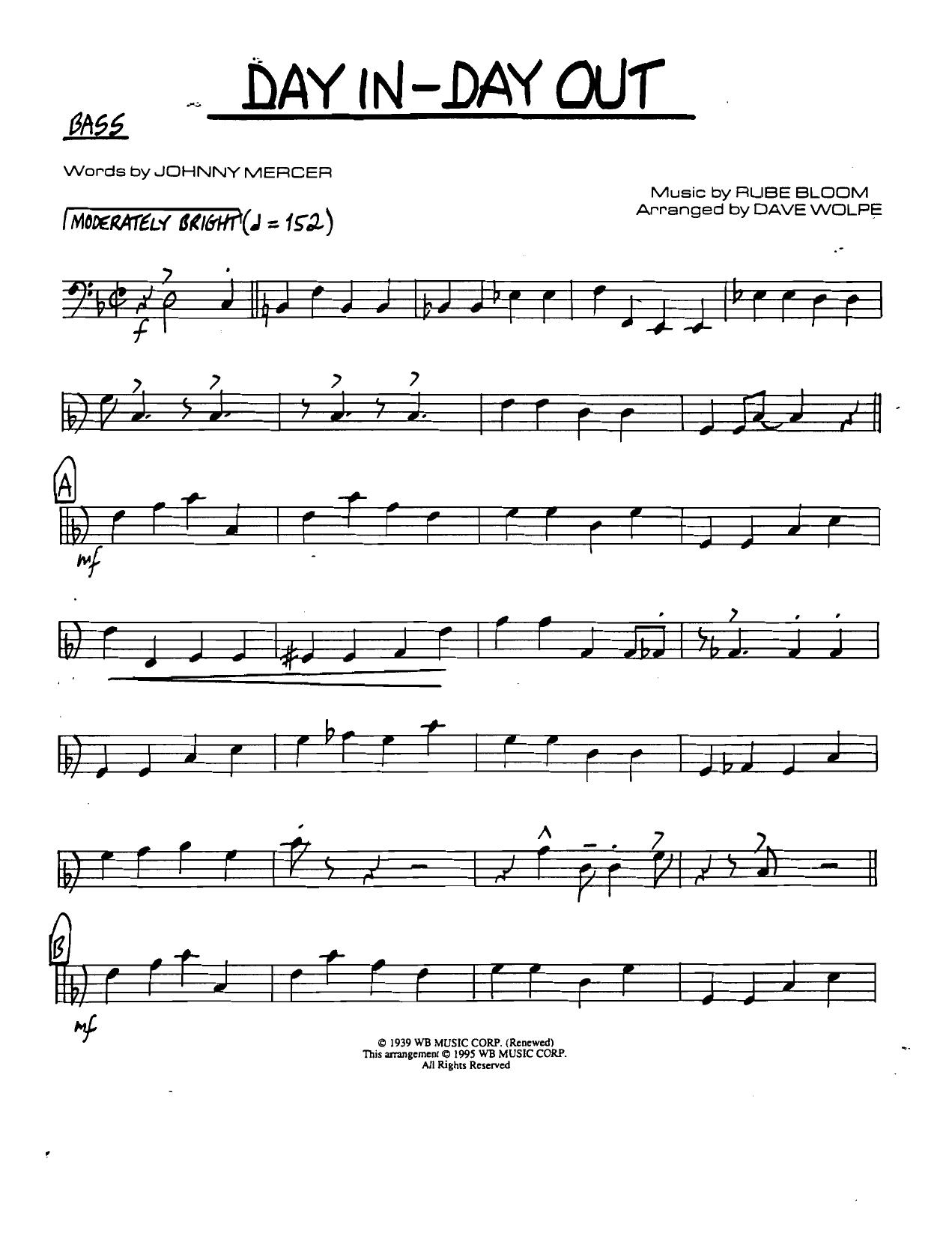
Dayindayout Bass (D.Wolpe)
Composed by RUBE BLOOM
Arranged by Dave Wolpe
- Ensemble: Small Ensemble
- Style: Jazz Standard
- Pages: 4
- Instruments (1): Bass
- Difficulty: easy
- Content: Individual Parts
- Format: PDF Download (Instant)
- Price: $12.99
"Day In, Day Out," composed by Rube Bloom with lyrics by Johnny Mercer, is a quintessential jazz standard that emerged in 1939, capturing the vibrant essence of the Swing Era. This timeless piece quickly gained popularity, with Helen Ward's recording with Bob Crosby and his Orchestra becoming a #1 hit on the Billboard charts in its debut year. Its enduring appeal is evidenced by countless recordings across decades, by legendary artists such as Frank Sinatra, Billie Holiday, and Lena Horne, solidifying its place in the jazz canon. The song is celebrated for its wonderfully soaring melodic line, which Alec Wilder described as "free from pretentiousness, but full of passion and intensity," beautifully complemented by Mercer's lyrics that cleverly contrast the mundane phrase "day in, day out" with exotic imagery. Dave Wolpe's small ensemble arrangement of "Day In, Day Out" reimagines this classic with a sophisticated yet accessible approach, ideally suited for a medium swing feel. Wolpe, a highly respected trombonist and arranger known for his extensive work with big bands and artists like the Glenn Miller Orchestra, brings his signature clarity and rich harmonic sensibility to this chart. His arrangements are often praised for their creative, warm, and colorful nature, making them a staple for jazz ensembles at various levels. This particular arrangement is likely to feature his characteristic attention to voicings that provide a full sound even with a smaller instrumentation, ensuring a lush texture without overwhelming individual players. Expect a key that is comfortable for small ensemble brass and woodwinds, facilitating smooth melodic lines and harmonic interplay. The arrangement breathes new life into the standard, offering rewarding performance opportunities. While specific solo sections are integral to most jazz standards, Wolpe's treatment for small ensemble often highlights individual voices within the ensemble, potentially featuring a bass solo as indicated by the title "Dayindayout Bass (D.Wolpe)". This focus on the bass as a melodic and improvisational voice adds a unique dimension, allowing the instrument to step out from its traditional rhythmic and harmonic support role. Technical challenges will likely involve precise articulation, dynamic control, and maintaining a consistent, driving swing feel. The chart is designed to be musically engaging for all members, with carefully crafted ensemble sections that build energy and showcase the group's cohesion. This arrangement is particularly well-suited for college and advanced high school jazz ensembles, as well as community bands seeking a polished and authentic jazz standard. The small ensemble format allows for greater individual expression and a more intimate musical dialogue among players, fostering stronger musicianship and improvisational skills. It provides an excellent vehicle for developing ensemble blend, rhythmic precision, and an understanding of classic jazz phrasing, making it a valuable addition to any jazz program's repertoire. Approaching this arrangement of "Day In, Day Out" requires a keen focus on rhythmic precision and a relaxed, medium swing feel. Emphasize a buoyant quarter note pulse, ensuring that eighth notes are swung consistently and authentically. The key technical challenge lies in maintaining clarity and balance within the small ensemble, especially during any soli passages, where blend and intonation are paramount. Conductors should encourage musicians to listen across sections to achieve a cohesive sound. For the featured bass, a warm, articulate tone is essential, with careful attention to phrasing that emulates a vocal quality. Rehearsal tips include isolating tricky rhythmic figures and practicing them slowly with a metronome, gradually increasing tempo. Encourage expressive dynamics to highlight the song's inherent emotional arc, building intensity through the form and then relaxing into softer passages. No special techniques like plunger mutes or falls are typically required for this style, allowing the focus to remain on core jazz articulation and swing interpretation. Q: What instruments/parts are included in this arrangement? A: This small ensemble arrangement typically includes parts for standard jazz rhythm section (piano, bass, drums, guitar) and a selection of horns such as trumpet, alto saxophone, and tenor saxophone, with specific parts tailored to highlight the bass. Q: What is the difficulty level of this arrangement? A: This arrangement is considered to be of an intermediate to advanced intermediate difficulty, suitable for college and advanced high school jazz ensembles, as well as proficient community jazz bands. Q: What musical style and historical context does "Day In, Day Out" represent? A: "Day In, Day Out" is a classic jazz standard from the Swing Era, composed in 1939, embodying the melodic and harmonic characteristics of that period. Q: What makes Dave Wolpe's arrangement of "Day In, Day Out" unique? A: Dave Wolpe's arrangement is distinguished by its sophisticated voicings for small ensemble, its authentic medium swing feel, and its particular focus on showcasing the bass as a melodic and improvisational voice. Q: What is the typical performance duration or tempo for this piece? A: As a medium swing, the performance tempo for "Day In, Day Out" generally falls between 120-140 beats per minute, resulting in a typical performance duration of approximately 3-5 minutes, depending on solos and repeats.
Questions and answers
- What is included in the Dayindayout Bass (D.Wolpe) PDF?
- The verified current file contains individual parts across 4 pages.
- How many instruments or parts are listed for Dayindayout Bass (D.Wolpe)?
- The verified instrumentation list contains 1 entries for this Small Ensemble arrangement.
- Who is credited for Dayindayout Bass (D.Wolpe)?
- Composer: RUBE BLOOM. Arranger: Dave Wolpe.
- What difficulty is listed for Dayindayout Bass (D.Wolpe)?
- The verified difficulty level is easy.
- What style is listed for Dayindayout Bass (D.Wolpe)?
- The catalog lists the style as Jazz Standard.
- Can I preview Dayindayout Bass (D.Wolpe) before buying?
- Yes. The product page provides a preview generated from the current PDF file.
- How is Dayindayout Bass (D.Wolpe) delivered?
- After successful payment, the digital PDF is made available for download. The displayed price is $12.99.
Musicians Also Search For
Dayindayout Bass Dave Wolpe PDF • Dayindayout Bass Dave Wolpe sheet music • Dayindayout Bass arranged by Dave Wolpe • Dave Wolpe small ensemble charts • Dave Wolpe jazz arrangements PDF • Dayindayout Bass RUBE BLOOM sheet music • Dayindayout Bass RUBE BLOOM small ensemble arrangements • RUBE BLOOM small ensemble charts • Dayindayout Bass small ensemble arrangements • Dayindayout Bass small ensemble PDF download • Dayindayout Bass jazz sheet music • small ensemble sheet music download • Dayindayout Bass individual parts download • Dayindayout Bass sheet music PDF • Dayindayout Bass Jazz Standard charts • Jazz Standard small ensemble arrangements • buy Dayindayout Bass sheet music • download Dayindayout Bass PDF • Dayindayout Bass jazz charts • best Dave Wolpe small ensemble arrangements • RUBE BLOOM arranged by Dave Wolpe • Dayindayout Bass printable sheet music • small ensemble repertoire PDF