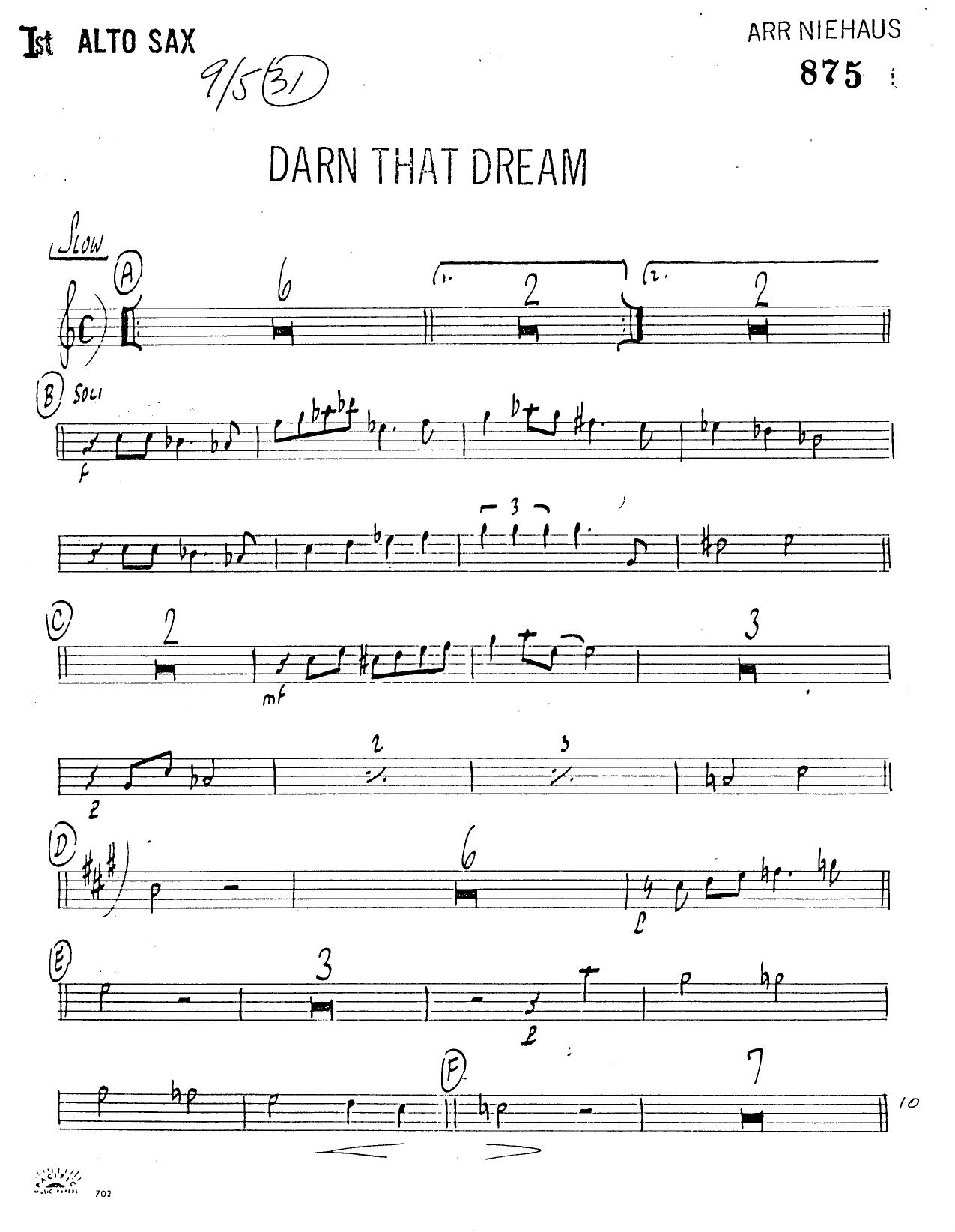
Darn That Dream (L.Niehaus)
Composed by Jimmy Van Heusen
Arranged by Lennie Niehaus
- Ensemble: Big Band
- Pages: 31
- Instruments (18): 1st Alto Sax, 2nd Alto Sax, 3rd Tenor Sax, 4th Tenor Sax, 5th Baritone Sax, 1st Trumpet, 2nd Trumpet, 3rd Trumpet, 4th Trumpet, 5th Trumpet, 1st Trombone, 2nd Trombone, 3rd Trombone, 4th Trombone, Guitar, Piano, Bass, 1st Drums
- Difficulty: medium
- Content: Individual Parts
- Format: PDF Download (Instant)
- Price: $24.99
Jimmy Van Heusen and Eddie DeLange penned "Darn That Dream" in 1939 for the Broadway musical *Swingin' the Dream*, a jazz adaptation of Shakespeare’s *A Midsummer Night's Dream*. While the theatrical production itself had a brief run, the song immediately transcended the stage to become an enduring jazz standard. Benny Goodman and his orchestra, featuring vocalist Mildred Bailey, famously introduced the tune to the broader public that same year, cementing its melancholy, dreamlike charm in the Great American Songbook. Over the decades, it has been reinterpreted by virtually every major figure in jazz, from Miles Davis and Dexter Gordon to Bill Evans and Sarah Vaughan, establishing itself as a quintessential vehicle for introspective ballad playing and rich harmonic exploration. Lennie Niehaus’s masterful big band setting approaches this classic standard with the polished West Coast cool sensibilities that defined his legendary career as an alto saxophonist, composer, and arranger—most notably through his defining work with the Stan Kenton Orchestra. Rather than leaning into heavy, thunderous brass climaxes, Niehaus treats the ensemble like a chamber jazz orchestra, utilizing transparent, sophisticated chord voicings and meticulous counterpoint. The arrangement unfolds at a lush, relaxed ballad tempo in a comfortable, horn-friendly key that allows the ensemble's warm lower-register textures to bloom. The overall mood is deeply nostalgic and reflective, evoking the quiet introspection of a late-night club scene through cascading chromatic lines and subtle harmonic shifts that gently modernize Van Heusen’s original changes. The melodic narrative is primarily driven by the woodwind section, with rich sax solis that highlight Niehaus’s signature gift for linear writing and tight, harmonized bebop-infused phrasing. Trumpets and trombones serve as a warm, cushion-like backdrop, interjecting with tasteful, muted commentary that never overpowers the primary voice. Featured improvised solo space allows a mature soloist—ideally on alto saxophone or trumpet—to stretch out over a lush, harmonically rich background figure provided by the ensemble. Technical demands center less on raw velocity and more on intonation, balance, endurance in the upper registers at soft dynamics, and the stylistic execution of subtle swing eighth-notes within a ballad framework. Advanced high school ensembles, collegiate jazz orchestras, and professional regional big bands will find this arrangement an ideal vehicle for developing ensemble sensitivity, dynamic control, and phrasing maturity. Because the chart relies heavily on inner-voice movement and subtle dynamic shadings rather than sheer volume, it provides an invaluable educational masterclass in section blend and lyrical interpretation. Performing this piece challenges musicians to listen across sections and maintain a forward-moving rhythmic pulse underneath a slow, expressive surface, making it a deeply rewarding centerpiece for any sophisticated concert program. Conductors should approach "Darn That Dream" with a focus on linear continuity and breath support, ensuring the slow ballad tempo never drags or loses its underlying momentum. The primary technical challenge lies in maintaining pristine intonation during dense, modern harmonic shifts, particularly when the saxophones and brass are interlocked in close-position voicings. Balance is critical: the rhythm section should maintain a feather-light touch, with the guitarist or pianist using sparse, tasteful chordal stabs that outline the alterations without cluttering the texture. Mute usage should be strictly monitored for blend; harmon or cup mutes in the brass must be balanced carefully against open woodwinds to preserve the warm, pastel colors characteristic of Niehaus’s West Coast writing. In rehearsal, isolate the sax soli passages to work on unified articulation and stylistic phrasing before integrating the accompanying brass pads. Emphasize a relaxed, behind-the-beat feeling even at slow tempos to capture the authentic, swinging melancholy of the idiom. Q: What instrumentation and parts are included in this big band arrangement? A: Scored for a standard 18-instrument big band, the set includes parts for two alto saxophones, baritone saxophone, a full rhythm section featuring bass and piano, and multiple trombone and trumpet parts starting with Trombone 1. Q: What is the difficulty level of this Lennie Niehaus chart? A: This arrangement is tailored for advanced high school, collegiate, and professional big bands due to its sophisticated harmonic language, demand for refined intonation, and requirement for mature dynamic control. Q: What is the historical style and background of this piece? A: Originally composed by Jimmy Van Heusen in 1939, this chart filters a timeless jazz standard through the sophisticated, cool-jazz arranging aesthetic of West Coast veteran Lennie Niehaus. Q: What makes this specific arrangement by Lennie Niehaus unique? A: Unlike bombastic contemporary charts, Niehaus treats the 18-piece ensemble with chamber-like transparency, utilizing intricate saxophone solis, rich inner-voice movement, and subtle harmonic reharmonizations. Q: What is the performance duration and tempo feel of the arrangement? A: The arrangement is set as a lush, expressive ballad in 4/4 time, prioritizing a relaxed, lingering swing feel and spatial phrasing over rapid tempos.
Questions and answers
- What is included in the Darn That Dream (L.Niehaus) PDF?
- The verified current file contains individual parts across 31 pages.
- How many instruments or parts are listed for Darn That Dream (L.Niehaus)?
- The verified instrumentation list contains 18 entries for this Big Band arrangement.
- Who is credited for Darn That Dream (L.Niehaus)?
- Composer: Jimmy Van Heusen. Arranger: Lennie Niehaus.
- What difficulty is listed for Darn That Dream (L.Niehaus)?
- The verified difficulty level is medium.
- Can I preview Darn That Dream (L.Niehaus) before buying?
- Yes. The product page provides a preview generated from the current PDF file.
- How is Darn That Dream (L.Niehaus) delivered?
- After successful payment, the digital PDF is made available for download. The displayed price is $24.99.
Musicians Also Search For
Darn That Dream Lennie Niehaus PDF • Darn That Dream Lennie Niehaus sheet music • Darn That Dream arranged by Lennie Niehaus • Lennie Niehaus big band charts • Lennie Niehaus jazz arrangements PDF • Darn That Dream Jimmy Van Heusen sheet music • Darn That Dream Jimmy Van Heusen big band arrangements • Jimmy Van Heusen big band charts • Darn That Dream big band arrangements • Darn That Dream big band PDF download • Darn That Dream jazz sheet music • big band sheet music download • Darn That Dream individual parts download • Darn That Dream sheet music PDF • buy Darn That Dream sheet music • download Darn That Dream PDF • Darn That Dream jazz charts • best Lennie Niehaus big band arrangements • Jimmy Van Heusen arranged by Lennie Niehaus • Darn That Dream printable sheet music • big band repertoire PDF