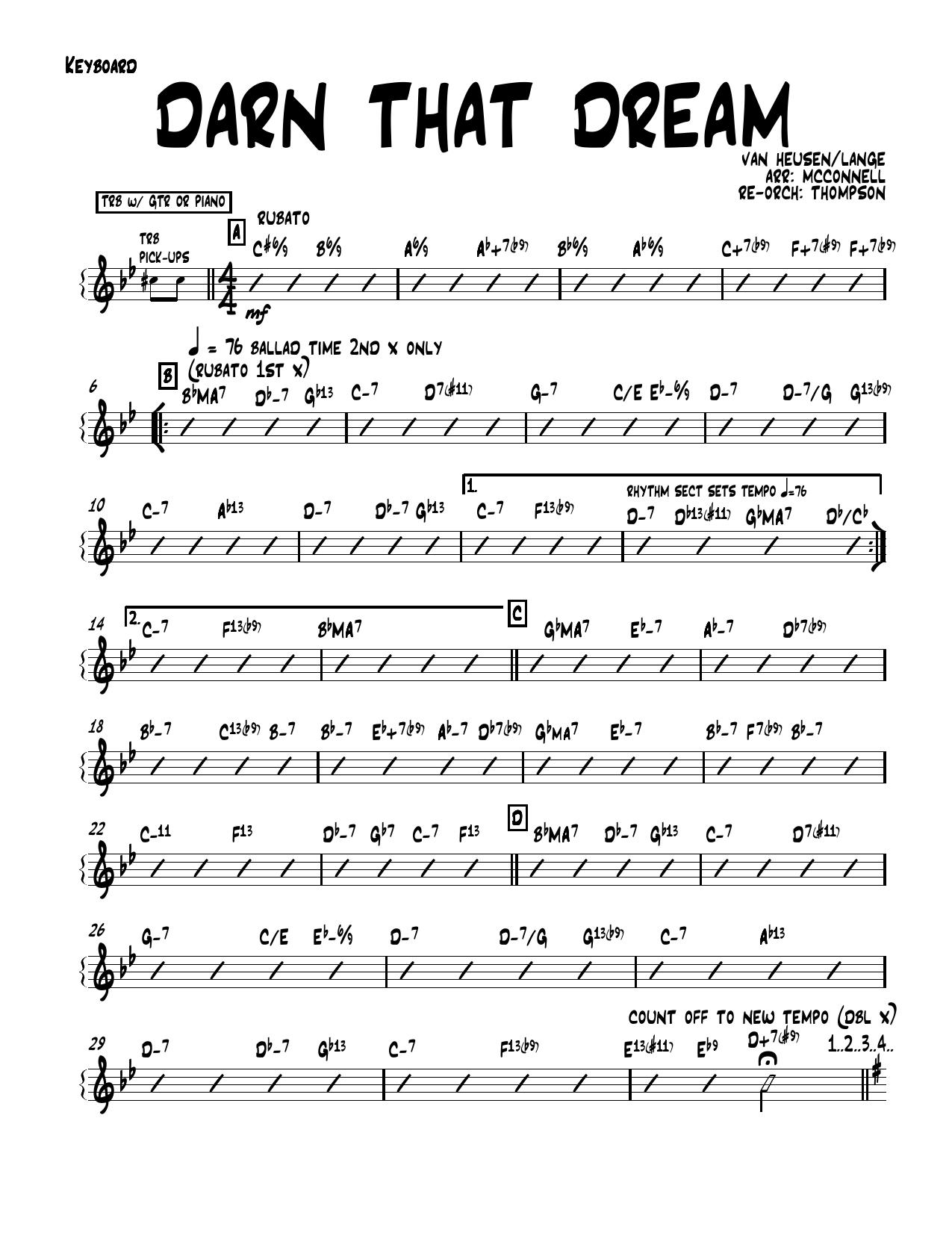
darn that dream 01 Keyboard (Mcconnell)
Composed by Jimmy Van Heusen and Johnny Lange
Arranged by Mcconnell
- Ensemble: Small Ensemble
- Style: Ballad
- Pages: 4
- Instruments (1): keyboard
- Difficulty: easy
- Content: Individual Parts
- Format: PDF Download (Instant)
- Price: $12.99
Jimmy Van Heusen and Johnny Lange crafted "Darn That Dream" in 1939 for the Broadway musical *Swingin' the Dream*, a jazz adaptation of Shakespeare’s *A Midsummer Night's Dream*. The tune was quickly embraced by the jazz pantheon, most notably immortalized by Benny Goodman and his vocalist Mildred Bailey that same year. It has since endured as an essential American songbook standard, cherished for its lush, plaintive melody and sophisticated harmonic progression that invites deep interpretation. Rooted in the late-swing and early-bebop transition era, the composition bridges the gap between accessible popular song forms and the rich, extended harmonic language that jazz modernists would later explore. This sensitive small ensemble setting by arranger McConnell approaches the timeless ballad with an exquisite balance of intimacy and harmonic depth, tailored specifically for the 16-page keyboard-centric configuration. Delivered at a relaxed, rubato-leaning slow ballad tempo, the arrangement evokes a nocturnal, introspective mood. McConnell utilizes sophisticated chord extensions, beautiful voice-leading, and subtle reharmonizations that highlight the bittersweet nostalgia of Van Heusen's original changes. The texture shifts fluidly between sparse, atmospheric comping and lush, harmonized statements, creating an emotionally resonant landscape that evokes both late-night contemplation and classic jazz-club romance. The keyboard part serves as the structural and harmonic anchor of the ensemble, demanding a high degree of touch sensitivity, dynamic control, and harmonic fluency. Rather than functioning merely as a rhythm-section pad, the keyboard writing incorporates rich chord voicings and counter-melodic lines that weave around the primary thematic material. Performers will encounter nuanced rubato sections, intricate chord transitions requiring smooth voice-leading, and delicate dynamic gradients ranging from a fragile *pianissimo* to a warm, resonant *mezzo-forte*. The interplay between the keyboard and accompanying small ensemble voices requires active listening and a shared sense of temporal elasticity. Advanced high school, collegiate, and professional small ensembles will find this chart deeply rewarding. It provides an exceptional vehicle for developing sophisticated ballad playing, ensemble blend, and rubato phrasing. Because the arrangement relies heavily on subtle micro-dynamics and rubato pacing rather than sheer technical velocity, success hinges on the musicians' collective ability to breathe together and maintain narrative tension through the quietest moments. Achieving a successful performance of McConnell’s setting of "Darn That Dream" requires rigorous attention to internal pulse, rubato control, and dynamic nuance. The conductor or ensemble leader must establish a flexible yet shared sense of time, particularly during transitional rubato passages where the keyboard player dictates the pacing. The primary technical challenge lies in executing the dense, extended chord voicings with absolute balance; the top voice must sing out clearly while inner voices remain blended and supportive. Pianists should avoid heavy-handedness, favoring a warm, singing tone that emulates a horn player's breath control. Rehearsals should begin by isolating the harmonic transitions without meter, allowing the ensemble to hear the voice-leading clearly before imposing any steady tempo feel. Pay meticulous attention to the written dynamic markings, as the emotional impact of this arrangement depends entirely on the contrast between delicate, introspective solos and full-ensemble swells. Q: What instruments and parts are included in this 16-page arrangement? A: The arrangement centers on an extensive 16-page keyboard part by McConnell, designed for a small ensemble instrumentation that typically supports a lead melodic voice alongside foundational rhythm section support. Q: What is the difficulty level of this chart? A: This arrangement is graded for advanced high school, collegiate, and professional small ensembles, primarily due to its sophisticated harmonic vocabulary and the requirement for mature rubato phrasing and balance. Q: What is the musical style and historical background of the piece? A: Written by Jimmy Van Heusen and Johnny Lange in 1939, this piece is treated here as a slow, sophisticated jazz ballad rooted in the American songbook tradition, emphasizing deep emotional expression and lush harmony. Q: What makes McConnell's arrangement unique? A: McConnell elevates the standard by giving the keyboard an unusually rich, counter-melodic and harmonically advanced role, utilizing intricate voice-leading and flexible pacing that treats the ensemble as a unified chamber jazz unit. Q: What is the performance duration and tempo guidance? A: The piece is performed at a slow ballad tempo with a flexible, rubato-influenced pulse, typically running between 4 to 5 minutes depending on the expressive breathing room taken during transitions.
Questions and answers
- What is included in the darn that dream 01 Keyboard (Mcconnell) PDF?
- The verified current file contains individual parts across 4 pages.
- How many instruments or parts are listed for darn that dream 01 Keyboard (Mcconnell)?
- The verified instrumentation list contains 1 entries for this Small Ensemble arrangement.
- Who is credited for darn that dream 01 Keyboard (Mcconnell)?
- Composer: Jimmy Van Heusen and Johnny Lange. Arranger: Mcconnell.
- What difficulty is listed for darn that dream 01 Keyboard (Mcconnell)?
- The verified difficulty level is easy.
- What style is listed for darn that dream 01 Keyboard (Mcconnell)?
- The catalog lists the style as Ballad.
- Can I preview darn that dream 01 Keyboard (Mcconnell) before buying?
- Yes. The product page provides a preview generated from the current PDF file.
- How is darn that dream 01 Keyboard (Mcconnell) delivered?
- After successful payment, the digital PDF is made available for download. The displayed price is $12.99.
Musicians Also Search For
darn that dream 01 Keyboard Mcconnell PDF • darn that dream 01 Keyboard Mcconnell sheet music • darn that dream 01 Keyboard arranged by Mcconnell • Mcconnell small ensemble charts • Mcconnell jazz arrangements PDF • darn that dream 01 Keyboard Jimmy Van Heusen and Johnny Lange sheet music • darn that dream 01 Keyboard Jimmy Van Heusen and Johnny Lange small ensemble arrangements • Jimmy Van Heusen and Johnny Lange small ensemble charts • darn that dream 01 Keyboard small ensemble arrangements • darn that dream 01 Keyboard small ensemble PDF download • darn that dream 01 Keyboard jazz sheet music • small ensemble sheet music download • darn that dream 01 Keyboard individual parts download • darn that dream 01 Keyboard sheet music PDF • darn that dream 01 Keyboard Ballad charts • Ballad small ensemble arrangements • buy darn that dream 01 Keyboard sheet music • download darn that dream 01 Keyboard PDF • darn that dream 01 Keyboard jazz charts • best Mcconnell small ensemble arrangements • Jimmy Van Heusen and Johnny Lange arranged by Mcconnell • darn that dream 01 Keyboard printable sheet music • small ensemble repertoire PDF