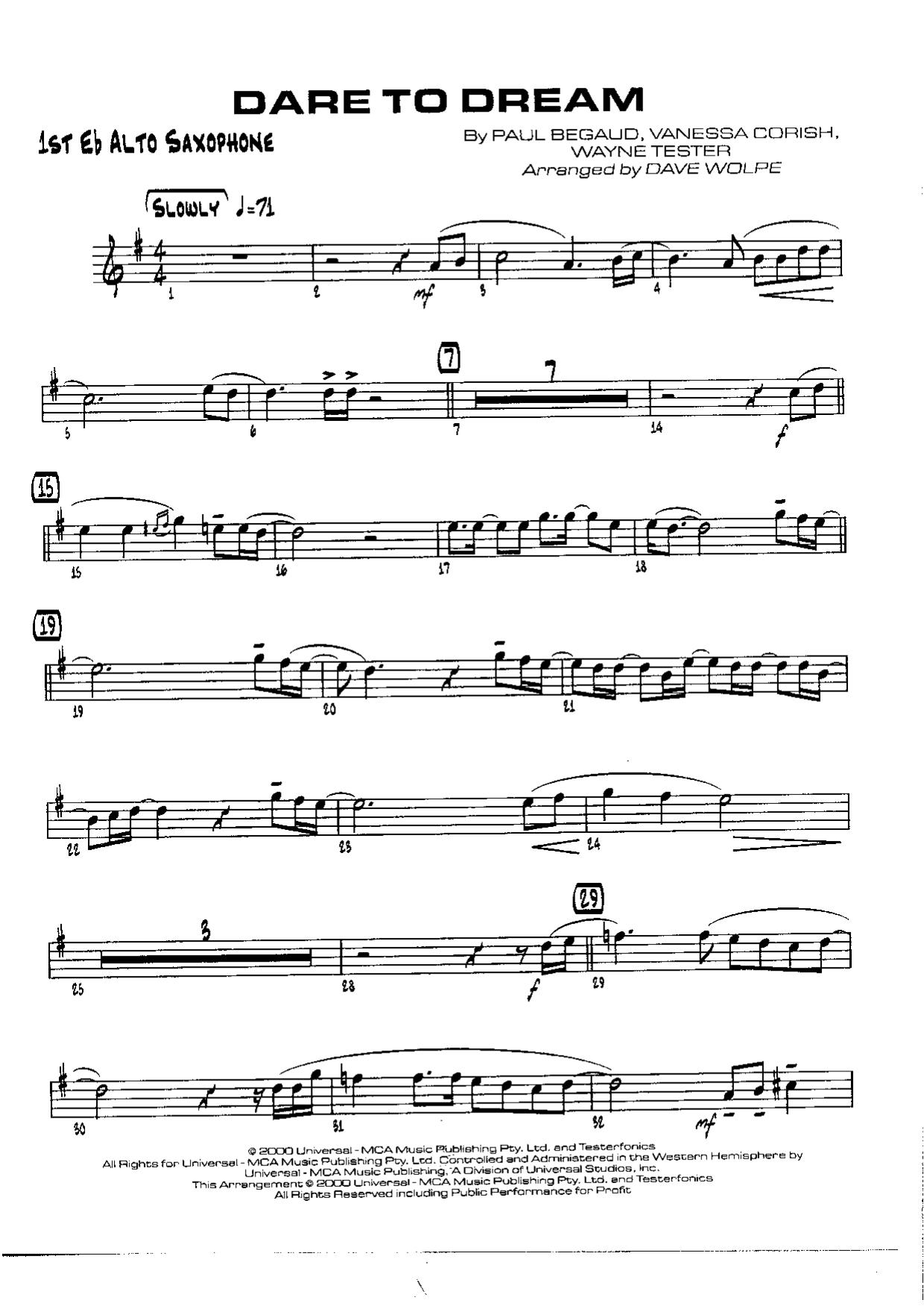
Dare To Dream (D.Wolpe)
Composed by Dave Wolpe
Arranged by Dave Wolpe
- Ensemble: Big Band
- Pages: 57
- Instruments (23): 1st Eb Alto Saxophone, 2nd Eb Alto Saxophone, 1st Bb Tenor Saxophone, 2nd Bb Tenor Saxophone, Eb Baritone Saxophone, 1st Bb Trumpet, 2nd Bb Trumpet, 3rd Bb Trumpet, 4th Bb Trumpet, 1st Trombone, 2nd Trombone, 3rd Trombone, 4th Trombone, Guitar, Piano, Bass, Drums, C Flute, Horn in F, 1st Baritone T.C., 2nd Baritone T.C., 3rd Baritone T.C., Tuba
- Difficulty: advanced
- Content: Individual Parts
- Format: PDF Download (Instant)
- Price: $24.99
Dave Wolpe’s masterful big band arrangement of his original composition, **"Dare To Dream,"** captures the sophisticated, driving essence of contemporary mainstream jazz writing. Conceived in the tradition of classic studio jazz and advanced festival literature, this chart bridges the gap between sophisticated harmonic language and high-octane ensemble energy. Wolpe, renowned for his prolific and idiomatic writing for large jazz ensembles, infuses the composition with a dynamic vitality that reflects the golden age of big band jazz while utilizing a rich, expanded harmonic palette suited for modern performers. From the opening downbeat, the chart establishes an infectious medium-up swing groove characterized by crisp articulation, tightly wound syncopation, and an underlying forward momentum. The harmonic landscape is lush yet punchy, moving seamlessly through extended chord structures, clever chromatic passing tones, and soaring modal colorations. The mood shifts effortlessly from introspective, harmonically rich interludes to explosive, brass-heavy proclamations, evoking a cinematic sense of aspiration and unstoppable drive. Wolpe’s mastery of dynamic contrast ensures that the tension-and-release cycles keep both the ensemble and the audience completely engaged from the first measure to the final chord. The compositional architecture relies heavily on classic big band mechanics: intricately woven sax solis that demand absolute stylistic unison, punchy brass counter-lines, and a thunderous shout chorus that serves as the emotional and sonic apex of the arrangement. The melody is introduced collaboratively, passing gracefully between the trumpet and saxophone sections before the full ensemble weighs in with rich, block-voicing harmonies. Solo opportunities are strategically integrated to showcase featured improvisers—typically within comfortable jazz changes that allow soloists to stretch out without disrupting the overarching narrative arc of the chart. The rhythm section functions as the engine, requiring a steady, driving ride cymbal pulse and crisp comping that respects the traditional swing vocabulary while anchoring the modern voicings. Advanced high school groups, collegiate ensembles, and professional community big bands will find "Dare To Dream" to be an exceptionally rewarding addition to their repertoire. While accessible to bands with strong section players, the chart offers enough technical and stylistic meat—particularly in terms of stylistic uniformity, intricate ensemble figures, and endurance—to challenge seasoned musicians. It serves as an ideal festival chart, competition piece, or concert closer, offering a masterclass in professional big band arranging, dynamic control, and straight-ahead swing execution. Conductors approaching Dave Wolpe’s "Dare To Dream" should prioritize stylistic uniformity and section balance above all else. The tempo should be kept at a driving, comfortable medium-up swing that never rushes; the groove must feel anchored by the rhythm section, utilizing a bouncy, triplet-based eighth-note feel in the horns. Pay close attention to the articulation markings—short notes must be clipped and clean, while longer lines require a smooth, vocal legato with a slight crescendo through the apex of the phrase. The brass section must exercise extreme care during the dynamic swells, ensuring that the lead trumpet stays on top of the texture without forcing the tone, while the trombones provide a warm, resonant cushion. For the rhythm section, the drummer should maintain a steady, unhurried time-feel on the ride cymbal, using crisp hi-hat chicks on beats 2 and 4, while the bass player walks a clear, quarter-note line that outlines the root movements and chromatic approaches. Rehearsal should begin slowly, isolating the sax soli to lock in intonation and articulation before integrating the full ensemble at performance tempo. Q: What specific instrumentation and parts are included in this arrangement? A: This standard 17-instrument big band arrangement includes full scores and parts for 5 saxophones (Alto Sax 1, Alto Sax 2, Tenor Sax 1, Tenor Sax 2, Baritone Sax), 4 trumpets, 4 trombones, and a complete 4-piece rhythm section (piano, bass, drums, and optional guitar), totaling 57 pages of music. Q: What is the difficulty level of this arrangement? A: This chart is graded as advanced, making it ideal for skilled high school jazz ensembles, collegiate bands, and professional community big bands looking for a substantive straight-ahead swing challenge. Q: What is the musical style and historical context of "Dare To Dream"? A: Written by master arranger and composer Dave Wolpe, this piece is an original composition written in the straight-ahead contemporary big band style, drawing heavily from the classic studio jazz and festival traditions of the late 20th century. Q: What makes this specific Dave Wolpe arrangement unique? A: The arrangement stands out for its sophisticated harmonic extensions, seamlessly integrated sax solis, dynamic contrast, and a powerhouse shout chorus that collectively elevate a straight-ahead swing chart into a dramatic concert centerpiece. Q: What is the performance duration and tempo feel of the piece? A: "Dare To Dream" is set to a driving medium-up swing tempo, typically clocking in around a brisk, energetic pace with a performance duration of approximately 4 to 5 minutes depending on the length of improvised solo choruses.
Questions and answers
- What is included in the Dare To Dream (D.Wolpe) PDF?
- The verified current file contains a conductor score and individual parts across 57 pages.
- How many instruments or parts are listed for Dare To Dream (D.Wolpe)?
- The verified instrumentation list contains 23 entries for this Big Band arrangement.
- Who is credited for Dare To Dream (D.Wolpe)?
- Composer: Dave Wolpe. Arranger: Dave Wolpe.
- What difficulty is listed for Dare To Dream (D.Wolpe)?
- The verified difficulty level is advanced.
- Can I preview Dare To Dream (D.Wolpe) before buying?
- Yes. The product page provides a preview generated from the current PDF file.
- How is Dare To Dream (D.Wolpe) delivered?
- After successful payment, the digital PDF is made available for download. The displayed price is $24.99.
Musicians Also Search For
Dare To Dream Dave Wolpe PDF • Dare To Dream Dave Wolpe sheet music • Dare To Dream arranged by Dave Wolpe • Dave Wolpe big band charts • Dave Wolpe jazz arrangements PDF • Dare To Dream Dave Wolpe big band arrangements • Dare To Dream big band arrangements • Dare To Dream big band PDF download • Dare To Dream jazz sheet music • big band sheet music download • Dare To Dream conductor score PDF • Dare To Dream individual parts download • Dare To Dream sheet music PDF • buy Dare To Dream sheet music • download Dare To Dream PDF • Dare To Dream jazz charts • best Dave Wolpe big band arrangements • Dare To Dream printable sheet music • big band repertoire PDF