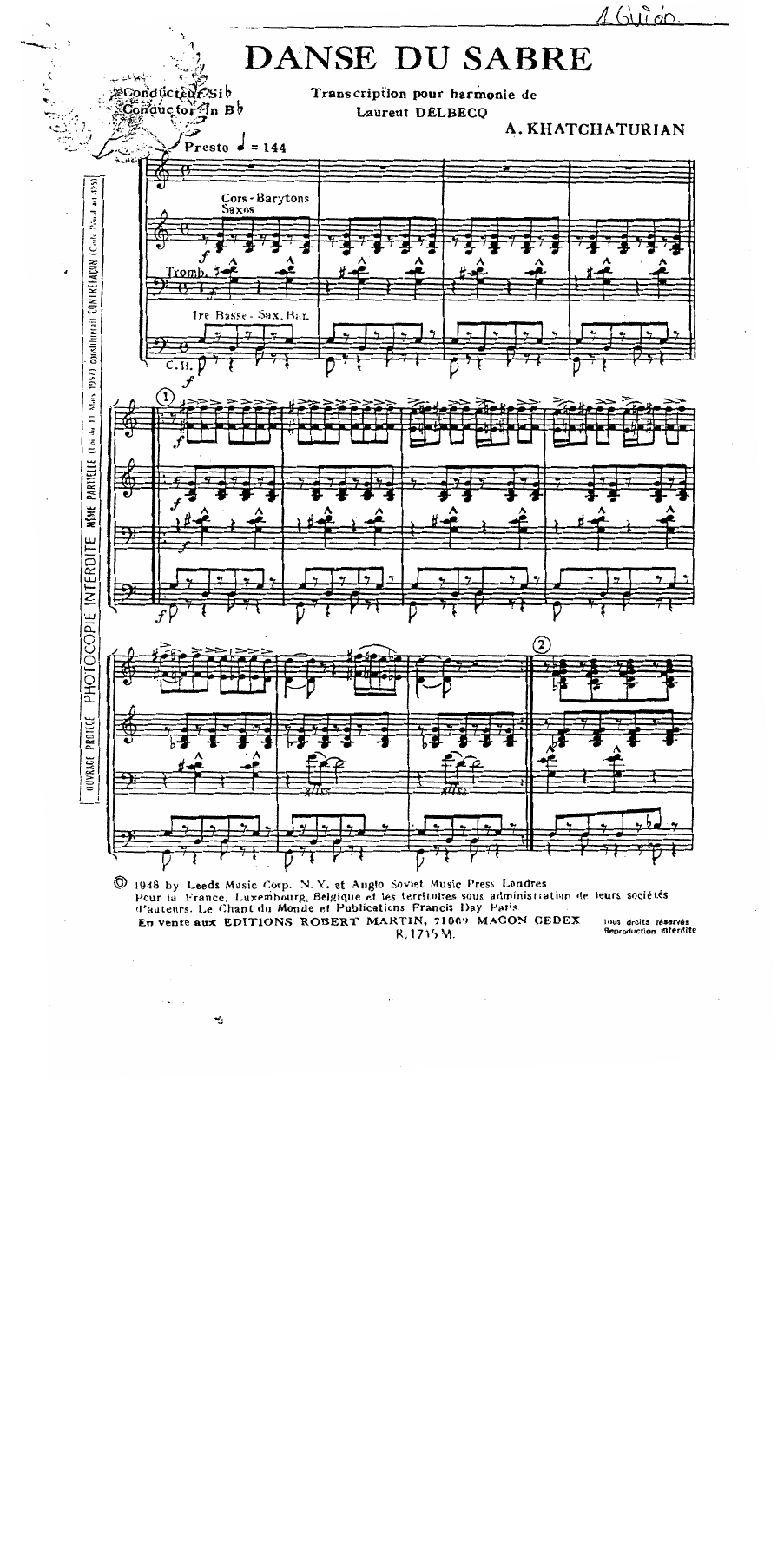
Danse De Sabre (L.Delbeco)
Composed by Aram Khachaturian
Arranged by L.Delbeco
- Ensemble: Concert Band
- Style: Traditional
- Pages: 36
- Difficulty: medium
- Content: Sheet Music
- Format: PDF Download (Instant)
- Price: $22.99
Aram Khachaturian's "Sabre Dance," originally composed in 1942 as part of the ballet *Gayane*, stands as one of the most recognizable and exhilarating pieces in the classical repertoire. While not a traditional jazz standard, its relentless energy, driving rhythm, and exotic melodic lines have long captivated audiences and inspired interpretations across diverse genres. The original ballet score, a vibrant tapestry of Armenian folk influences and Soviet-era classical grandeur, depicts a fiery dance sequence, embodying a sense of urgent celebration and dramatic flair. Khachaturian's genius lies in his ability to craft a melody that is both simple and incredibly potent, instantly conjuring images of rapid movement and intense passion. This piece's enduring popularity is a testament to its universal appeal and its capacity to transcend its original classical context, making it a fascinating candidate for reinterpretation in a concert band setting. L.Delbeco's arrangement of "Danse De Sabre" for concert band masterfully translates the original's frenetic energy and distinctive character into a compelling and accessible format. Delbeco, known for his meticulous attention to orchestral color and rhythmic integrity, approaches this iconic work with a deep respect for Khachaturian's original intent while skillfully adapting it for the unique timbral palette of a concert band. The arrangement maintains the original's blistering *Presto* tempo, typically around 120-132 bpm in cut time (2/2), preserving the relentless drive that defines the piece. While not a jazz arrangement in the traditional sense, Delbeco's treatment emphasizes rhythmic precision and dynamic contrast, essential elements for any high-energy performance. The overall mood is one of exhilaration and dramatic intensity, demanding both technical prowess and expressive flair from the ensemble. Delbeco's distinctive approach is evident in his intelligent orchestration, which ensures that the iconic melodic lines are distributed effectively across the various sections, creating a rich and full sound. The opening features the woodwinds, particularly the flutes and clarinets, carrying the primary melodic motive with crisp articulation, supported by driving percussion. Brass sections are utilized for powerful interjections and to reinforce the rhythmic pulse, building excitement through layered textures. While there are no improvised solos, the arrangement features intricate soli passages for woodwinds and brass, requiring tight ensemble playing and precise intonation. The technical challenges lie primarily in maintaining the demanding tempo, executing rapid sixteenth-note passages cleanly, and achieving unified articulation across sections. The piece culminates in a powerful, full-ensemble shout chorus, bringing the arrangement to a thrilling and impactful close. This arrangement is particularly well-suited for advanced high school, collegiate, and community concert bands seeking a show-stopping, high-energy piece for their repertoire. Its inherent excitement and familiar melody make it an instant audience favorite, while its technical demands provide a rewarding challenge for musicians. The clear scoring and logical voice leading make it approachable for conductors, allowing them to focus on shaping the dynamic contours and rhythmic precision. Performing "Danse De Sabre" is a test of endurance and ensemble cohesion, but the reward is an electrifying performance that showcases the band's virtuosity and dynamic range. Conductors should emphasize a relentless, driving *Presto* tempo, ideally around cut time (2/2) at 120-132 bpm, focusing on rhythmic precision over speed for its own sake initially. The key technical challenges include maintaining clean articulation in the rapid sixteenth-note passages, particularly in the woodwinds, and ensuring unified rhythmic attacks across all sections. Encourage a light, detached articulation for the main thematic material to prevent it from sounding heavy. Dynamic contrasts are crucial; practice exaggerated *p* and *ff* sections to achieve maximum impact. Pay close attention to the percussion parts, which are integral to maintaining the piece's driving momentum. Rehearsal should prioritize rhythmic accuracy and ensemble tightness before pushing for the final performance tempo. Q: What instruments and parts are included in the "Danse De Sabre (L.Delbeco)" arrangement? A: This arrangement for concert band typically includes a full complement of woodwinds (flute, oboe, clarinet, bass clarinet, bassoon, saxophone), brass (trumpet, horn, trombone, euphonium, tuba), and a comprehensive percussion section. Specific part listings are usually detailed on the score. Q: What is the difficulty level of this arrangement for concert band? A: L.Delbeco's "Danse De Sabre" is considered advanced, suitable for high school, collegiate, and community concert bands. Its demanding tempo, intricate rhythmic figures, and need for precise ensemble articulation present significant technical challenges. Q: What is the musical style and historical context of this piece? A: The original "Sabre Dance" is a classical ballet piece composed by Aram Khachaturian in 1942, reflecting Armenian folk influences within a dramatic, high-energy classical framework. This arrangement adapts that traditional classical style for concert band. Q: What makes L.Delbeco's arrangement of "Danse De Sabre" unique? A: Delbeco's arrangement is unique for its faithful yet effective translation of Khachaturian's iconic energy and melodic lines into the concert band idiom, utilizing intelligent orchestration and dynamic scoring to maintain the original's thrilling character without sacrificing playability. Q: What is the typical performance duration and tempo for this arrangement? A: The performance duration for "Danse De Sabre" is typically around 2-3 minutes, depending on the chosen tempo. It is meant to be performed at a *Presto* tempo, generally in cut time (2/2) between 120-132 beats per minute.
Musicians Also Search For
Danse De Sabre L.Delbeco PDF • Danse De Sabre L.Delbeco sheet music • Danse De Sabre arranged by L.Delbeco • L.Delbeco concert band charts • L.Delbeco jazz arrangements PDF • Danse De Sabre Aram Khachaturian sheet music • Danse De Sabre Aram Khachaturian concert band arrangement • Aram Khachaturian concert band charts • Danse De Sabre concert band arrangement • Danse De Sabre concert band PDF download • Danse De Sabre jazz ensemble sheet music • concert band sheet music instant download • Danse De Sabre sheet music with parts • Danse De Sabre Traditional chart • Traditional concert band arrangements • buy Danse De Sabre sheet music online • download Danse De Sabre PDF • Danse De Sabre jazz chart • best L.Delbeco concert band arrangements • Aram Khachaturian songs arranged by L.Delbeco • Danse De Sabre printable sheet music • concert band repertoire PDF