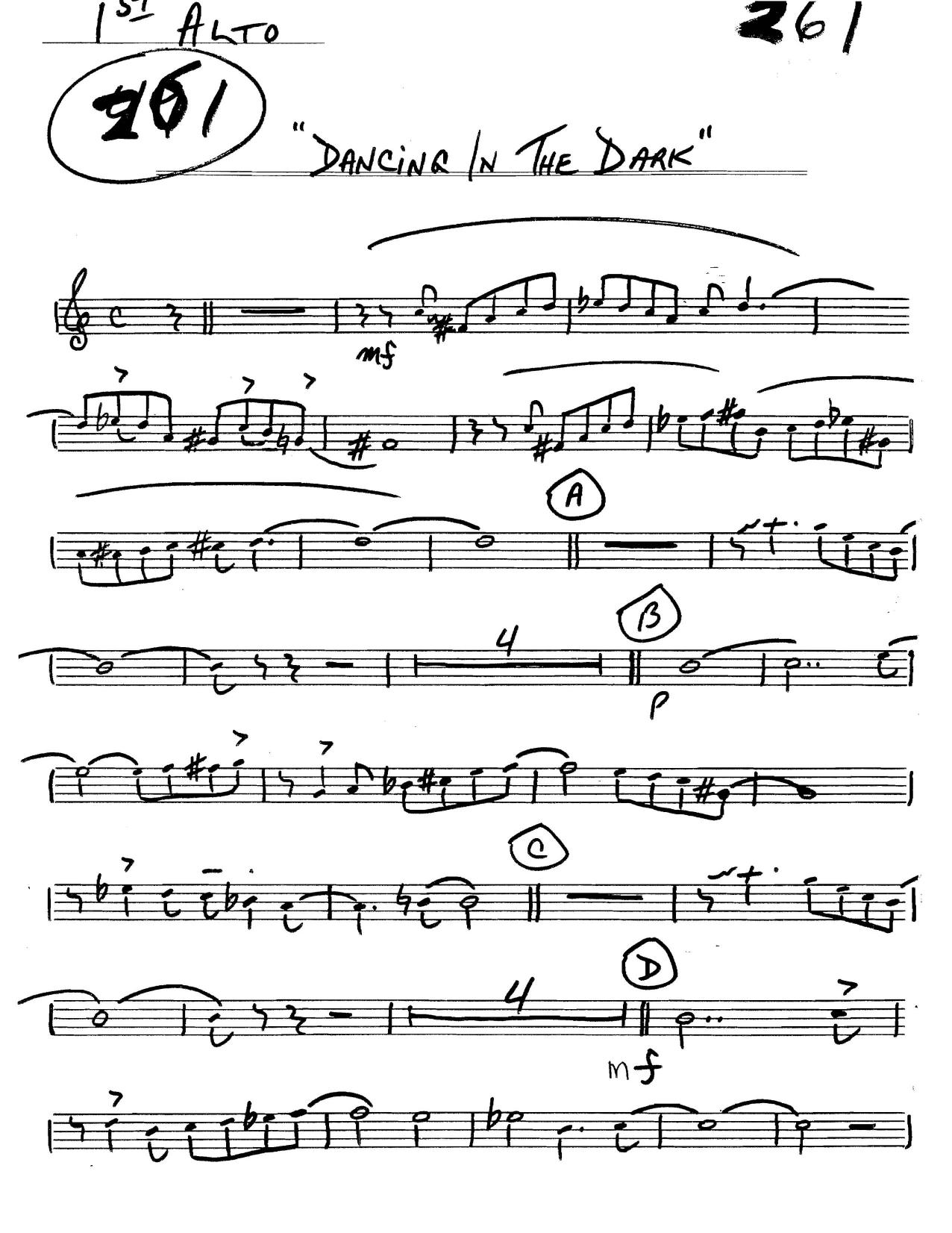
Dancing In The Dark (B.Holman) sheet music preview

Dancing In The Dark (B.Holman)

Composed by Arthur Schwartz

Arranged by Bill Holman

  • Ensemble: Big Band
  • Pages: 55
  • Instruments (17): 1st Alto Saxophone, 2nd Alto Saxophone, 1st Tenor Saxophone, 2nd Tenor Saxophone, Baritone Saxophone, 1st Trumpet, 2nd Trumpet, 3rd Trumpet, 4th Trumpet, 1st Trombone, 2nd Trombone, 3rd Trombone, 4th Trombone, Drums, Piano, Bass, Guitar
  • Difficulty: advanced
  • Content: Individual Parts
  • Format: PDF Download (Instant)
  • Price: $24.99

Arthur Schwartz and Howard Dietz introduced "Dancing In The Dark" in the 1931 Broadway revue *The Band Wagon*, where it was originally sung by Fred Astaire. It swiftly transcended its theatrical origins to become a cornerstone of the Great American Songbook, interpreted by virtually every major jazz luminary from Art Tatum and Stan Getz to John Coltrane and Cannonball Adderley. The tune's sophisticated, yearning melody and flowing harmonic progression make it an ideal canvas for jazz interpretation, inviting both lush romanticism and intricate modernist reharmonization. Legendary West Coast arranger Bill Holman applies his unmistakable compositional brilliance to this chart, transforming a familiar standard into a masterclass of modern big band writing. Moving away from a conventional, predictable ballad treatment, Holman injects the arrangement with a sophisticated medium-tempo swing feel that emphasizes linear counterpoint, unexpected harmonic shifts, and driving momentum. The mood oscillates between introspective, cool-school lyricism and bursts of high-energy, brass-heavy intensity, showcasing Holman's signature penchant for quirky angular lines juxtaposed against lush, overarching chord structures. Holman distributes thematic material fluidly across the ensemble, avoiding stagnant scoring by utilizing clever woodwind doublings and conversational interplay between the saxophones and brass. The arrangement features sophisticated soli writing that demands immaculate blend, intonation, and articulation from the horn sections, alongside ample space for featured soloists to stretch out over changes that retain the sophisticated essence of Schwartz’s original harmony. Rhythmic displacement, syncopated background figures, and inventive reharmonizations challenge the rhythm section to maintain a buoyant, interactive groove rather than a static vamp. Advanced collegiate ensembles, premier youth jazz orchestras, and professional big bands will find this chart deeply rewarding. Because of its dense harmonic language, intricate rhythmic unisons, and the high level of listening required across all sections, it demands a mature band with strong section leaders and experienced soloists. Bringing out the subtle nuances of Holman’s counterlines while maintaining a relaxed, driving swing feel will elevate any concert program, offering audiences a refreshing and structurally brilliant perspective on a timeless jazz standard. Navigating Bill Holman’s sophisticated chart requires a meticulous approach to balance, articulation, and rhythmic precision. The tempo should settle comfortably into a relaxed medium-swing feel—avoiding any tendency to rush, as the rhythmic integrity of Holman's jagged counterlines depends on absolute pocket placement from the rhythm section. The drummer should favor a crisp, conversational ride-cymbal pattern with light hi-hat chokes on beats two and four, keeping the dynamic level supportive during horn soli sections. Key technical challenges include executing the fast, linear unisons cleanly across different instrument families without sacrificing warmth of tone. Horn players must pay close attention to dynamic markings; contrasting whispered, cool-toned backgrounds against explosive brass stabs defines the emotional architecture of the chart. Directors should rehearse sectional passages independently to lock in intonation on altered dominant chords before integrating them with the full ensemble. Encourage soloists to lean into the harmonic tension of the changes rather than relying solely on diatonic clichés. Q: What instruments and parts are included in this big band arrangement? A: Scored for a standard 17-piece big band instrumentation, the set includes 5 saxophones (Alto 1, Alto 2, Tenor 1, Tenor 2, Baritone), 4 trumpets, 4 trombones, and a standard 4-piece rhythm section consisting of piano, guitar, bass, and drums. Q: What is the difficulty level of this arrangement? A: This chart is graded as advanced, making it best suited for collegiate ensembles, professional big bands, and elite high school jazz orchestras capable of handling complex harmonies and demanding technical unisons. Q: How does this arrangement fit into the jazz tradition of "Dancing In The Dark"? A: While Arthur Schwartz’s 1931 composition is historically treated as a slow ballad, Bill Holman reimagines the standard through a sophisticated, modern West Coast jazz lens with a medium-swing groove and intricate contrapuntal writing. Q: What makes Bill Holman’s treatment of this tune unique? A: Holman’s signature writing style shines through inventive reharmonizations, surprising linear counterpoint, and dynamic, shifting textures that avoid predictable big band formulas in favor of restless, modern creativity. Q: What is the recommended tempo and performance duration for this piece? A: The arrangement is set in a comfortable medium-swing tempo that allows the intricate harmonic details and solo spaces to breathe, typically resulting in a performance duration of approximately 4 to 5 minutes depending on solo extensions.

Questions and answers

What is included in the Dancing In The Dark (B.Holman) PDF?
The verified current file contains individual parts across 55 pages.
How many instruments or parts are listed for Dancing In The Dark (B.Holman)?
The verified instrumentation list contains 17 entries for this Big Band arrangement.
Who is credited for Dancing In The Dark (B.Holman)?
Composer: Arthur Schwartz. Arranger: Bill Holman.
What difficulty is listed for Dancing In The Dark (B.Holman)?
The verified difficulty level is advanced.
Can I preview Dancing In The Dark (B.Holman) before buying?
Yes. The product page provides a preview generated from the current PDF file.
How is Dancing In The Dark (B.Holman) delivered?
After successful payment, the digital PDF is made available for download. The displayed price is $24.99.

Musicians Also Search For

Dancing In The Dark Bill Holman PDFDancing In The Dark Bill Holman sheet musicDancing In The Dark arranged by Bill HolmanBill Holman big band chartsBill Holman jazz arrangements PDFDancing In The Dark Arthur Schwartz sheet musicDancing In The Dark Arthur Schwartz big band arrangementsArthur Schwartz big band chartsDancing In The Dark big band arrangementsDancing In The Dark big band PDF downloadDancing In The Dark jazz sheet musicbig band sheet music downloadDancing In The Dark individual parts downloadDancing In The Dark sheet music PDFbuy Dancing In The Dark sheet musicdownload Dancing In The Dark PDFDancing In The Dark jazz chartsbest Bill Holman big band arrangementsArthur Schwartz arranged by Bill HolmanDancing In The Dark printable sheet musicbig band repertoire PDF

All arrangements by Bill Holman All Arthur Schwartz sheet music