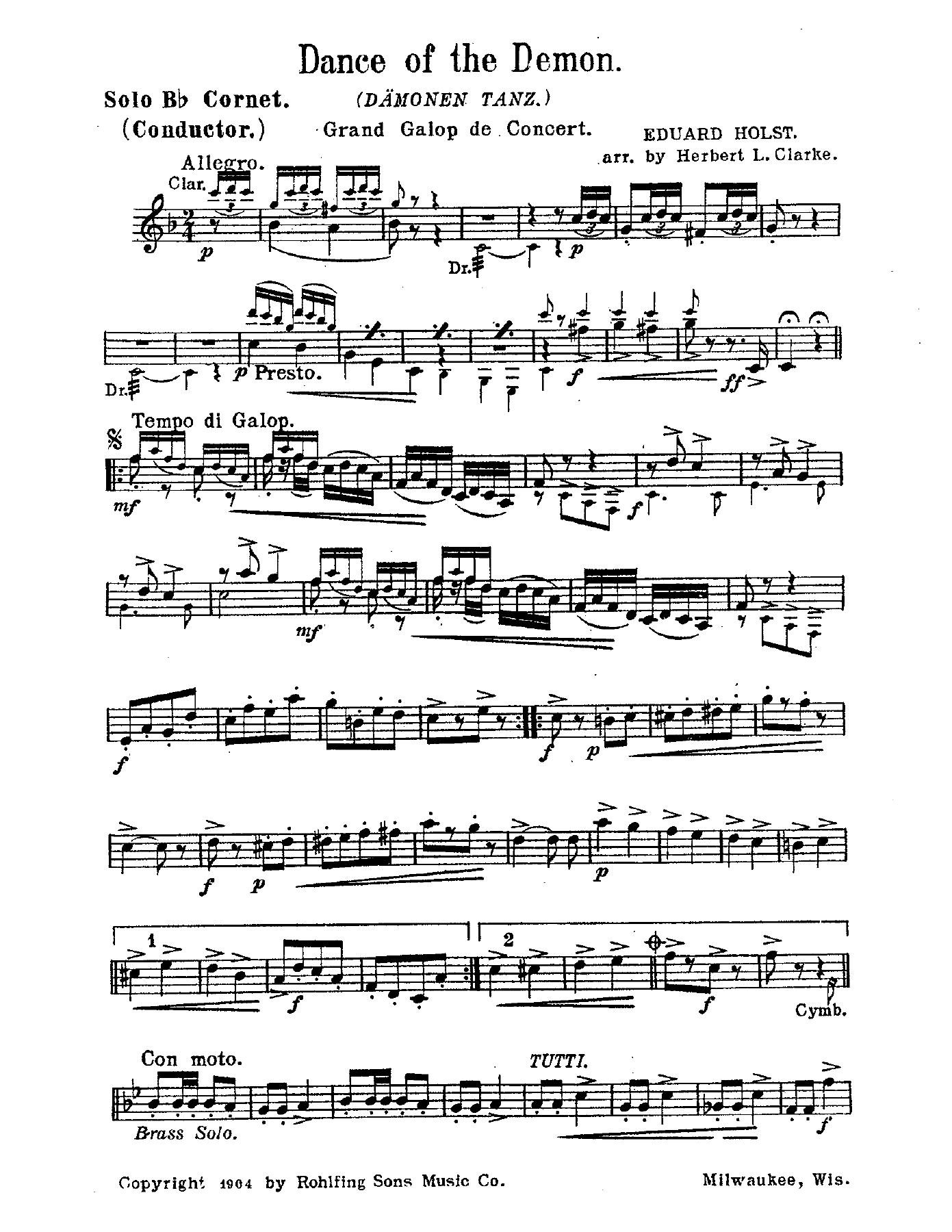
Dance Of The Demons, Eduard Holst (H.Clarke)
Composed by Eduard Holst
Arranged by Herbert L. Clarke
- Ensemble: Concert Band
- Style: Traditional
- Pages: 27
- Instruments (23): Solo Bb Cornet (Conductor), Piccolo, Oboe, Bassoon, Eb Clarinet, 1st Bb Clarinet, 2nd and 3rd Clarinets, Bb Bass, Soprano Saxophone, Alto Saxophone, Tenor Saxophone, Baritone Saxophone, Eb Cornet, 1st Bb Cornet, 2nd and 3rd Cornets, 1st and 2nd Horns in Eb, 3rd and 4th Horns in Eb, 1st and 2nd Trombones, 3rd Trombone, Baritone (Bass Clef), Baritone (Treble Clef), Tuba in Eb Bass, Tympain, Drums and Tamborine
- Difficulty: medium
- Content: Individual Parts
- Format: PDF Download (Instant)
- Price: $22.99
Step into the vibrant world of early 20th-century concert band repertoire with Herbert L. Clarke's masterful arrangement of Eduard Holst's "Dance Of The Demons." While not a jazz standard in the contemporary sense, this piece embodies the "traditional" musical style prevalent in American concert bands during the late 19th and early 20th centuries, a period that laid foundational groundwork for many popular music forms, including early jazz and ragtime. Eduard Holst, a prolific composer of light classical and popular pieces for band and orchestra, crafted the original work, which became a staple in vaudeville, circuses, and community concerts. Herbert L. Clarke, renowned cornet virtuoso and bandmaster, brought his unparalleled understanding of brass and wind writing to this arrangement, ensuring its enduring appeal and technical brilliance. It represents an era when concert bands were the primary purveyors of popular entertainment, showcasing both lyrical beauty and dazzling technical displays. "Dance Of The Demons" is characterized by its exhilarating, up-tempo energy and dramatic flair. Typically performed at a brisk allegro or presto tempo, it evokes a mood of playful mischief, theatrical excitement, and virtuosic display. The piece is generally in a bright major key, often C or F, allowing for maximum brilliance from the brass and woodwinds. Its structure often features contrasting sections: a driving, rhythmic main theme interspersed with more lyrical, cantabile passages that offer brief respite before returning to the frenetic pace. The overall effect is one of continuous motion and escalating excitement, culminating in a powerful, often triumphant, finish. This arrangement captures the essence of a bygone era, where musical storytelling was direct, engaging, and designed to captivate a broad audience. Herbert L. Clarke's treatment of Holst's original is a clinic in effective concert band scoring. Known for his exceptional command of brass writing, Clarke leverages the full spectrum of the ensemble, giving prominent, often technically demanding, lines to the cornets and trombones, while woodwinds provide intricate counter-melodies and rapid filigree. Expect robust full-ensemble passages, often featuring a powerful brass soli that drives the main thematic material. Clarke’s arrangements are celebrated for their clarity, balance, and the intelligent distribution of melodic and rhythmic interest across all sections. While there are no improvised solos in the jazz sense, the piece features highly virtuosic written-out passages, particularly for the cornets and clarinets, which serve as featured instrumentalists. The arrangement demands precision, agility, and a strong sense of ensemble from all players, making it a rewarding challenge. This arrangement is ideally suited for advanced high school, collegiate, community, and professional concert bands. Its technical demands, particularly in the upper brass and woodwinds, require experienced players with strong fundamental technique and endurance. The piece offers an excellent opportunity to develop ensemble precision, dynamic contrast, and stylistic authenticity in traditional concert band literature. Performing "Dance Of The Demons" is a thrilling experience, offering moments of collective power, individual brilliance, and a chance to connect with a rich vein of American musical history. The intricate interplay between sections and the sheer exuberance of the music make it a standout choice for concert programs seeking a blend of historical significance and exhilarating performance. "Dance Of The Demons" demands a brisk, unwavering tempo, typically in the range of quarter note = 144-160 bpm, to convey its intended energy and theatricality. Conductors should emphasize rhythmic precision and clarity, particularly in the rapid sixteenth-note passages found in the woodwinds and cornets. Technical challenges include sustained endurance for brass, rapid articulation for all sections, and precise ensemble coordination during fast tutti sections. Encourage light, crisp tonguing from woodwinds and a brilliant, focused tone from brass. Dynamic contrasts are crucial; ensure a clear distinction between forte and piano sections to enhance the dramatic narrative. Rehearsal time should focus on isolating technically challenging phrases, practicing them slowly and gradually increasing tempo, and ensuring all parts are balanced within the full ensemble. Pay particular attention to clean releases and consistent intonation, especially in the upper registers. Q: What instruments/parts are included in this arrangement? A: This concert band arrangement typically includes a full complement of standard concert band instrumentation: piccolo, flutes, oboes, bassoons, clarinets (Eb, Bb 1-3, Alto, Bass), alto/tenor/baritone saxophones, cornets/trumpets (1-3), horns (1-4), trombones (1-3), euphonium, tuba, and percussion (snare drum, bass drum, cymbals). Q: What is the difficulty level of this arrangement? A: This arrangement is considered advanced (Grade 5-6). It requires highly proficient musicians with strong technical skills, particularly in the upper brass and woodwinds, and a well-developed sense of ensemble playing. Q: What is the musical style and historical context of "Dance Of The Demons"? A: The piece is in a "Traditional" concert band style, reflecting late 19th and early 20th-century American popular music. It's a programmatic work designed for entertainment, often performed in vaudeville, circuses, and community concerts of that era. Q: What makes Herbert L. Clarke's arrangement of this piece unique? A: Clarke's arrangement showcases his unparalleled expertise in brass writing, featuring virtuosic cornet passages, robust full-ensemble scoring, and a balanced distribution of melodic and rhythmic interest across all sections, elevating the original work with his signature brilliance. Q: What is the typical performance duration and tempo for this piece? A: "Dance Of The Demons" typically has a performance duration of approximately 3-4 minutes. It is usually performed at a brisk allegro or presto tempo, often in the range of quarter note = 144-160 bpm, to maintain its energetic and dramatic character.
Questions and answers
- What is included in the Dance Of The Demons, Eduard Holst (H.Clarke) PDF?
- The verified current file contains individual parts across 27 pages.
- How many instruments or parts are listed for Dance Of The Demons, Eduard Holst (H.Clarke)?
- The verified instrumentation list contains 23 entries for this Concert Band arrangement.
- Who is credited for Dance Of The Demons, Eduard Holst (H.Clarke)?
- Composer: Eduard Holst. Arranger: Herbert L. Clarke.
- What difficulty is listed for Dance Of The Demons, Eduard Holst (H.Clarke)?
- The verified difficulty level is medium.
- What style is listed for Dance Of The Demons, Eduard Holst (H.Clarke)?
- The catalog lists the style as Traditional.
- Can I preview Dance Of The Demons, Eduard Holst (H.Clarke) before buying?
- Yes. The product page provides a preview generated from the current PDF file.
- How is Dance Of The Demons, Eduard Holst (H.Clarke) delivered?
- After successful payment, the digital PDF is made available for download. The displayed price is $22.99.
Musicians Also Search For
Dance Of The Demons, Eduard Holst Herbert L. Clarke PDF • Dance Of The Demons, Eduard Holst Herbert L. Clarke sheet music • Dance Of The Demons, Eduard Holst arranged by Herbert L. Clarke • Herbert L. Clarke concert band charts • Herbert L. Clarke jazz arrangements PDF • Dance Of The Demons, Eduard Holst Eduard Holst sheet music • Dance Of The Demons, Eduard Holst Eduard Holst concert band arrangements • Eduard Holst concert band charts • Dance Of The Demons, Eduard Holst concert band arrangements • Dance Of The Demons, Eduard Holst concert band PDF download • Dance Of The Demons, Eduard Holst jazz sheet music • concert band sheet music download • Dance Of The Demons, Eduard Holst individual parts download • Dance Of The Demons, Eduard Holst sheet music PDF • Dance Of The Demons, Eduard Holst Traditional charts • Traditional concert band arrangements • buy Dance Of The Demons, Eduard Holst sheet music • download Dance Of The Demons, Eduard Holst PDF • Dance Of The Demons, Eduard Holst jazz charts • best Herbert L. Clarke concert band arrangements • Eduard Holst arranged by Herbert L. Clarke • Dance Of The Demons, Eduard Holst printable sheet music • concert band repertoire PDF