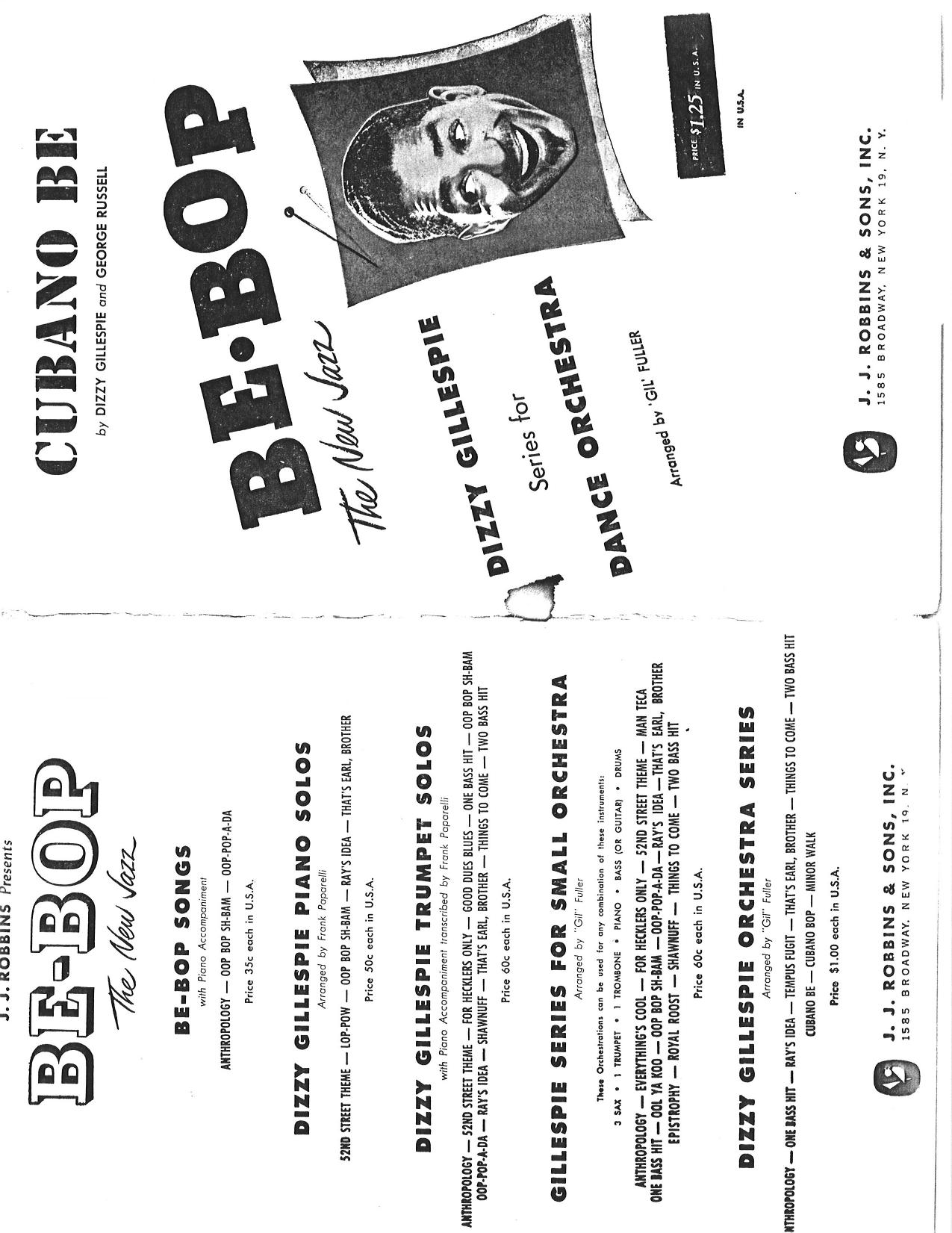
Cubano Be (G.Fuller)
Composed by George Russell
Arranged by Gil Fuller-D.GILLESPIE
- Ensemble: Big Band
- Pages: 11
- Instruments (16): 1st Saxophone Eb Alto, 2nd Saxophone Bb Tenor, 3rd Saxophone Eb Alto, 4th Saxophone Bb Tenor, 5th Saxophone Eb Baritone, 1st Trumpet in Bb, 2nd Trumpet in Bb, 3rd Trumpet in Bb, 4th Trumpet in Bb, 1st Trombone, 2nd Trombone, 3rd Trombone, Bass, Guitar, Piano, Drums
- Difficulty: easy
- Content: Individual Parts
- Format: PDF Download (Instant)
- Price: $24.99
Composed by George Russell and co-credited to the legendary partnership of Gil Fuller and Dizzy Gillespie, "Cubano Be" stands as a monumental milestone in the genesis of Afro-Cuban jazz. Premiered and recorded in the late 1940s—an era when Gillespie’s groundbreaking big band was actively fusing bebop harmony with authentic Cuban rhythms pioneered by percussionist Chano Pozo—this piece broke traditional stylistic boundaries. It represents a daring departure from standard American big band writing, merging complex modal explorations, advanced harmonic extensions, and driving Latin percussion grooves into a cohesive, high-intensity modernist canvas. Drenched in atmospheric tension and rhythmic urgency, the musical character of "Cubano Be" oscillates between brooding, modal mystery and explosive, high-octane celebration. The piece opens with a hypnotic, chant-like motif over a dense, pulsing Afro-Cuban compound meter before accelerating into driving, syncopated passages that evoke the electric atmosphere of a Havana street festival. The harmonic landscape relies heavily on suspended structures, sharp dissonances, and rich brass voicings that create a sense of impending release, continually building an emotional intensity that electrifies both performers and listeners alike. Gil Fuller’s arranging hand is immediately recognizable in the sophisticated distribution of textures across the nine-instrument ensemble. Rather than treating the rhythm section as mere accompaniment, Fuller weaves percussion directly into the counterpoint, utilizing the compact horn line—comprising alto, tenor, and baritone saxophones, trumpet, and trombone—to deliver dense, interlocking block-chord voicings and aggressive, linear solis. The arrangement demands absolute rhythmic precision, particularly in navigating the shifting accents between the 6/8 Afro-Cuban feel and straight-ahead 4/4 swing pulses. Soloists are given ample room to stretch out over modal vamps, requiring a mature command of both bebop vocabulary and pentatonic/modal exploratory phrasing. Mastering this chart requires an ensemble that possesses advanced rhythmic independence and strong stylistic versatility. Because the instrumentation is tailored for a tight 9-piece horn section, every player acts as a principal voice, leaving no room for hiding behind a massive section sound. Intonation on extended chords, balance during dense counterpoint, and seamless integration with the Latin percussion core are primary technical hurdles. Advanced college ensembles, elite high school groups, and professional regional big bands will find this arrangement an intensely rewarding centerpiece for concert programming. It offers an invaluable educational vehicle for studying the historical roots of Latin jazz while providing a rigorous technical workout that showcases a band's stylistic agility, rhythmic cohesion, and collective maturity. Unlocking the authentic drive of "Cubano Be" begins with the rhythm section, particularly the percussionists and drummer, who must firmly anchor the interlocking 6/8 and 4/4 feels without rushing the tempo. Conductors should insist that the horn players articulate eighth-note lines with crisp, clean separation to match the sharpness of the percussion. Technically, the primary challenge lies in the execution of syncopated modal figures that cross standard barline boundaries. Horn players must practice their lines away from the groove first to ensure accurate placement of accented upbeats. Pay close attention to dynamic contrast: the transition from the mysterious, subdued modal intros to the thunderous shout sections requires strict adherence to written markings rather than natural over-blowing. Rehearsal should be segmented by isolating the rhythm section first to lock in the foundational Afro-Cuban ostinatos before layering in the saxophones and brass. Ensure that the tenor and alto soloists understand the modal framework of their improvisational spots, encouraging them to build tension incrementally rather than relying on standard bebop clichés from the outset. Q: What instruments and parts are included in this 9-instrument arrangement of "Cubano Be"? A: The arrangement is scored for a 9-piece ensemble featuring alto saxophone, tenor saxophone, baritone saxophone, trumpet, trombone, and a full rhythm section including piano, bass, drums, and authentic Afro-Cuban auxiliary percussion. Q: What is the difficulty level of this chart? A: This arrangement is rated as advanced, requiring a high degree of rhythmic independence, strong stylistic versatility in Latin-jazz idioms, and mature intonation for extended modal harmonies. Q: What is the historical context and style of "Cubano Be"? A: Originally composed by George Russell and made famous by Dizzy Gillespie’s pioneering 1940s orchestra, this piece is a foundational masterwork of Afro-Cuban jazz that bridges bebop innovation with traditional Cuban rhythms. Q: What makes this specific Gil Fuller arrangement unique? A: It utilizes a compact 9-instrument voicing strategy that achieves the power and harmonic density of a full big band, brilliantly integrating intricate counterpoint and modal vamps with driving percussion grooves. Q: What is the approximate performance duration and tempo framework of the piece? A: The arrangement runs approximately 4 to 5 minutes and features a dynamic tempo structure that moves between a hypnotic, medium-tempo Afro-Cuban groove and high-energy up-tempo sections.
Questions and answers
- What is included in the Cubano Be (G.Fuller) PDF?
- The verified current file contains individual parts across 11 pages.
- How many instruments or parts are listed for Cubano Be (G.Fuller)?
- The verified instrumentation list contains 16 entries for this Big Band arrangement.
- Who is credited for Cubano Be (G.Fuller)?
- Composer: George Russell. Arranger: Gil Fuller-D.GILLESPIE.
- What difficulty is listed for Cubano Be (G.Fuller)?
- The verified difficulty level is easy.
- Can I preview Cubano Be (G.Fuller) before buying?
- Yes. The product page provides a preview generated from the current PDF file.
- How is Cubano Be (G.Fuller) delivered?
- After successful payment, the digital PDF is made available for download. The displayed price is $24.99.
Musicians Also Search For
Cubano Be Gil Fuller-D.GILLESPIE PDF • Cubano Be Gil Fuller-D.GILLESPIE sheet music • Cubano Be arranged by Gil Fuller-D.GILLESPIE • Gil Fuller-D.GILLESPIE big band charts • Gil Fuller-D.GILLESPIE jazz arrangements PDF • Cubano Be George Russell sheet music • Cubano Be George Russell big band arrangements • George Russell big band charts • Cubano Be big band arrangements • Cubano Be big band PDF download • Cubano Be jazz sheet music • big band sheet music download • Cubano Be individual parts download • Cubano Be sheet music PDF • buy Cubano Be sheet music • download Cubano Be PDF • Cubano Be jazz charts • best Gil Fuller-D.GILLESPIE big band arrangements • George Russell arranged by Gil Fuller-D.GILLESPIE • Cubano Be printable sheet music • big band repertoire PDF