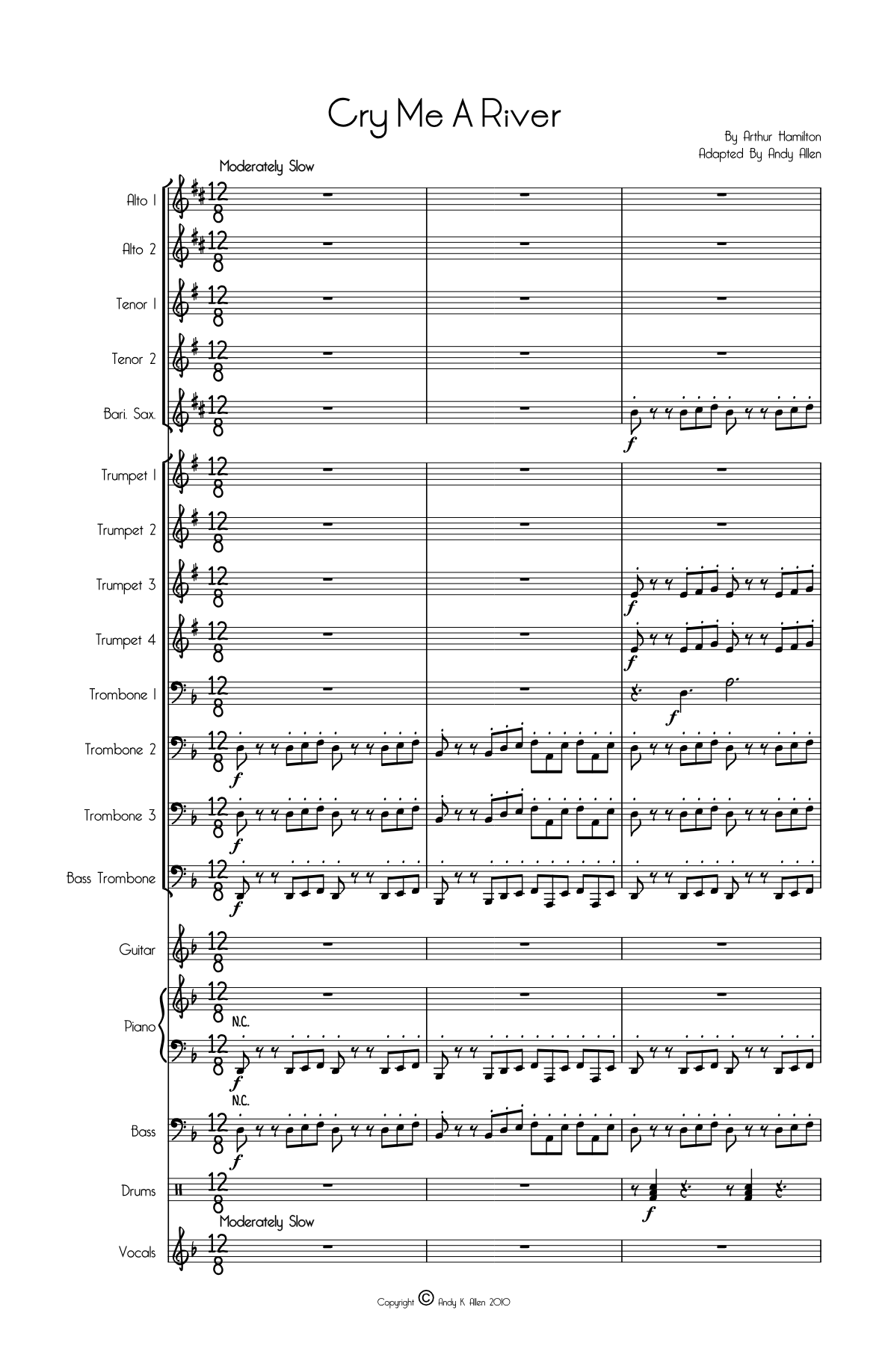
Cry Me A River (A.Hamilton) sheet music preview

Cry Me A River (A.Hamilton)

Composed by Arthur Hamilton

Arranged by A.Hamilton

  • Ensemble: Big Band Vocal
  • Style: Jazz Standard
  • Pages: 41
  • Instruments (18): Alto 1, Alto 2, Tenor 1, Tenor 2, Bari. Sax., Trumpet 1, Trumpet 2, Trumpet 3, Trumpet 4, Trombone 1, Trombone 2, Trombone 3, Bass Trombone, Guitar, Piano, Bass, Drums, Vocals
  • Difficulty: medium
  • Content: Individual Parts
  • Format: PDF Download (Instant)
  • Price: $24.99

Arthur Hamilton's timeless ballad, "Cry Me A River," emerged in 1953, quickly becoming an iconic lament of lost love and defiant heartbreak. While initially offered to Ella Fitzgerald, it was Julie London's smoldering 1955 rendition, featured in the film *The Girl Can't Help It*, that catapulted the song to international fame, establishing it as a quintessential torch song. Its enduring appeal lies in its dramatic narrative and haunting melody, making it a staple in the jazz and pop vocal repertoire for decades, covered by artists from Barbra Streisand to Joe Cocker. The song's emotional depth and harmonic sophistication lend themselves perfectly to jazz interpretation, offering a canvas for expressive vocalists and imaginative arrangers. This big band vocal arrangement by A.Hamilton masterfully captures the dramatic essence of the original while infusing it with contemporary jazz sensibilities. Set in a medium-slow swing feel at approximately 80-88 BPM, the arrangement opens with a sparse, evocative introduction, immediately establishing a melancholic yet powerful mood. The primary key is E minor, providing a rich, dark tonal palette that perfectly complements the song's lyrical content. A.Hamilton's signature approach often involves sophisticated harmonic reharmonization and judicious use of counterpoint, and this arrangement is no exception. Expect lush, extended voicings in the brass and saxophones, creating a dense, supportive texture for the vocalist. The arranger's treatment of "Cry Me A River" is characterized by its dynamic build and thoughtful interplay between the vocalist and the ensemble. The melody is predominantly carried by the vocalist, allowing for maximum interpretive freedom. However, A.Hamilton skillfully weaves in instrumental soli sections, particularly for the saxophones, which echo and elaborate upon melodic fragments, adding depth and interest. A notable feature is a beautifully orchestrated ensemble passage following the first chorus, acting as a dramatic interlude before returning to the vocal. While there isn't an extended improvised solo section, the arrangement provides ample space for the vocalist to shine, culminating in a powerful, full-band shout chorus that underscores the song's emotional climax, before resolving into a poignant, reflective outro. This arrangement is ideally suited for college, community, and professional big bands seeking a challenging yet deeply rewarding vocal feature. The technical demands include precise ensemble articulation, controlled dynamics across a wide range, and sophisticated harmonic navigation. The brass section will need strong breath support for sustained chords and nuanced phrasing, while the saxophones require blend and rhythmic precision in their soli passages. Performing this piece offers immense satisfaction, allowing musicians to explore emotional depth and dynamic contrast, creating a truly memorable experience for both performers and audience. Approach this arrangement with a focus on dynamic control and emotional nuance. The medium-slow swing feel (approx. 80-88 BPM) should be consistent but flexible enough to support the vocalist's interpretation. Pay close attention to the sustained chords, particularly in the brass, ensuring excellent intonation and blend. Sections marked *subito piano* or *cresc. molto* require precise execution to achieve the intended dramatic effect. The saxophone soli passages demand tight rhythmic synchronicity and a unified sound. Rehearsal should emphasize the interplay between the band and vocalist, ensuring the ensemble acts as a supportive, yet powerful, backdrop. Articulation markings are crucial; differentiate clearly between legato, staccato, and marcato to convey the arranger's intent. No special techniques like plungers or doits are explicitly required, but expressive falls and scoops should be encouraged where appropriate for stylistic authenticity. Q: What instruments and parts are included in this arrangement? A: This is a big band vocal arrangement, typically including parts for a vocalist, 5 saxophones (AATTB), 4 trumpets, 4 trombones, piano, bass, and drums. Q: What is the difficulty level of this arrangement? A: This arrangement is rated as advanced intermediate to advanced, suitable for college, community, and professional big bands due to its sophisticated harmonies, dynamic demands, and ensemble precision requirements. Q: What musical style and historical context does "Cry Me A River" represent? A: "Cry Me A River" is a classic jazz standard and torch song from the mid-1950s, famously popularized by Julie London, embodying the dramatic and melancholic vocal jazz style of that era. Q: What makes A.Hamilton's arrangement of "Cry Me A River" unique? A: A.Hamilton's arrangement stands out for its lush, reharmonized voicings, dramatic dynamic builds, and thoughtful interplay between the vocalist and the ensemble, including evocative saxophone soli sections and a powerful shout chorus. Q: What is the typical performance duration and tempo for this piece? A: The typical performance duration for this arrangement is approximately 3-4 minutes, performed at a medium-slow swing tempo of around 80-88 beats per minute.

Questions and answers

What is included in the Cry Me A River (A.Hamilton) PDF?
The verified current file contains individual parts across 41 pages.
How many instruments or parts are listed for Cry Me A River (A.Hamilton)?
The verified instrumentation list contains 18 entries for this Big Band Vocal arrangement.
Who is credited for Cry Me A River (A.Hamilton)?
Composer: Arthur Hamilton. Arranger: A.Hamilton.
What difficulty is listed for Cry Me A River (A.Hamilton)?
The verified difficulty level is medium.
What style is listed for Cry Me A River (A.Hamilton)?
The catalog lists the style as Jazz Standard.
Can I preview Cry Me A River (A.Hamilton) before buying?
Yes. The product page provides a preview generated from the current PDF file.
How is Cry Me A River (A.Hamilton) delivered?
After successful payment, the digital PDF is made available for download. The displayed price is $24.99.

Musicians Also Search For

Cry Me A River A.Hamilton PDFCry Me A River A.Hamilton sheet musicCry Me A River arranged by A.HamiltonA.Hamilton big band vocal chartsA.Hamilton jazz arrangements PDFCry Me A River Arthur Hamilton sheet musicCry Me A River Arthur Hamilton big band vocal arrangementsArthur Hamilton big band vocal chartsCry Me A River big band vocal arrangementsCry Me A River big band vocal PDF downloadCry Me A River jazz sheet musicbig band vocal sheet music downloadCry Me A River individual parts downloadCry Me A River sheet music PDFCry Me A River Jazz Standard chartsJazz Standard big band vocal arrangementsbuy Cry Me A River sheet musicdownload Cry Me A River PDFCry Me A River jazz chartsbest A.Hamilton big band vocal arrangementsArthur Hamilton arranged by A.HamiltonCry Me A River printable sheet musicbig band vocal repertoire PDF

All arrangements by A.Hamilton All Arthur Hamilton sheet music