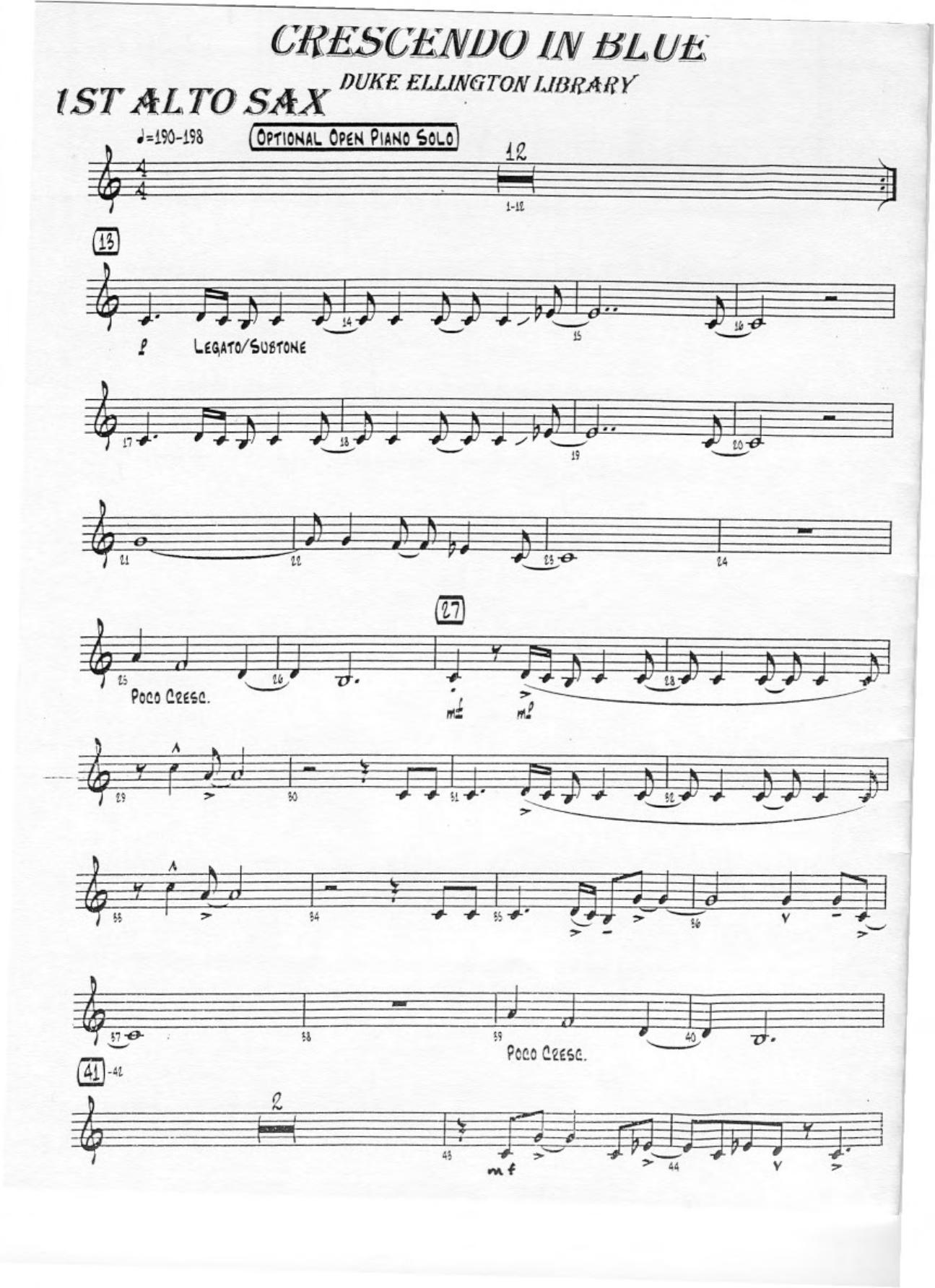
Crescendo In Blue (D.Ellington)
Composed by Duke Ellington
Arranged by Duke Ellington & B.Strayhorn.D.Berger
- Ensemble: Big Band
- Pages: 56
- Instruments (15): 1st Alto Sax, 3rd Alto Sax, Clarinet / 1st Tenor Sax, 2nd Tenor Sax, Bari Sax, 1st Trumpet, 2nd Trumpet, 3rd Trumpet, 4th Trumpet, 1st Trombone, 2nd Trombone, 3rd Trombone, Drums, Bass, Piano
- Difficulty: advanced
- Content: Individual Parts
- Format: PDF Download (Instant)
- Price: $24.99
Duke Ellington’s monumental composition *Crescendo in Blue* represents a pinnacle of the swing era and a masterclass in large-ensemble dynamic architecture. Originally recorded by the famed Duke Ellington Orchestra in 1937, the piece showcases Ellington’s pioneering approach to extended form composition within the jazz idiom, predating his more expansive suite works by several years. Unlike standard thirty-two-bar popular song forms, *Crescendo in Blue* is constructed around a twelve-bar blues framework that undergoes a continuous, calculated intensification of volume, density, and rhythmic complexity. The work stands as a testament to the telepathic synergy between Ellington and his legendary ensemble, capturing the sophisticated, high-energy spirit of Harlem's vibrant nightlife during the late 1930s. Propelled by a driving, medium-up swing feel in 4/4 time, the arrangement opens with deceptively cool, understated ensemble colors before systematically building tension across successive choruses. The mood shifts dynamically from bluesy introspection to unbridled, explosive jubilation. The distinctive collaborative stewardship of Duke Ellington, Billy Strayhorn, and archival scholar David Berger shines through in the meticulous restoration of the original voicings. Berger's transcription work preserves the signature Ellingtonian color palette—utilizing unorthodox instrumental pairings, such as baritone saxophones doubling high trumpet lines and rich, cluster-voiced chordal stabs in the brass. Rather than relying on simple volume escalation, the arrangement achieves its titular crescendo through progressive rhythmic layering, counterpoint, and increasingly dense harmonic extensions that stretch the traditional blues vocabulary. Melodic and harmonic responsibilities are distributed democratically across the nine-piece instrumental framework, ensuring that the alto, tenor, and baritone saxophones, alongside the trumpet and trombone, all engage in intricate conversational soli work. Featured solo spaces allow proficient improvisers to stretch out over the blues form, backed by punchy horn shout choruses that demand absolute precision in articulation and swing placement. Technical challenges center heavily on maintaining a relaxed, driving pulse while executing rapid dynamic shifts and precise ensemble phrasing. Performers will find immense satisfaction in navigating the sophisticated voice-leading and the thrilling sonic payoff of the climactic final chorus, which demands total commitment from every section to achieve the iconic Ellingtonian roar. Advanced high school ensembles, collegiate jazz bands, and professional repertory orchestras will find this configuration exceptionally well-suited for their libraries. Because the arrangement balances historical authenticity with rigorous ensemble demands, it serves as an ideal centerpiece for concert programs exploring the evolution of big band jazz. Directors seeking to challenge their musicians’ command of macro-dynamics, section blend, and authentic swing articulation will discover that this 56-page publication offers a profoundly rewarding rehearsal and performance experience. Successfully realizing *Crescendo in Blue* requires rigorous attention to macro-dynamics and sustained momentum. The primary technical challenge lies in pacing the titular crescendo; conductors must ensure the band does not peak too early, holding back enough sonic headroom during the opening choruses to make the final sections genuinely explosive. Establish a steady, resilient medium-up swing tempo and insist on a light, forward-moving ride cymbal feel from the rhythm section to anchor the pulse. Horn sections should approach their articulations with a crisp, clipped swing style, paying close attention to the balance between background figures and primary melodic lines. Special techniques such as gentle vibrato, controlled cup mutes, and subtle falls should be treated as stylistic necessities rather than optional ornaments. Rehearsal time is best utilized by section-isolating the dense harmonic passages to ensure pitch blend across the saxophone and brass choirs before assembling the full ensemble for dynamic balance checks. Q: What specific instruments and parts are included in this publication? A: This arrangement is scored for a 9-instrument ensemble featuring Alto Saxophone, Tenor Saxophone, Baritone Saxophone, Trumpet, and Trombone, spanning a comprehensive 56-page score and parts set tailored for flexible big band instrumentation. Q: What is the difficulty level of this arrangement? A: This piece is best suited for advanced high school, collegiate, and professional jazz ensembles due to its sophisticated harmonic language, sustained dynamic control demands, and intricate ensemble phrasing. Q: What is the historical style and context of *Crescendo in Blue*? A: Composed by Duke Ellington and originally recorded in 1937, this work is a landmark swing-era composition built on an extended twelve-bar blues form that emphasizes progressive dynamic and textural intensification. Q: What makes this specific transcription and arrangement unique? A: This version benefits from the collaborative editorial work of Duke Ellington, Billy Strayhorn, and David Berger, meticulously restoring authentic Ellingtonian voicings and signature harmonic colorations from archival manuscripts. Q: What is the performance duration and tempo feel of the piece? A: The arrangement operates at a driving, medium-up swing tempo in 4/4 time, with a typical performance duration ranging between 3 to 4 minutes depending on solo rotations.
Questions and answers
- What is included in the Crescendo In Blue (D.Ellington) PDF?
- The verified current file contains individual parts across 56 pages.
- How many instruments or parts are listed for Crescendo In Blue (D.Ellington)?
- The verified instrumentation list contains 15 entries for this Big Band arrangement.
- Who is credited for Crescendo In Blue (D.Ellington)?
- Composer: Duke Ellington. Arranger: Duke Ellington & B.Strayhorn.D.Berger.
- What difficulty is listed for Crescendo In Blue (D.Ellington)?
- The verified difficulty level is advanced.
- Can I preview Crescendo In Blue (D.Ellington) before buying?
- Yes. The product page provides a preview generated from the current PDF file.
- How is Crescendo In Blue (D.Ellington) delivered?
- After successful payment, the digital PDF is made available for download. The displayed price is $24.99.
Musicians Also Search For
Crescendo In Blue Duke Ellington & B.Strayhorn.D.Berger PDF • Crescendo In Blue Duke Ellington & B.Strayhorn.D.Berger sheet music • Crescendo In Blue arranged by Duke Ellington & B.Strayhorn.D.Berger • Duke Ellington & B.Strayhorn.D.Berger big band charts • Duke Ellington & B.Strayhorn.D.Berger jazz arrangements PDF • Crescendo In Blue Duke Ellington sheet music • Crescendo In Blue Duke Ellington big band arrangements • Duke Ellington big band charts • Crescendo In Blue big band arrangements • Crescendo In Blue big band PDF download • Crescendo In Blue jazz sheet music • big band sheet music download • Crescendo In Blue individual parts download • Crescendo In Blue sheet music PDF • buy Crescendo In Blue sheet music • download Crescendo In Blue PDF • Crescendo In Blue jazz charts • best Duke Ellington & B.Strayhorn.D.Berger big band arrangements • Duke Ellington arranged by Duke Ellington & B.Strayhorn.D.Berger • Crescendo In Blue printable sheet music • big band repertoire PDF