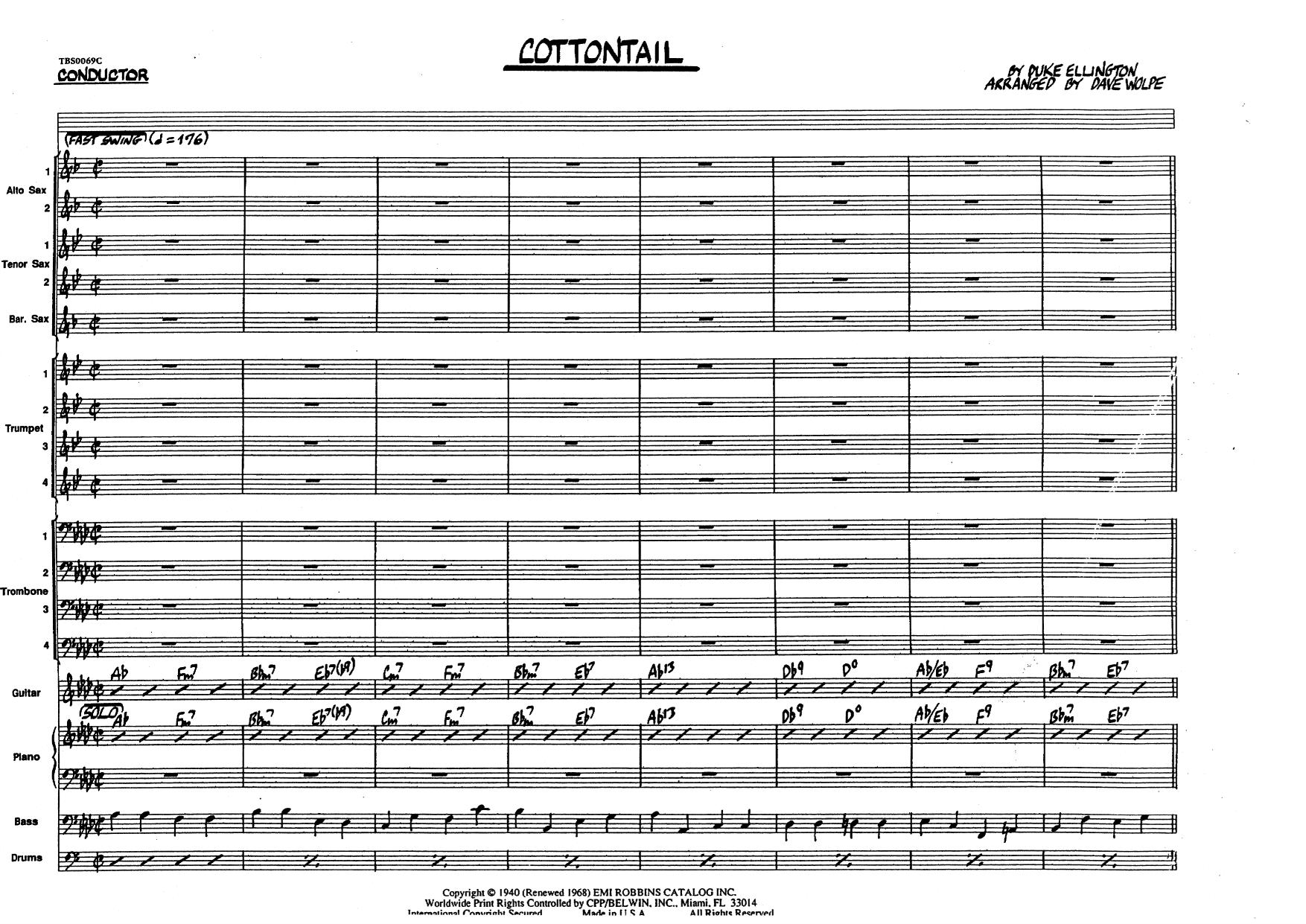
Cottontail (D.Wolpe)
Composed by Duke Ellington
Arranged by Dave Wolpe
- Ensemble: Big Band
- Pages: 59
- Instruments (17): Conductor, 1st Eb Alto Saxophone, 2nd Eb Alto Saxophone, 1st Bb Tenor Saxophone, 2nd Bb Tenor Saxophone, Eb Baritone Saxophone, 1st Bb Trumpet, 2nd Bb Trumpet, 3rd Bb Trumpet, 4th Bb Trumpet, 1st Trombone, 2nd Trombone, 3rd Trombone, Bass Trombone, Piano, Bass, Drums
- Difficulty: advanced
- Content: Individual Parts
- Format: PDF Download (Instant)
- Price: $24.99
Duke Ellington’s timeless rhythm-changes masterpiece, "Cottontail," stands as one of the definitive pillars of the swing era and big band literature. Originally recorded by the Duke Ellington Orchestra in May 1940 with the brilliant Ben Webster on tenor saxophone, the composition brilliantly adapts the chord progression of George Gershwin's "I Got Rhythm" into a vehicle for high-octane swing. It also serves as an early blueprint for bebop, famously inspiring modal and chromatic explorations by later modernists. The piece immortalized the classic Ellington brass and reed interplay, driven by the legendary drumming of Sonny Greer and the peerless foundational pulse of bassist Jimmy Blanton. Blazing at a high-velocity up-tempo swing, this chart captures the breakneck energy and exhilarating euphoria of the original 1940 recording while tailoring the demands for modern ensembles. Built upon relentless, driving eighth-note lines and lightning-fast shout choruses, the arrangement explodes with radiant brass stabs and tightly wound saxophone counterpoint. The harmonic landscape retains Ellington's sophisticated extensions while incorporating Dave Wolpe’s trademark clean, crisp contemporary big band scoring. The mood is celebratory, urgent, and fiercely swinging, requiring immense focus and stamina from every section to maintain the relentless forward momentum without dragging or rushing. Dave Wolpe approaches this classic material with a deep respect for traditional swing articulation coupled with an intuitive grasp of modern big band pedagogy. Known for his masterclasses in transcribing and adapting seminal jazz literature, Wolpe crafts a transparent texture that allows the intricate bebop-infused horn lines to speak clearly even at top speeds. The arrangement features classic call-and-response figures between the brass and saxophones, leading into a meticulously crafted sax soli that mirrors the breathless brilliance of the historic Webster lines. The shout chorus builds layer by layer, utilizing upper-structure extensions and dynamic contrast before roaring to a high-register finish. Executing this chart successfully requires exceptional finger dexterity, particularly in the reed section where rapid-fire scalar passages and articulated bebop lines dominate. The rhythm section bears a massive responsibility; the drummer must drive the ensemble with crisp ride-cymbal punctuation and well-placed hi-hat barks on two and four, while the bassist locks in an unyielding walking quarter-note groove. Featured solo sections provide an ideal platform for an advanced tenor saxophone or trumpet soloist to stretch out over standard rhythm changes. Advanced high school, collegiate, and professional jazz ensembles will find this arrangement an exhilarating centerpiece for festival performances and formal concerts alike. Conductors must approach this arrangement with strict attention to tempo discipline, as up-tempo swing charts have a natural tendency to either drag during complex transitions or rush during loud ensemble passages. Establish a rock-solid, driving pulse before the first downbeat, ensuring the rhythm section understands that light, articulate eighth notes are essential to the swing feel. The primary technical challenge lies in the sheer velocity of the horn lines; reed players should practice passages slowly with a metronome, focusing on clean finger drops and precise double-tonguing where necessary in the brass. Emphasize dynamic contrast—subdue the background figures during solo sections to allow the featured soloist maximum headroom. Utilize intentional marcato and staccato markings to give the 1940s-style shout chorus its signature bite, and ensure all falls and doits are executed with stylistic taste rather than exaggerated noise. Q: What instrumentation and parts are included in this publication? A: The arrangement is scored for a standard 17-instrument big band, consisting of 5 saxophones (2 altos, 2 tenors, 1 baritone), 4 trumpets, 4 trombones, piano, guitar, bass, and drums, alongside a comprehensive conductor score spanning 59 total pages. Q: What is the difficulty level of this Dave Wolpe arrangement? A: This chart is graded as advanced (approximate difficulty level 4 to 5), primarily due to the blistering up-tempo swing tempo and the technical agility required for the rapid horn lines and extended soli sections. Q: What is the historical style and background of "Cottontail"? A: Originally composed by Duke Ellington in 1940, "Cottontail" is a foundational swing-era jazz standard built upon the chord changes of "I Got Rhythm," famously featuring Ben Webster on the landmark tenor saxophone recording. Q: What makes this specific arrangement by Dave Wolpe unique? A: Wolpe expertly balances the authentic, high-energy flavor of the 1940 Ellington original with modern big band pedagogical clarity, ensuring crisp sectional voicings and accessible yet thrilling shout choruses for contemporary players. Q: What is the approximate performance duration and tempo feel? A: The piece is a high-octane, up-tempo swing chart that typically clocks in around 3 to 4 minutes depending on the length of the open solo sections and the conductor's chosen tempo.
Questions and answers
- What is included in the Cottontail (D.Wolpe) PDF?
- The verified current file contains a conductor score and individual parts across 59 pages.
- How many instruments or parts are listed for Cottontail (D.Wolpe)?
- The verified instrumentation list contains 17 entries for this Big Band arrangement.
- Who is credited for Cottontail (D.Wolpe)?
- Composer: Duke Ellington. Arranger: Dave Wolpe.
- What difficulty is listed for Cottontail (D.Wolpe)?
- The verified difficulty level is advanced.
- Can I preview Cottontail (D.Wolpe) before buying?
- Yes. The product page provides a preview generated from the current PDF file.
- How is Cottontail (D.Wolpe) delivered?
- After successful payment, the digital PDF is made available for download. The displayed price is $24.99.
Musicians Also Search For
Cottontail Dave Wolpe PDF • Cottontail Dave Wolpe sheet music • Cottontail arranged by Dave Wolpe • Dave Wolpe big band charts • Dave Wolpe jazz arrangements PDF • Cottontail Duke Ellington sheet music • Cottontail Duke Ellington big band arrangements • Duke Ellington big band charts • Cottontail big band arrangements • Cottontail big band PDF download • Cottontail jazz sheet music • big band sheet music download • Cottontail conductor score PDF • Cottontail individual parts download • Cottontail sheet music PDF • buy Cottontail sheet music • download Cottontail PDF • Cottontail jazz charts • best Dave Wolpe big band arrangements • Duke Ellington arranged by Dave Wolpe • Cottontail printable sheet music • big band repertoire PDF