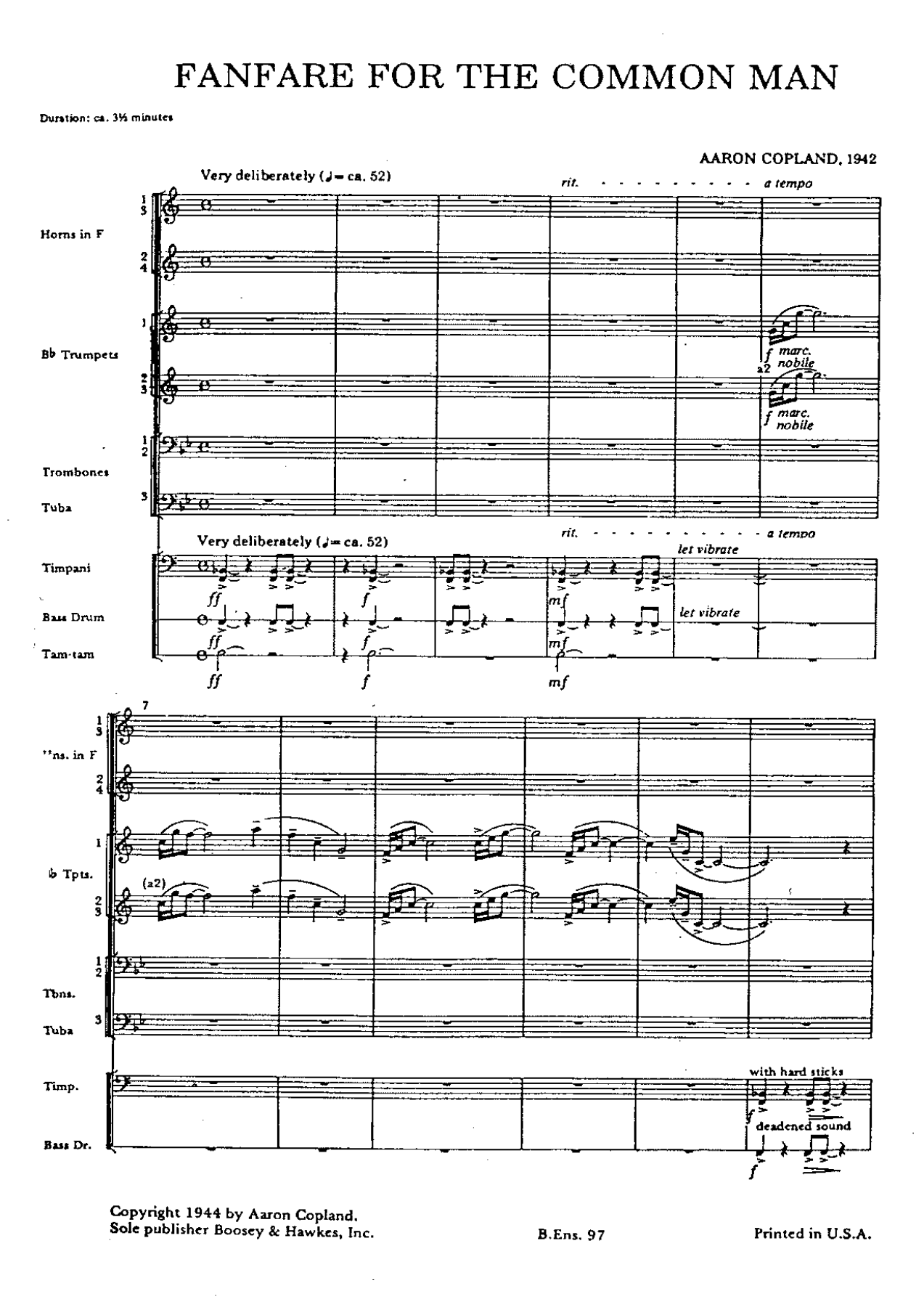
Copland - Fanfare For The Common Man (S.parts)
Composed by Aaron Copland
Arranged by score and parts
- Ensemble: Small Ensemble
- Style: Jazz Standard
- Pages: 17
- Instruments (13): 1st Bb Trumpet, 2nd Bb Trumpet, 3rd Bb Trumpet, 1st F Horn, 2nd F Horn, 3rd F Horn, 4th F Horn, 1st Trombone, 2nd Trombone, 3rd Trombone, Tuba, Timpani, Percussion (Bass Drum, Tam-tam)
- Difficulty: easy
- Content: Individual Parts
- Format: PDF Download (Instant)
- Price: $12.99
Aaron Copland’s iconic "Fanfare for the Common Man" was composed in 1942, premiering on March 12, 1943, by the Cincinnati Symphony Orchestra. This powerful work emerged during World War II, commissioned as part of a series of fanfares to honor the Allied war effort and the American citizen. Copland drew inspiration from a 1942 speech by Vice President Henry A. Wallace, who proclaimed the dawning of the "Century of the Common Man," a vision of postwar peace and prosperity. While many fanfares were commissioned, Copland's is the only one that remains a staple in the standard repertoire, recognized globally for its majestic and noble character. Its enduring appeal lies in its ability to evoke a sense of human aspiration and heroic purpose, making it a timeless piece of American classical music. This jazz standard arrangement reimagines Copland's original in a medium swing feel, transforming its stately pronouncements into a sophisticated, grooving experience. The original's signature powerful drumbeats and brass themes are reinterpreted with a contemporary jazz sensibility, maintaining the grandeur while introducing a fresh rhythmic pulse. The arrangement is primarily in Bb Major, a common and comfortable key for jazz ensembles, allowing for rich harmonic exploration. The mood shifts between moments of robust, full-ensemble declarations and intricate, layered voicings, creating a dynamic energy that is both reverent to the source material and distinctly modern. The arrangement evokes a feeling of dignified celebration and swinging elegance, a testament to the "common man" through a new musical lens. The arranger, score and parts, is known for their meticulous attention to detail and a nuanced understanding of jazz idiom, ensuring that this transcription is both authentic to the genre and highly playable. Their approach often involves thoughtful reharmonization, incorporating extended harmonies and substitute chords that enrich the harmonic landscape without obscuring the original melodic intent. Expect to find carefully crafted soli sections that feature different instrument groups, creating exciting call-and-response passages. The arrangement likely includes a powerful shout chorus, a hallmark of big band jazz, where the entire ensemble plays with maximum intensity, often culminating in a climactic moment that echoes the original's powerful ending. Modulations are handled smoothly, providing harmonic interest and building tension and release throughout the piece. Performance of this arrangement offers numerous rewarding moments. The primary melody is initially carried by the trumpet section, often doubled by alto saxophones for a bright, unified sound, before being passed to other sections for varied textures. While specific solo sections are indicated, the arrangement is designed with flexibility, allowing for improvisation from various instruments, such as tenor saxophone or trumpet, over clearly defined chord changes. Technical challenges include precise ensemble articulation in the swing passages, maintaining a consistent rhythmic drive, and navigating the extended harmonies. The reward lies in the collective power of the ensemble, the opportunity for individual expression through improvisation, and the unique experience of presenting a familiar classic in an entirely new, vibrant style. This arrangement is well-suited for college and community jazz ensembles, as well as advanced high school bands, offering a challenging yet accessible piece that expands their repertoire and stylistic understanding. Conductors should emphasize a deliberate, yet flowing medium swing feel, ensuring that the quarter note remains steady and unhurried at approximately 52 BPM, as in the original. The opening, particularly, requires careful attention to the powerful, sustained brass chords and precise rhythmic unison. Rehearsal should focus on clean articulation, especially in the soli sections, where clarity between voices is paramount. Encourage musicians to listen across sections to achieve balanced voicings and to lock into the rhythmic groove. For the improvised solos, provide clear guidance on chord changes and scales, allowing soloists creative freedom within the harmonic framework. While no specific special techniques like plunger mutes are explicitly required, encouraging a full, resonant brass sound and a crisp, articulate saxophone section will enhance the overall jazz aesthetic. Pay close attention to dynamic contrasts, building from the majestic opening to the powerful shout chorus, ensuring a cohesive and impactful performance. Q: What instruments are included in this arrangement? A: This arrangement is for a small jazz ensemble, and the 17 pages of score and parts typically include standard jazz ensemble instrumentation such as trumpets, trombones, saxophones (alto, tenor, baritone), and a rhythm section (piano, bass, drums). Q: What is the difficulty level of this jazz arrangement? A: This arrangement is suitable for college and community jazz ensembles, as well as advanced high school bands, presenting a challenging yet rewarding experience for musicians proficient in jazz idiom and ensemble playing. Q: What is the musical style and historical context of this piece? A: This is a jazz standard arrangement of Aaron Copland's "Fanfare for the Common Man," originally composed in 1942 during World War II. It transforms the original's majestic classical style into a medium swing jazz feel, while retaining its iconic character. Q: What makes this arrangement unique compared to other versions of "Fanfare for the Common Man"? A: This arrangement by score and parts distinctively reharmonizes Copland's original for a small jazz ensemble, incorporating extended harmonies, intricate soli sections, and a powerful shout chorus, all within a medium swing groove. Q: What is the approximate performance duration of this arrangement? A: While the original Copland piece typically lasts around 3 to 4 minutes, this jazz arrangement, with its expanded sections and potential for improvisation, will likely fall within a similar timeframe, generally between 3 to 5 minutes.
Questions and answers
- What is included in the Copland - Fanfare For The Common Man (S.parts) PDF?
- The verified current file contains a conductor score and individual parts across 17 pages.
- How many instruments or parts are listed for Copland - Fanfare For The Common Man (S.parts)?
- The verified instrumentation list contains 13 entries for this Small Ensemble arrangement.
- Who is credited for Copland - Fanfare For The Common Man (S.parts)?
- Composer: Aaron Copland. Arranger: score and parts.
- What difficulty is listed for Copland - Fanfare For The Common Man (S.parts)?
- The verified difficulty level is easy.
- What style is listed for Copland - Fanfare For The Common Man (S.parts)?
- The catalog lists the style as Jazz Standard.
- Can I preview Copland - Fanfare For The Common Man (S.parts) before buying?
- Yes. The product page provides a preview generated from the current PDF file.
- How is Copland - Fanfare For The Common Man (S.parts) delivered?
- After successful payment, the digital PDF is made available for download. The displayed price is $12.99.
Musicians Also Search For
Copland - Fanfare For The Common Man score and parts PDF • Copland - Fanfare For The Common Man score and parts sheet music • Copland - Fanfare For The Common Man arranged by score and parts • score and parts small ensemble charts • score and parts jazz arrangements PDF • Copland - Fanfare For The Common Man Aaron Copland sheet music • Copland - Fanfare For The Common Man Aaron Copland small ensemble arrangements • Aaron Copland small ensemble charts • Copland - Fanfare For The Common Man small ensemble arrangements • Copland - Fanfare For The Common Man small ensemble PDF download • Copland - Fanfare For The Common Man jazz sheet music • small ensemble sheet music download • Copland - Fanfare For The Common Man conductor score PDF • Copland - Fanfare For The Common Man individual parts download • Copland - Fanfare For The Common Man sheet music PDF • Copland - Fanfare For The Common Man Jazz Standard charts • Jazz Standard small ensemble arrangements • buy Copland - Fanfare For The Common Man sheet music • download Copland - Fanfare For The Common Man PDF • Copland - Fanfare For The Common Man jazz charts • best score and parts small ensemble arrangements • Aaron Copland arranged by score and parts • Copland - Fanfare For The Common Man printable sheet music • small ensemble repertoire PDF