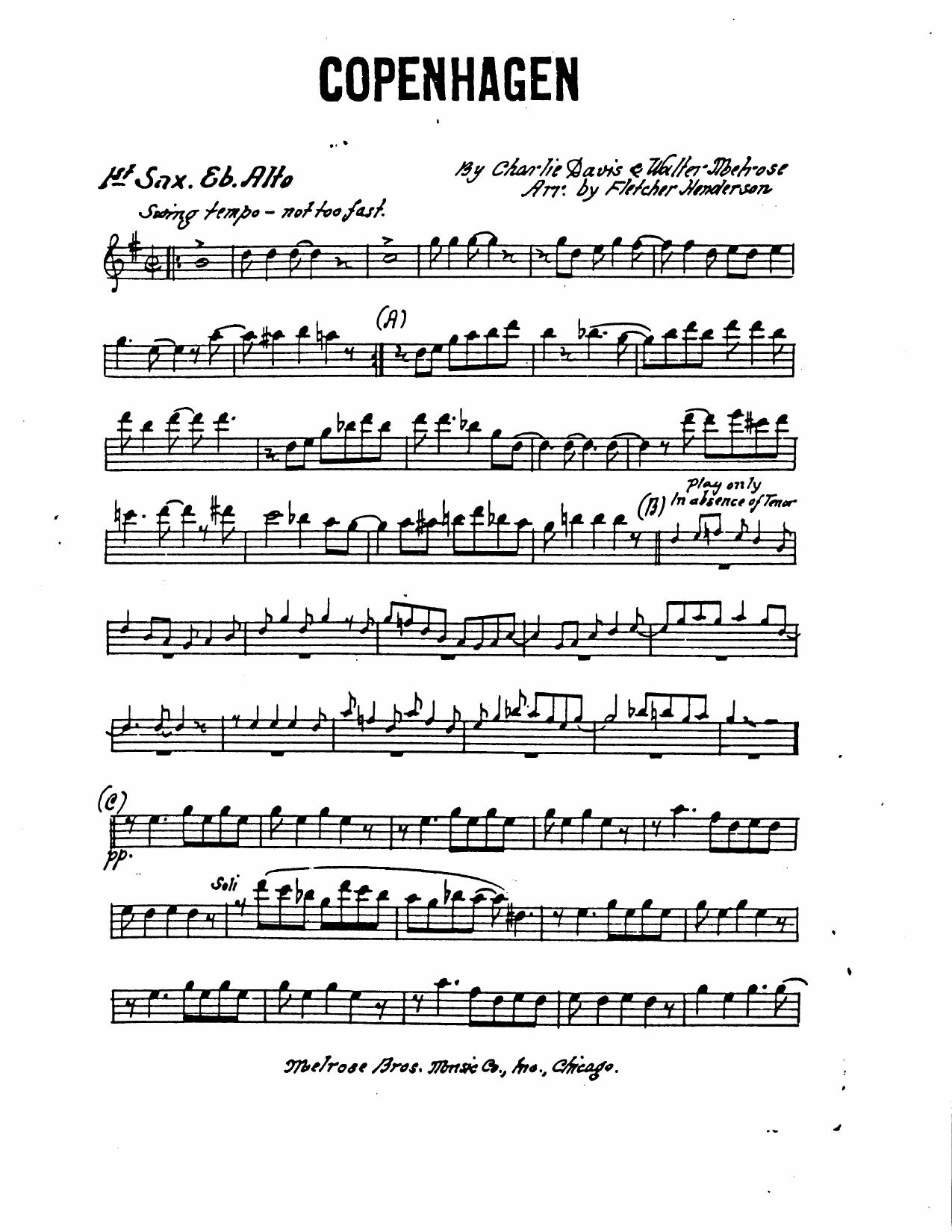
Copenhagen (F.Henderson)
Composed by Walter Donaldson
Arranged by Fletcher Henderson
- Ensemble: Big Band
- Pages: 26
- Instruments (13): 1st Sax. Eb Alto, 2nd Sax. Eb Alto, 3rd Sax. Eb Alto, 4th Sax. Bb Tenor, 1st Bb Trumpet, 2nd Bb Trumpet, 3rd Bb Trumpet, 1st Trombone, 2nd Trombone, Piano, Drums, Bass, Guitar
- Difficulty: medium
- Content: Individual Parts
- Format: PDF Download (Instant)
- Price: $24.99
Walter Donaldson’s 1924 composition "Copenhagen" stands as a cornerstone of early jazz repertoire, capturing the irrepressible energy and innovative spirit of the Roaring Twenties. Originally popularized by the pioneering Fletcher Henderson Orchestra during their residency at New York's Roseland Ballroom, the tune bridges the gap between early New Orleans polyphony and the birth of the modern big band. Henderson's visionary approach to orchestration transformed a catchy Tin Pan Alley tune into a roaring vehicle for collective swing, cementing his orchestra's reputation as the premier Black dance band of the Harlem Renaissance era and influencing a young Louis Armstrong, who was in the band at the time. Driving forward with a relentless, high-energy two-beat swing feel characteristic of mid-1920s jazz, this arrangement pulses with vibrant optimism and syncopated punch. The mood is celebratory, ebullient, and rhythmically infectious, evoking the smoky, high-stakes atmosphere of Prohibition-era dance halls. Henderson utilizes a bright, brass-forward tonal palette, balancing crisp ensemble breaks with driving reed countermelodies. The harmonic language relies on crisp dominant-seventh voicings, unexpected modal shifts, and call-and-response patterns that keep the momentum relentlessly pushing ahead from the first downbeat to the final explosive chord. Henderson’s signature arranging style shines through in the clever interplay between the brass and reed sections, utilizing sectional independence long before it became standard big band practice. Rather than simply doubling parts, Henderson pits the trumpets and trombones against a nimble saxophone section, carving out crisp counterlines and driving rhythmic figures. The arrangement features tightly integrated ensemble solis and structurally vital transitional interludes that showcase early jazz polyphony adapted for a larger ensemble. The melodic weight is shared democratically across the sections, giving every player a stake in the rhythmic drive, while structured solo spaces invite improvisers to capture the hot-jazz vernacular of the mid-1920s. Executing this chart successfully requires a deep understanding of early jazz articulation, where eighth notes are often played even or with a distinct ragtime-derived bounce rather than a modern triplet swing. The technical challenges lie primarily in the stylistic execution of period-authentic phrasing, clean articulation at brisk tempos, and maintaining a light, buoyant rhythmic feel without sacrificing power. Advanced high school, collegiate, and professional jazz ensembles will find this arrangement an exhilarating challenge and a historically vital programming choice. It offers modern musicians a rare, authentic window into the laboratory where big band jazz was first invented, rewarding meticulous attention to balance, style, and historical nuance. Mastering this Fletcher Henderson arrangement demands rigorous attention to stylistic authenticity and rhythmic precision. The tempo should be brisk and driving, maintaining an energetic two-beat feel that emphasizes beats one and three in the rhythm section while keeping the high-hat crisp on two and four. Avoid a modern, heavy swing; instead, lean toward a tighter, punchier articulation reminiscent of 1920s hot jazz, where eighth notes lean closer to straight or lightly bounced. Brass players should master early jazz effects such as gentle lip slurs, shakes, and controlled plunger or cup mutes where appropriate to emulate the vocalized textures of the era. Rehearsal should begin slowly, focusing on section isolation to ensure the intricate counterlines between the reeds and brass speak with equal clarity. Conductors must emphasize dynamic contrast, ensuring that background figures never swamp the lead melodic voices, and that ensemble shout choruses build organically without forcing the tone. Q: What instruments and parts are included in this arrangement? A: The arrangement is scored for a 14-instrument big band instrumentation, featuring three trumpets, two trombones, and a complete reed and rhythm section across its 26 pages of parts and full score. Q: What is the difficulty level of this arrangement? A: This chart is best suited for advanced high school, collegiate, and professional jazz ensembles due to its demands for stylistic authenticity, endurance, and period-specific articulation. Q: What is the historical context and musical style of "Copenhagen"? A: Composed by Walter Donaldson and arranged by Fletcher Henderson in 1924, this piece represents the vanguard of early big band jazz, transitioning from early New Orleans small-group styles into the expansive territory of the swing era. Q: What makes this Fletcher Henderson arrangement unique? A: It showcases Henderson's pioneering approach to section writing, utilizing sophisticated call-and-response patterns, independent reed counterlines, and brilliant transitional interludes that defined the sound of the Harlem Renaissance. Q: What is the performance duration and tempo feel of the piece? A: The arrangement typically runs around 3 minutes in duration and relies on a brisk, highly energetic two-beat swing feel that propels the ensemble with relentless rhythmic drive.
Questions and answers
- What is included in the Copenhagen (F.Henderson) PDF?
- The verified current file contains individual parts across 26 pages.
- How many instruments or parts are listed for Copenhagen (F.Henderson)?
- The verified instrumentation list contains 13 entries for this Big Band arrangement.
- Who is credited for Copenhagen (F.Henderson)?
- Composer: Walter Donaldson. Arranger: Fletcher Henderson.
- What difficulty is listed for Copenhagen (F.Henderson)?
- The verified difficulty level is medium.
- Can I preview Copenhagen (F.Henderson) before buying?
- Yes. The product page provides a preview generated from the current PDF file.
- How is Copenhagen (F.Henderson) delivered?
- After successful payment, the digital PDF is made available for download. The displayed price is $24.99.
Musicians Also Search For
Copenhagen Fletcher Henderson PDF • Copenhagen Fletcher Henderson sheet music • Copenhagen arranged by Fletcher Henderson • Fletcher Henderson big band charts • Fletcher Henderson jazz arrangements PDF • Copenhagen Walter Donaldson sheet music • Copenhagen Walter Donaldson big band arrangements • Walter Donaldson big band charts • Copenhagen big band arrangements • Copenhagen big band PDF download • Copenhagen jazz sheet music • big band sheet music download • Copenhagen individual parts download • Copenhagen sheet music PDF • buy Copenhagen sheet music • download Copenhagen PDF • Copenhagen jazz charts • best Fletcher Henderson big band arrangements • Walter Donaldson arranged by Fletcher Henderson • Copenhagen printable sheet music • big band repertoire PDF