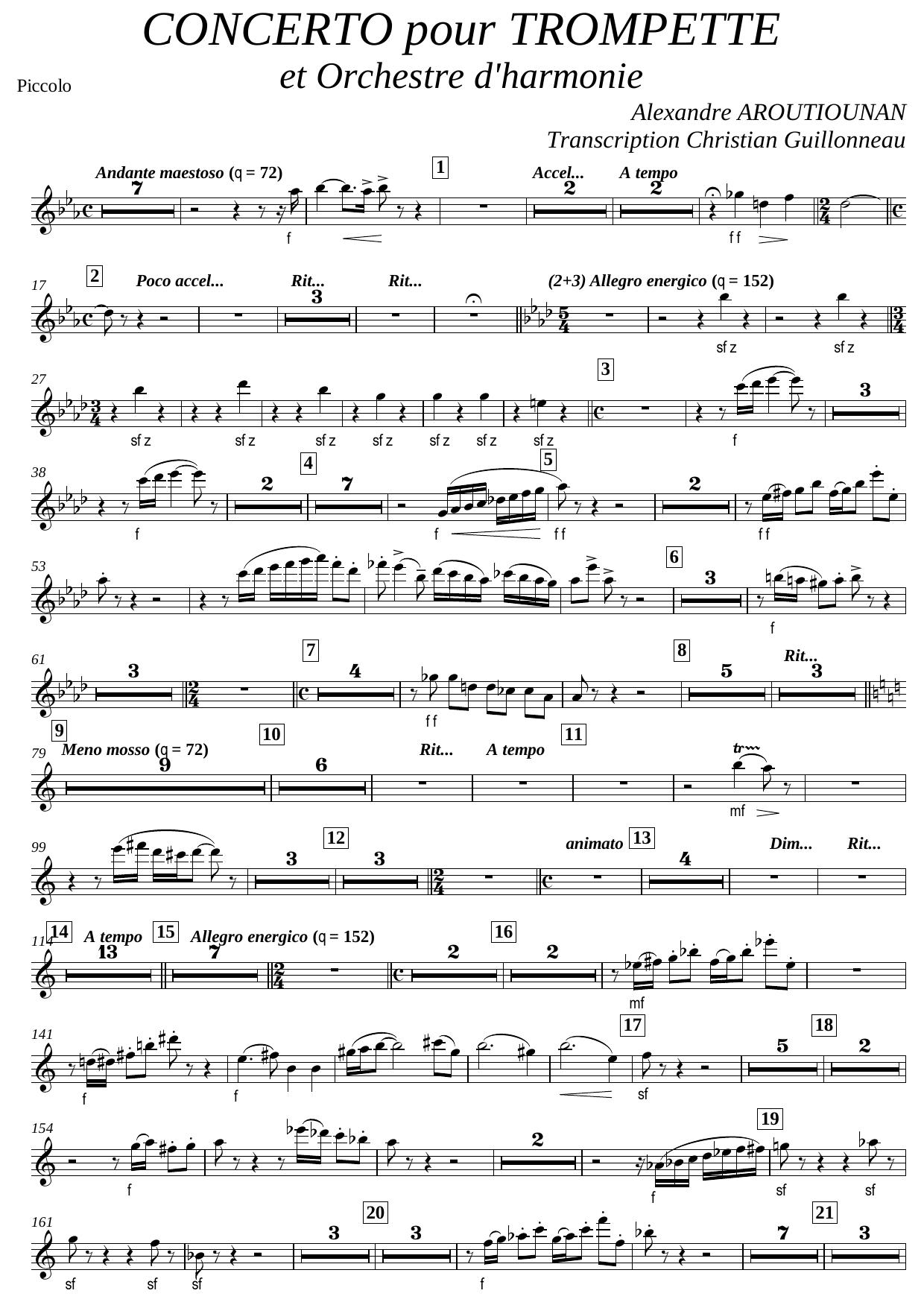
Concerto For Tumpet (A.Aroutiounan)
Composed by Alexander Arutiunian
- Ensemble: Concert Band
- Pages: 117
- Instruments (38): Piccolo, Flûte 1, 2, Hautbois 1, 2, Cor anglais, Basson 1, 2, Pte Clarinette Eb, Clarinette Bb 1, Clarinettes Bb 2, Clarinettes Bb 3, Clarinette alto, Clarinette basse, Saxophones Alto 1, 2, Saxophones ténor 1, 2, Saxophone baryton, Trompette Bb Solo, Trompette Bb 1, Trompettes Bb 2, 3, Cors F 1, 2, Cors F 1, 3, Cors F 2, 4, Cors F 3, 4, Trombone 1, Trombones 2, 3, Euphoniums Bb 1, 2, Euphoniums Ut 1, 2, Basse Bb, Contrebasse Bb (8ve réelle), Contrebasse Bb, Tuba Ut, Contrebasse à cordes, Timbales, Caisse-claire, Cymbales fr., Grosse-caisse, Xylophone, Vibraphone, triangle, Harpe
- Difficulty: advanced
- Content: Individual Parts
- Format: PDF Download (Instant)
- Price: $22.99
Alexander Arutiunian's iconic "Concerto for Trumpet" stands as a cornerstone of the trumpet repertoire, originally composed in 1950. While not a jazz piece in its original form, its dramatic flair, lyrical beauty, and virtuosic demands have long captivated musicians across genres. This particular arrangement reimagines Arutiunian's masterpiece through a thoroughly jazz-infused lens, transforming the classical concerto into a vibrant, swinging showcase for a lead trumpet soloist within a modern jazz idiom. The original work, known for its blend of Armenian folk melodies, soaring romanticism, and dazzling technical passages, has been performed by virtually every major trumpet soloist, from Timofei Dokschitzer to Wynton Marsalis, making it a globally recognized and beloved composition. This jazz arrangement breathes new life into the concerto, presenting it as a medium-up swing chart, predominantly in 4/4 time, with occasional shifts to a more lyrical, ballad-like feel for contrast. The overall mood is one of sophisticated energy, balancing the original's inherent grandeur with the improvisational freedom and rhythmic drive characteristic of jazz. The arrangement maintains the original's key structure, allowing the familiar melodic contours to shine through, but reharmonizes extensively with extended jazz chords (9ths, 11ths, 13ths, altered dominants) to create a richer, more contemporary harmonic palette. Expect intricate soli sections for the woodwinds, particularly the clarinets and flutes, providing lush counterpoint to the trumpet's lead lines. The energy builds dynamically, culminating in a powerful shout chorus that reinterprets the concerto's climactic moments with a big band punch. The arranger, though unknown, demonstrates a profound understanding of both the original Arutiunian work and the nuances of jazz orchestration. The lead trumpet carries the primary melodic material throughout, requiring a soloist with exceptional technical command, endurance, and a strong jazz vocabulary for the improvised sections. While the core melodies are preserved, they are often presented with a swing eighth-note feel and jazz articulation. Featured solos are primarily for the lead trumpet, but there are also opportunities for improvised fills or short breaks from other principal voices, particularly the clarinet or flute, adding textural variety. Technical challenges include rapid scale passages and arpeggios in the trumpet part, intricate rhythmic figures across the ensemble, and precise articulation for the woodwind sections. The reward lies in performing a familiar classic in an entirely new, exhilarating context, offering both a nod to tradition and a fresh, contemporary interpretation. This arrangement is ideally suited for advanced high school, college, community, or professional concert bands looking to expand their repertoire with a challenging yet highly rewarding crossover piece. Its demands on the lead trumpet soloist are significant, requiring a player capable of both classical virtuosity and jazz improvisation. The ensemble parts, while supportive, are far from trivial, demanding strong section playing, precise rhythmic execution, and an understanding of jazz phrasing. It offers a unique opportunity to bridge the gap between classical and jazz idioms, providing an engaging experience for both performers and audiences. Conductors should emphasize a consistent medium-up swing feel throughout, even during technically demanding passages, ensuring that the eighth notes are properly swung. The lead trumpet soloist requires exceptional stamina and a strong, clear tone, capable of both lyrical phrasing and powerful, articulated lines. Encourage the soloist to approach the improvisational sections with creativity while respecting the original melodic framework. For the woodwind sections, particular attention should be paid to blend and balance during the intricate soli passages, ensuring clarity in the rapid runs. Dynamics are crucial; highlight the dramatic contrasts between the powerful tutti sections and the more intimate, lyrical moments. Rehearsal time should be dedicated to synchronizing rhythmic figures between sections, especially where the jazz rhythms might be unfamiliar to classically trained players. No special techniques like plunger mutes or falls are explicitly notated, but tasteful jazz articulation, including scoops and subtle bends, should be encouraged from the trumpet soloist where appropriate to enhance the jazz aesthetic. Q: What instruments are included in this arrangement? A: This arrangement is scored for a concert band with 17 instruments, including Flute, Oboe, Clarinet, Bass Clarinet, Bassoon, and standard brass and percussion sections, designed to accompany a featured trumpet soloist. Q: What is the difficulty level of this arrangement? A: This is an advanced-level arrangement, suitable for college, community, or professional concert bands. It demands a highly skilled and versatile trumpet soloist capable of both classical virtuosity and jazz improvisation, along with strong ensemble playing. Q: What is the musical style and historical context of this piece? A: This is a jazz arrangement of Alexander Arutiunian's "Concerto for Trumpet," originally composed in 1950. While the source material is classical, this arrangement reinterprets it with a medium-up swing feel, jazz harmonies, and improvisational elements. Q: What makes this arrangement unique compared to other versions of Arutiunian's Concerto? A: Its uniqueness lies in its complete transformation of the classical concerto into a jazz idiom for concert band. It features extensive jazz reharmonization, a swinging rhythmic interpretation, and integrated improvised solo sections, offering a fresh perspective on a classic. Q: What is the approximate performance duration or tempo of this arrangement? A: The arrangement is primarily set at a medium-up swing tempo, with contrasting lyrical sections. While exact duration can vary with interpretation, expect a performance time of approximately 12-15 minutes, similar to the original concerto.
Questions and answers
- What is included in the Concerto For Tumpet (A.Aroutiounan) PDF?
- The verified current file contains individual parts across 117 pages.
- How many instruments or parts are listed for Concerto For Tumpet (A.Aroutiounan)?
- The verified instrumentation list contains 38 entries for this Concert Band arrangement.
- Who is credited for Concerto For Tumpet (A.Aroutiounan)?
- Composer: Alexander Arutiunian.
- What difficulty is listed for Concerto For Tumpet (A.Aroutiounan)?
- The verified difficulty level is advanced.
- Can I preview Concerto For Tumpet (A.Aroutiounan) before buying?
- Yes. The product page provides a preview generated from the current PDF file.
- How is Concerto For Tumpet (A.Aroutiounan) delivered?
- After successful payment, the digital PDF is made available for download. The displayed price is $22.99.
Musicians Also Search For
Concerto For Tumpet Alexander Arutiunian sheet music • Concerto For Tumpet Alexander Arutiunian concert band arrangements • Alexander Arutiunian concert band charts • Concerto For Tumpet concert band arrangements • Concerto For Tumpet concert band PDF download • Concerto For Tumpet jazz sheet music • concert band sheet music download • Concerto For Tumpet individual parts download • Concerto For Tumpet sheet music PDF • buy Concerto For Tumpet sheet music • download Concerto For Tumpet PDF • Concerto For Tumpet jazz charts • Concerto For Tumpet printable sheet music • concert band repertoire PDF