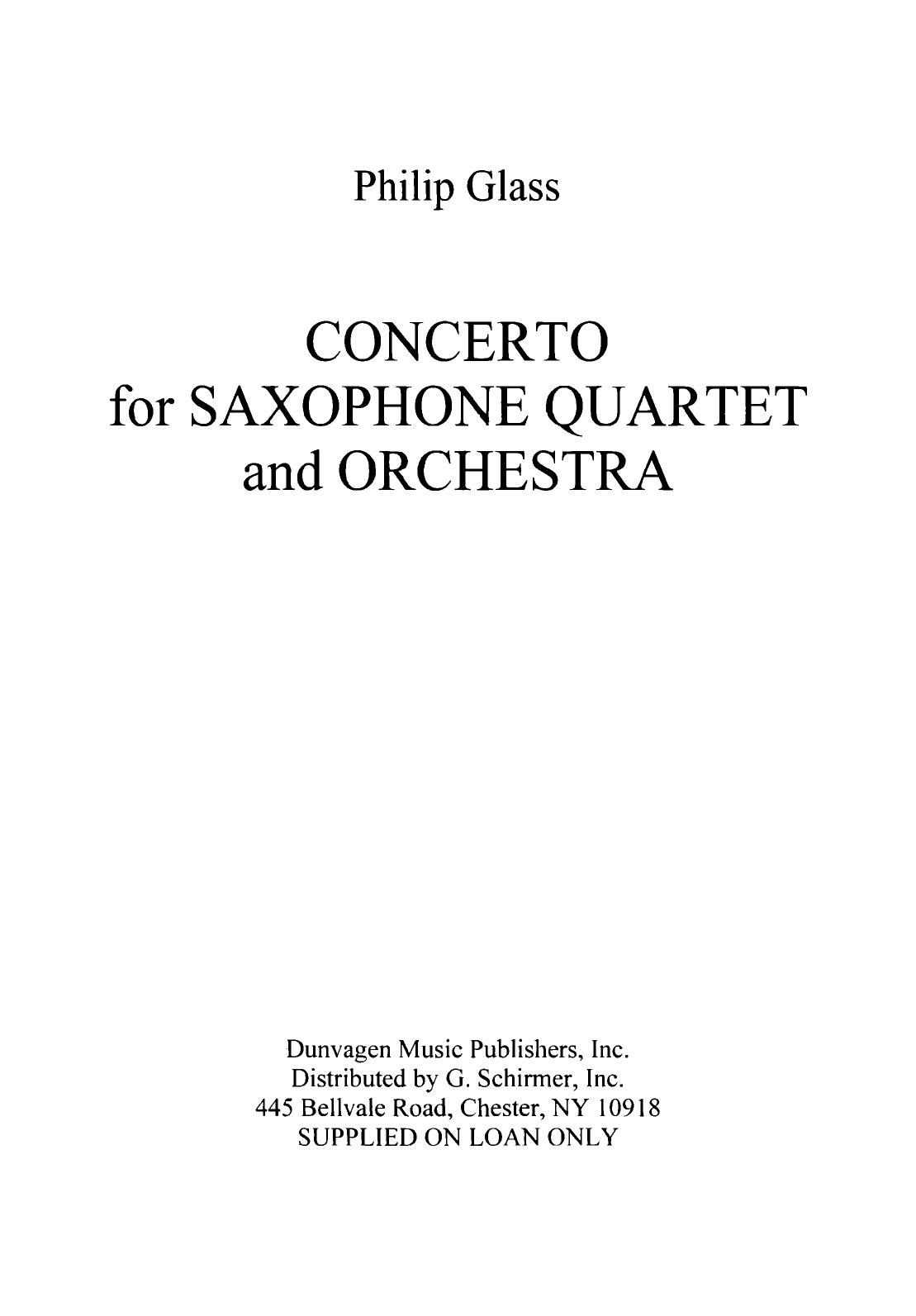
Concerto For Saxophone Quartet & Orchestra (P.Glass)
Composed by Philip Glass
Arranged by P.Glass
- Ensemble: Concert Band
- Style: Jazz Standard
- Pages: 152
- Instruments (24): Flute 1, Flute 2, Piccolo, Oboe 1, Oboe 2, Clarinet in Bb 1, Clarinet in Bb 2, Bassoon 1, Bassoon 2, Trumpet in Bb 1, Trumpet in Bb 2, Horn in F 1, Horn in F 2, Percussion (Triangle, Snare Drum, Tambourine, Maracas, Glockenspiel, Hi-Hat, Cymbals, Wood Block, Temple Blocks, Bass Drum, Cow Bell), Celeste, Soprano Saxophone in Bb, Alto Saxophone in Eb, Tenor Saxophone in Bb, Baritone Saxophone in Eb, Violin I, Violin II, Viola, Cello, Double Bass
- Difficulty: advanced
- Content: Individual Parts
- Format: PDF Download (Instant)
- Price: $22.99
Philip Glass's "Concerto For Saxophone Quartet & Orchestra" is a monumental work, originally conceived in 1995, that stands as a testament to the composer's enduring exploration of minimalist structures within a classical framework. While not a traditional "jazz standard" in its original form, this P.Glass arrangement reimagines the concerto's distinctive motifs and expansive harmonic language through a sophisticated jazz lens, transforming its inherent rhythmic drive into a compelling concert band experience. The original piece is celebrated for its intricate interplay between the solo saxophone quartet and the orchestral forces, characterized by Glass's signature repetitive figures, slowly evolving harmonies, and a sense of hypnotic forward momentum. This arrangement honors that legacy while infusing it with the improvisational spirit and harmonic richness inherent to contemporary jazz. This particular arrangement by P.Glass masterfully translates the original's dynamic energy into a vibrant concert band setting. The musical character maintains the driving, often propulsive, rhythmic feel of Glass's original, typically at a medium-fast tempo, but reinterprets it with a nuanced jazz sensibility. While the original is often in a modal or non-functional harmonic context, P.Glass introduces extended harmonies and voicings that evoke a modern jazz aesthetic without sacrificing the minimalist essence. Expect sections that build with relentless intensity, juxtaposed with moments of lyrical introspection. The mood oscillates between powerful, almost cinematic grandeur and intricate, tightly woven ensemble passages, demanding both precision and expressive depth from the performers. The arrangement is primarily in keys that are comfortable for concert band instrumentation, often exploring modal scales and shifting tonal centers that reflect the original's innovative harmonic landscape. P.Glass's approach to this arrangement is both respectful and transformative. Distinctive elements include the meticulous re-orchestration of the original's orchestral textures for concert band, ensuring that the rich timbral palette is preserved and enhanced. The saxophone quartet remains the focal point, with P.Glass crafting intricate soli sections that highlight their virtuosic capabilities, often featuring tightly voiced harmonies that lean into a modern jazz sound. While not a traditional "jazz standard" arrangement with open solo sections, the arranger has subtly woven in opportunities for expressive interpretation within the quartet's lines, allowing for a jazz-inflected phrasing. The arrangement features dynamic contrasts, from delicate, interwoven lines to powerful, full-ensemble shout choruses that build to exhilarating climaxes, all while maintaining the hypnotic rhythmic undercurrent. P.Glass's signature is evident in the thoughtful reharmonization and the intelligent use of counterpoint, creating a fresh yet familiar sound world. Performing this arrangement is an immensely rewarding experience for a dedicated concert band. The saxophone quartet carries the primary melodic and thematic material throughout, requiring exceptional blend, intonation, and technical facility. While there are no traditional improvised solos, the quartet's parts are highly exposed and demand a soloist's command of their instrument. Technical challenges include navigating complex rhythmic patterns, maintaining precise ensemble cohesion during rapidly evolving passages, and executing challenging dynamic shifts. The piece offers numerous musical moments that stand out, such as the intricate call-and-response between the quartet and the full ensemble, the powerful climaxes, and the moments of sustained, ethereal beauty. This arrangement is ideally suited for college-level concert bands, advanced community ensembles, or professional groups seeking a challenging and innovative contemporary work that bridges the gap between classical minimalism and modern jazz. Its demands on musicianship and ensemble precision make it a significant addition to any concert program. This arrangement of "Concerto For Saxophone Quartet & Orchestra (P.Glass)" requires meticulous attention to rhythmic precision and dynamic control. The primary technical challenge lies in maintaining the driving, often repetitive, rhythmic figures with unwavering accuracy across the entire ensemble, particularly in the faster sections. Conductors should emphasize a clear, consistent pulse and encourage musicians to subdivide diligently. The saxophone quartet parts are highly exposed and technically demanding; extensive rehearsal on intonation, blend, and rhythmic synchronization within the quartet is crucial before integrating with the full band. Focus on shaping the long, evolving phrases, ensuring that the build-ups are gradual and sustained, and that the releases are controlled. While the tempo is generally medium-fast, conductors should establish a precise metronomic marking that allows for clarity without sacrificing momentum. No special techniques like plunger mutes or falls are explicitly notated, but expressive phrasing with a jazz sensibility, particularly from the saxophone quartet, will enhance the performance. Rehearsal tips include isolating challenging rhythmic passages, practicing dynamic swells and decays, and ensuring the balance highlights the saxophone quartet while allowing the band to provide a rich, supportive texture. Q: What instruments and parts are included in this arrangement? A: This 152-page arrangement includes a full conductor's score and individual parts for a standard concert band instrumentation, specifically featuring a dedicated saxophone quartet (Soprano, Alto, Tenor, Baritone Saxophones) as the primary soloistic ensemble. Q: What is the difficulty level of this arrangement? A: This arrangement is considered advanced, suitable for college-level concert bands, advanced community ensembles, or professional groups due to its complex rhythmic interplay, demanding saxophone quartet parts, and sophisticated harmonic language. Q: What is the musical style and historical context of this piece? A: This arrangement reimagines Philip Glass's "Concerto For Saxophone Quartet & Orchestra," originally composed in 1995, through a contemporary jazz lens. It combines Glass's minimalist structures and rhythmic drive with modern jazz harmonies and voicings. Q: What makes this P.Glass arrangement unique? A: This arrangement is unique for its successful fusion of Philip Glass's distinctive minimalist compositional style with a sophisticated jazz aesthetic, re-orchestrating the original orchestral work for concert band while maintaining the saxophone quartet as the central focus. Q: What is the typical performance duration and tempo of this arrangement? A: The performance duration typically ranges from 18-22 minutes, depending on the conductor's interpretation. The piece generally maintains a medium-fast, driving tempo, with variations in mood and intensity throughout.
Questions and answers
- What is included in the Concerto For Saxophone Quartet & Orchestra (P.Glass) PDF?
- The verified current file contains a conductor score across 152 pages.
- How many instruments or parts are listed for Concerto For Saxophone Quartet & Orchestra (P.Glass)?
- The verified instrumentation list contains 24 entries for this Concert Band arrangement.
- Who is credited for Concerto For Saxophone Quartet & Orchestra (P.Glass)?
- Composer: Philip Glass. Arranger: P.Glass.
- What difficulty is listed for Concerto For Saxophone Quartet & Orchestra (P.Glass)?
- The verified difficulty level is advanced.
- What style is listed for Concerto For Saxophone Quartet & Orchestra (P.Glass)?
- The catalog lists the style as Jazz Standard.
- Can I preview Concerto For Saxophone Quartet & Orchestra (P.Glass) before buying?
- Yes. The product page provides a preview generated from the current PDF file.
- How is Concerto For Saxophone Quartet & Orchestra (P.Glass) delivered?
- After successful payment, the digital PDF is made available for download. The displayed price is $22.99.
Musicians Also Search For
Concerto For Saxophone Quartet & Orchestra P.Glass PDF • Concerto For Saxophone Quartet & Orchestra P.Glass sheet music • Concerto For Saxophone Quartet & Orchestra arranged by P.Glass • P.Glass concert band charts • P.Glass jazz arrangements PDF • Concerto For Saxophone Quartet & Orchestra Philip Glass sheet music • Concerto For Saxophone Quartet & Orchestra Philip Glass concert band arrangements • Philip Glass concert band charts • Concerto For Saxophone Quartet & Orchestra concert band arrangements • Concerto For Saxophone Quartet & Orchestra concert band PDF download • Concerto For Saxophone Quartet & Orchestra jazz sheet music • concert band sheet music download • Concerto For Saxophone Quartet & Orchestra conductor score PDF • Concerto For Saxophone Quartet & Orchestra sheet music PDF • Concerto For Saxophone Quartet & Orchestra Jazz Standard charts • Jazz Standard concert band arrangements • buy Concerto For Saxophone Quartet & Orchestra sheet music • download Concerto For Saxophone Quartet & Orchestra PDF • Concerto For Saxophone Quartet & Orchestra jazz charts • best P.Glass concert band arrangements • Philip Glass arranged by P.Glass • Concerto For Saxophone Quartet & Orchestra printable sheet music • concert band repertoire PDF