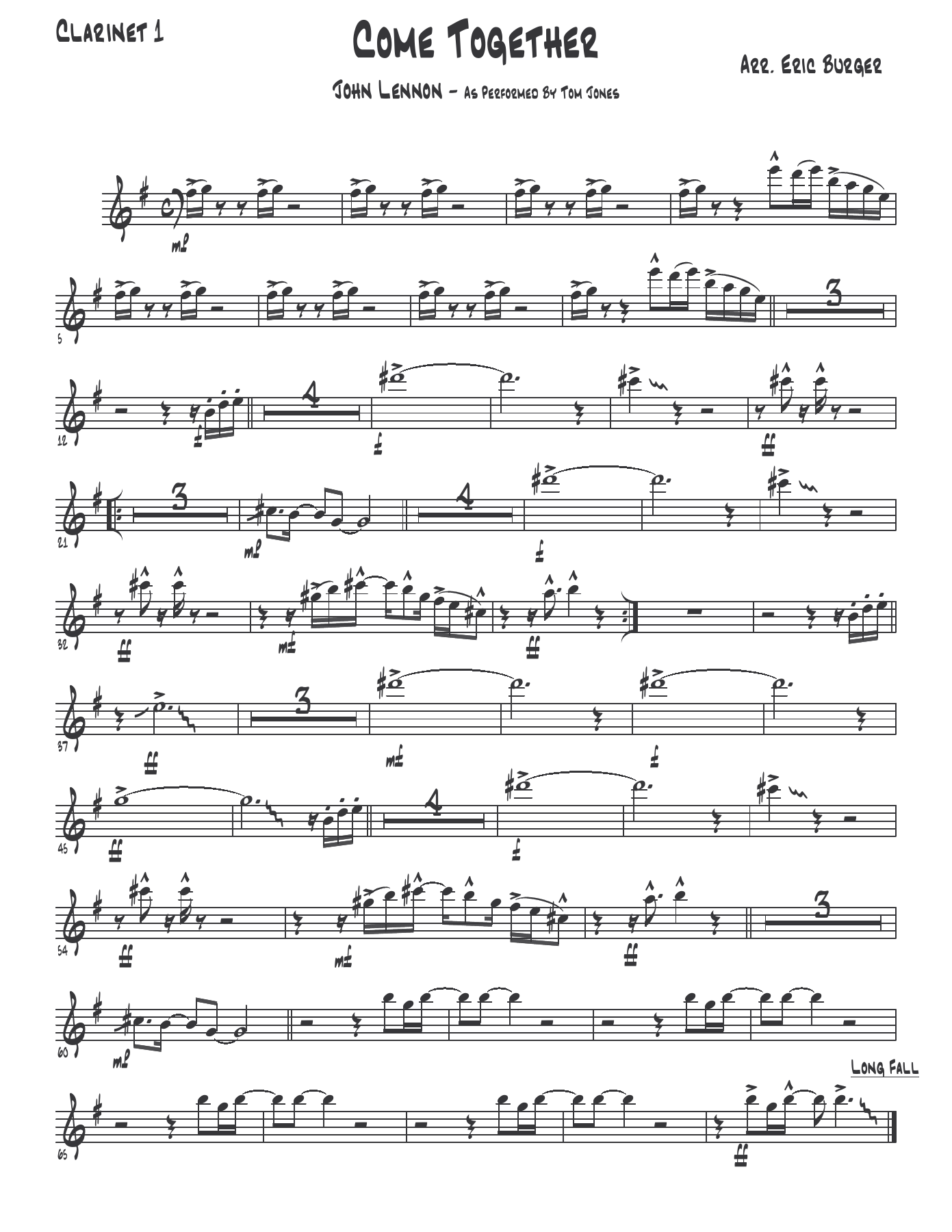
Come TG - clr (E.Burger)
Composed by John Lennon
Arranged by Eric Burger
- Ensemble: Big Band Vocal
- Style: Swing
- Pages: 50
- Instruments (24): Voice, Flute, Clarinet 1, Clarinet 2, Alto Saxophone 1, Alto Saxophone 2, Tenor Saxophone 1, Tenor Saxophone 2, Baritone Saxophone, Trumpet 1, Trumpet 2, Trumpet 3, Trumpet 4, Horn 1, Horn 2, Trombone 1, Trombone 2, Trombone 3, Trombone 4, Tuba, Guitar, Keys, Bass, Drum Set
- Difficulty: easy
- Content: Individual Parts
- Format: PDF Download (Instant)
- Price: $12.99
The iconic rock anthem "Come Together," penned by John Lennon and originally released by The Beatles in 1969 on their seminal *Abbey Road* album, transcends its origins to become a compelling vehicle for jazz improvisation and big band interpretation. While not a traditional jazz standard, its distinctive, blues-inflected bassline, enigmatic lyrics, and driving rhythm have long appealed to musicians seeking to bridge genre divides. The original track, a cornerstone of late-60s rock, is renowned for its hypnotic groove and R&B undertones, making it ripe for re-imagination within a swing context. Its enduring popularity ensures immediate recognition and audience engagement, offering a fresh perspective on a familiar classic. Eric Burger's masterful arrangement transforms this rock staple into a sophisticated medium-swing big band vocal chart, firmly rooted in the 4/4 tradition of classic jazz. Burger's signature approach to big band writing is evident throughout: he consistently crafts arrangements that are harmonically rich, rhythmically engaging, and meticulously voiced, often featuring intricate soli sections and powerful shout choruses that build dynamic intensity. For "Come TG - clr," Burger establishes a relaxed, yet propulsive medium swing feel from the outset, setting a confident and cool mood. The arrangement is primarily in C minor, offering a slightly darker, more introspective character than some of its rock counterparts, while still maintaining an undeniable swagger. The vocal melody is presented clearly, often supported by lush horn pads or counter-melodic figures that weave through the arrangement. Burger skillfully utilizes the full dynamic range of the big band, moving from understated, grooving sections to full-throated ensemble passages. A standout feature is the expertly crafted saxophone soli, which reinterprets the original's melodic fragments with intricate jazz voicings, providing a challenging yet rewarding moment for the sax section. There are ample opportunities for featured improvisation, typically including a tenor saxophone solo over the familiar chord changes, allowing a soloist to explore the bluesy, modal implications of the harmony. The arrangement culminates in a powerful shout chorus that drives to a satisfying conclusion, showcasing the band's collective power. This arrangement is ideally suited for college-level jazz ensembles, advanced community big bands, and professional groups. Its blend of familiar melodic material with sophisticated jazz orchestration offers significant educational value in terms of ensemble blend, rhythmic precision, and harmonic understanding. The vocal part requires a singer with strong rhythmic sensibilities and the ability to navigate a medium-swing feel with conviction. While technically demanding in its ensemble precision and solo requirements, the piece is incredibly rewarding to perform, offering both musicians and audiences a fresh, swinging take on a timeless classic. Conductors should emphasize a consistent, relaxed medium-swing feel throughout the arrangement, ensuring the rhythm section lays down a solid, grooving foundation without rushing. The iconic bassline must be played with precision and a strong sense of pocket. Key technical challenges include the intricate saxophone soli, which requires careful attention to blend, balance, and rhythmic accuracy; sectional rehearsals are highly recommended. Trumpet parts feature some sustained upper-register playing in the shout chorus, demanding good breath support and endurance. Encourage soloists to embrace the bluesy, slightly modal character of the harmony, drawing inspiration from both the original's attitude and classic jazz improvisation. Dynamic contrast is crucial, particularly in the build-up to the shout chorus and the subsequent dynamic drop-offs. No special mutes or extended techniques are explicitly required, allowing the focus to remain on articulation, blend, and groove. Q: What instruments are included in this arrangement? A: This arrangement is scored for a standard big band lineup: 5 saxophones (AATTB), 4 trumpets, 4 trombones, piano, bass, drums, guitar, and a vocal soloist. Q: What is the difficulty level of "Come TG - clr (E.Burger)"? A: This arrangement is considered advanced intermediate to advanced, making it suitable for college-level jazz ensembles, advanced community bands, and professional groups due to its intricate voicings, solo requirements, and ensemble precision demands. Q: What musical style and historical context does this arrangement represent? A: While the original "Come Together" is a classic rock song from The Beatles' 1969 *Abbey Road* album, Eric Burger's arrangement reinterprets it as a sophisticated medium-swing big band vocal chart, firmly within the jazz tradition. Q: What makes Eric Burger's arrangement of "Come Together" unique? A: Burger's arrangement stands out for its masterful transformation of a rock anthem into a swinging jazz vehicle, featuring lush voicings, an intricate saxophone soli, and a powerful shout chorus, all while maintaining the original's iconic groove. Q: What is the typical performance duration and tempo for this piece? A: The typical performance duration for this arrangement is approximately 4-5 minutes, performed at a medium-swing tempo, usually around 120-130 beats per minute.
Questions and answers
- What is included in the Come TG - clr (E.Burger) PDF?
- The verified current file contains a conductor score and individual parts across 50 pages.
- How many instruments or parts are listed for Come TG - clr (E.Burger)?
- The verified instrumentation list contains 24 entries for this Big Band Vocal arrangement.
- Who is credited for Come TG - clr (E.Burger)?
- Composer: John Lennon. Arranger: Eric Burger.
- What difficulty is listed for Come TG - clr (E.Burger)?
- The verified difficulty level is easy.
- What style is listed for Come TG - clr (E.Burger)?
- The catalog lists the style as Swing.
- Can I preview Come TG - clr (E.Burger) before buying?
- Yes. The product page provides a preview generated from the current PDF file.
- How is Come TG - clr (E.Burger) delivered?
- After successful payment, the digital PDF is made available for download. The displayed price is $12.99.
Musicians Also Search For
Come TG - clr Eric Burger PDF • Come TG - clr Eric Burger sheet music • Come TG - clr arranged by Eric Burger • Eric Burger big band vocal charts • Eric Burger jazz arrangements PDF • Come TG - clr John Lennon sheet music • Come TG - clr John Lennon big band vocal arrangements • John Lennon big band vocal charts • Come TG - clr big band vocal arrangements • Come TG - clr big band vocal PDF download • Come TG - clr jazz sheet music • big band vocal sheet music download • Come TG - clr conductor score PDF • Come TG - clr individual parts download • Come TG - clr sheet music PDF • Come TG - clr Swing charts • Swing big band vocal arrangements • buy Come TG - clr sheet music • download Come TG - clr PDF • Come TG - clr jazz charts • best Eric Burger big band vocal arrangements • John Lennon arranged by Eric Burger • Come TG - clr printable sheet music • big band vocal repertoire PDF