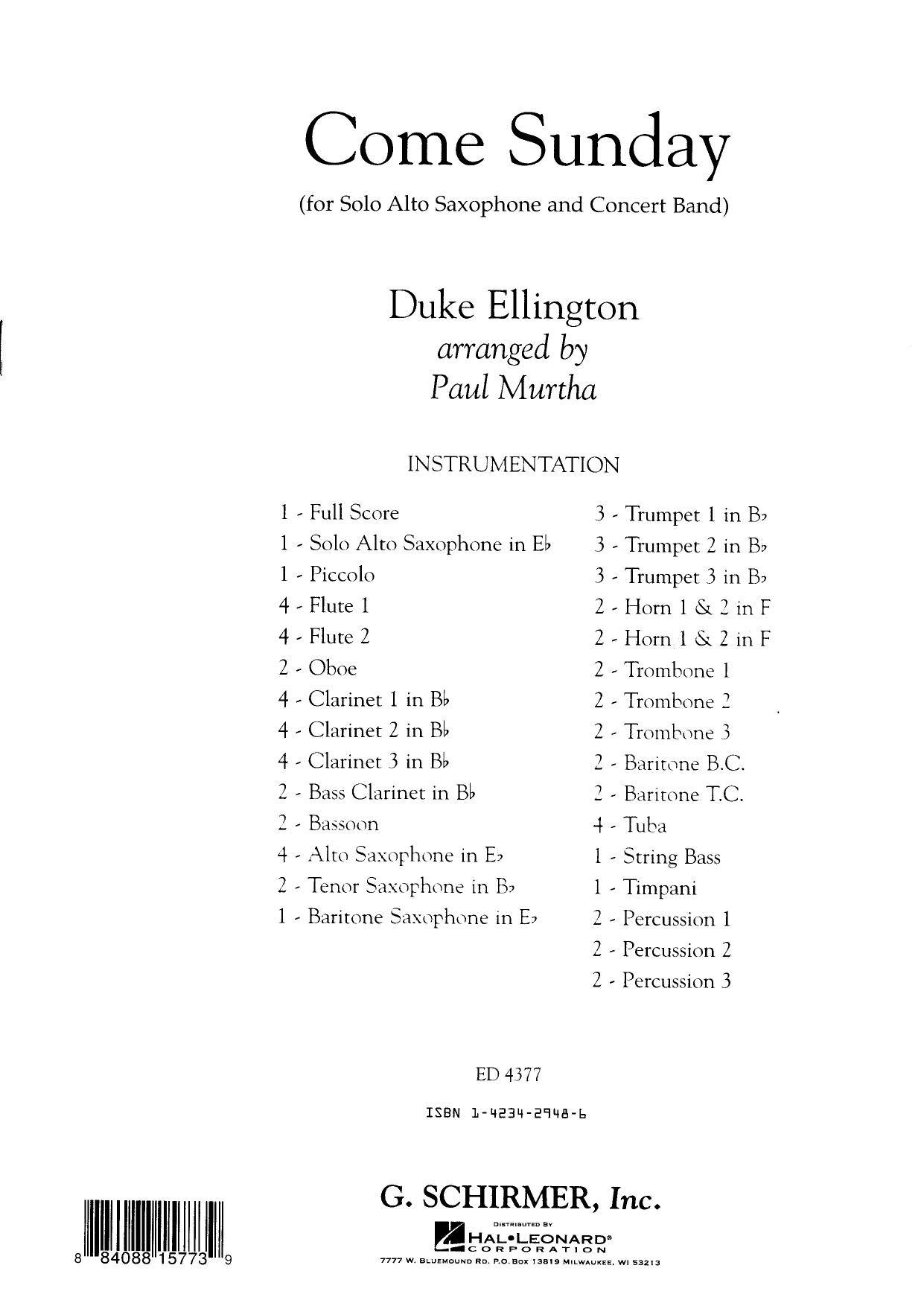
Come Sunday (P.Murtha) sheet music preview

Come Sunday (P.Murtha)

Composed by Duke Ellington

Arranged by P.Murtha

  • Ensemble: Concert Band
  • Pages: 46
  • Instruments (31): Piccolo, Flute 1, Flute 2, Oboe, Bassoon, Clarinet 1, Clarinet 2, Clarinet 3, Bass Clarinet, Alto Sax 1, Alto Sax 2, Tenor Sax 1, Tenor Sax 2, Baritone Sax, Trumpet 1, Trumpet 2, Trumpet 3, Trumpet 4, Horn 1, Horn 2, Horn 3, Horn 4, Trombone 1, Trombone 2, Trombone 3, Trombone 4, Euphonium, Tuba, String Bass, Piano, Drums
  • Difficulty: medium
  • Content: Individual Parts
  • Format: PDF Download (Instant)
  • Price: $18.99

## SECTION 1: Description Duke Ellington’s "Come Sunday," originally composed as the spiritual centerpiece of his monumental 1943 suite *Black, Brown and Beige*, stands as one of the most profound and enduring melodies in the jazz canon. This timeless hymn, often performed as a feature for saxophone or trombone, transcends its jazz origins to evoke a universal sense of reverence and hope. Ellington himself frequently featured it, most notably with Mahalia Jackson, cementing its status as a piece of deep spiritual resonance and lyrical beauty. Its simple yet profound melody, often presented in a slow, expressive 4/4 meter, speaks to the heart of the American experience, reflecting themes of faith, struggle, and eventual triumph. The original composition is characterized by its rich, often melancholic, harmonic underpinnings and its capacity to convey immense emotional depth through seemingly straightforward melodic lines. P. Murtha's concert band arrangement of "Come Sunday" thoughtfully reimagines this iconic spiritual for a full symphonic wind ensemble, preserving its inherent dignity while exploring the vast timbral palette available to this instrumentation. Murtha approaches the piece as a slow, reverent ballad, maintaining the original's reflective and prayerful mood. The arrangement opens with a delicate, almost ethereal quality, often featuring woodwind choirs or muted brass to establish the solemn atmosphere. As the piece progresses, Murtha masterfully builds intensity through careful orchestration, employing rich, extended harmonies that swell and recede, echoing the emotional arc of a spiritual. Expect lush voicings, particularly in the brass and low woodwinds, providing a warm, supportive foundation for the soaring melodic lines. The melodic duties are distributed thoughtfully throughout the ensemble, ensuring engagement across sections. Initially, the melody might be presented by a solo instrument such as oboe or alto saxophone, or a small woodwind choir, before being taken up by the full brass or combined woodwinds for moments of greater grandeur. Murtha’s signature is evident in the nuanced dynamic shaping and the intelligent use of counter-melodies and obligato lines that weave through the primary theme, adding layers of interest without obscuring the melody's clarity. While the overall tempo remains slow, the arrangement demands exceptional control over phrasing, blend, and intonation, particularly in sustained passages and delicate entrances. The technical challenges lie less in rapid finger work and more in achieving a unified, expressive sound and maintaining precise rhythmic subdivision within the slow tempo. This arrangement is particularly well-suited for college, community, and advanced high school concert bands seeking a profoundly moving and musically rewarding piece that showcases their expressive capabilities and ensemble cohesion. ## SECTION 2: Performance Notes This arrangement of "Come Sunday" requires a dedicated focus on intonation, blend, and expressive phrasing to capture its spiritual essence. Maintain a slow, reverent 4/4 tempo (quarter note around 60-66 BPM), emphasizing a sustained, legato feel throughout. Avoid rushing or pushing the tempo, allowing the rich harmonies to resonate fully. Key technical challenges include sustaining long tones with consistent tone quality and precise intonation, especially in exposed woodwind and brass choir sections. Encourage musicians to listen across sections for balance, ensuring that inner voices support rather than overpower the melody. Dynamic contrasts, from *pianissimo* whispers to full, resonant *fortissimo*, are crucial; practice gradual crescendos and decrescendos to achieve a natural ebb and flow. Some brass sections may benefit from using straight mutes for specific passages to achieve a more ethereal or distant sound, as indicated in the score. Encourage a unified approach to vibrato, if used, to maintain a cohesive ensemble sound. Rehearsal should prioritize listening exercises, focusing on harmonic tuning and the collective shaping of phrases, treating the entire piece as one continuous, unfolding prayer. ## SECTION 3: FAQ Q: What instruments are included in this arrangement? A: This arrangement is scored for a full concert band, including Piccolo, Flute 1, Flute 2, Oboe, Bassoon, Clarinet 1, Clarinet 2, Clarinet 3, Bass Clarinet, Alto Saxophone 1, Alto Saxophone 2, Tenor Saxophone, Baritone Saxophone, Trumpet 1, Trumpet 2, Trumpet 3, Horn 1, Horn 2, Horn 3, Horn 4, Trombone 1, Trombone 2, Trombone 3, Euphonium, Tuba, String Bass, Piano, and Percussion (including Timpani, Suspended Cymbal, and Tam-Tam). Q: What is the difficulty level of this arrangement? A: This arrangement is rated as medium-advanced, suitable for college, community, and advanced high school concert bands. Its challenges lie in expressive phrasing, precise intonation, dynamic control, and ensemble blend rather than rapid technical passages. Q: What is the musical style and historical context of "Come Sunday"? A: "Come Sunday" is a jazz spiritual, originally composed by Duke Ellington in 1943 as part of his *Black, Brown and Beige* suite. It embodies a reflective, hymn-like quality, blending jazz harmonies with a profound spiritual reverence, and is considered a timeless classic in the jazz and American music canon. Q: What makes P. Murtha's arrangement of "Come Sunday" unique? A: P. Murtha's arrangement uniquely reimagines this iconic piece for concert band, utilizing the full symphonic wind ensemble's timbral range to create a rich, expressive tapestry. It maintains the original's reverent ballad feel while employing sophisticated orchestration, lush voicings, and thoughtful distribution of melodic lines across various sections. Q: What is the approximate performance duration and tempo of this arrangement? A: The approximate performance duration for this arrangement is around 4-5 minutes. It is intended to be performed as a slow, expressive ballad in 4/4 time, with a quarter note tempo typically ranging from 60-66 BPM.

All arrangements by P.Murtha All Duke Ellington sheet music