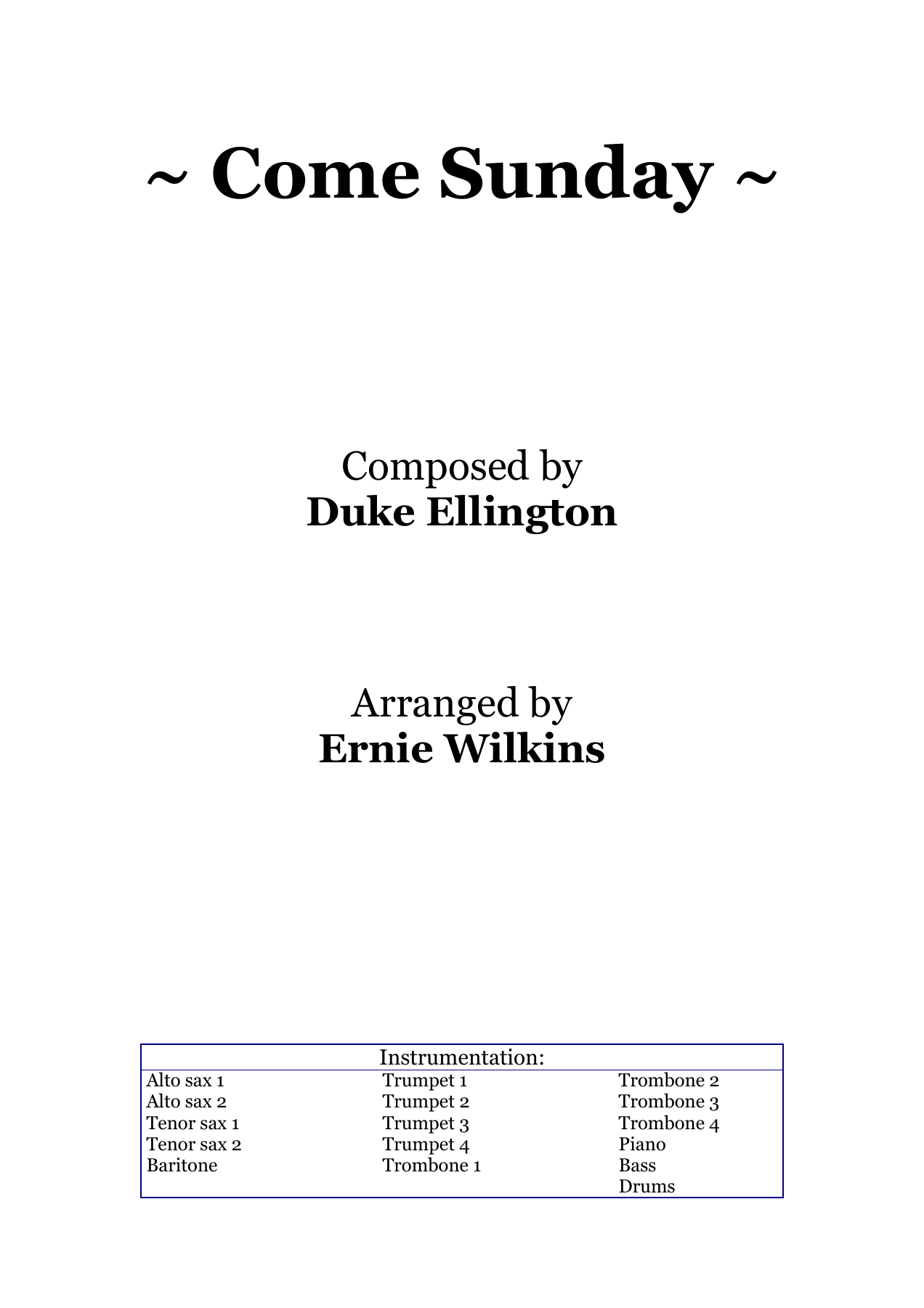
Come Sunday (E.Wilkins)
Composed by Duke Ellington
Arranged by Ernie Wilkins
- Ensemble: Big Band
- Style: Jazz Standard
- Pages: 35
- Instruments (16): I Alto Sax (Flute), II Alto Sax, I Tenor Sax, II Tenor Sax, Baryton Sax, I Trombone, II Trombone, III Trombone, IV Trombone, I Trumpet, II Trumpet, III Trumpet, IV Trumpet (Flugelhorn), Piano, Bass, Drums
- Difficulty: medium
- Content: conductor score and individual parts
- Format: PDF Download (Instant)
- Price: $24.99
Duke Ellington's "Come Sunday" stands as a profound and enduring jazz standard, originally conceived in 1942 as a pivotal movement within his monumental suite, *Black, Brown and Beige*. This extended work premiered at Carnegie Hall in January 1943, serving as Ellington's ambitious musical chronicle of the African American experience. The piece itself, a sacred jazz composition, evokes the deep spiritual resonance and emotional depth of Black spirituals, unfolding with a tender, hymn-like melody at a slow, contemplative pace. While initially a feature for the distinctive alto saxophone voice of Johnny Hodges, its soaring, vocal quality quickly cemented its status as a standalone jazz standard, later gaining even wider recognition with lyrics added by Ellington and a celebrated vocal recording by Mahalia Jackson in 1958. "Come Sunday" embodies the solemnity and hope often associated with the "Day of Rest," reflecting themes of freedom, redemption, and gratitude within the historical context of African American life. Ernie Wilkins' arrangement of "Come Sunday" for big band masterfully reinterprets this spiritual ballad, filtering Ellington's original reverence through Wilkins' signature arranging style. Known for his work with Count Basie's "New Testament" band, Wilkins' approach typically combines a Kansas City blues sensibility with modern jazz harmonies, characterized by a "punchy" and "crackling" sound. In this arrangement, Wilkins likely employs his distinctive voicing design, which often emphasizes triadic structures with added sixths and ninths rather than overly dense extended harmonies, creating clarity and an iridescent orchestral color. Expect artful brass writing with close-position voicings in the middle register, maintaining an octave span within the trumpet section for a cohesive yet powerful sound. The arrangement maintains the original's slow, ballad tempo, allowing the rich harmonies and melodic contours to breathe, fostering a mood of introspection and quiet grandeur. This arrangement features the melody predominantly in the alto saxophone, echoing its origins as a Johnny Hodges feature, providing an opportunity for a soloist to imbue the performance with expressive depth. While the overall feel is a slow, reverent ballad, Wilkins' touch ensures that the ensemble sections are anything but static, likely incorporating subtle rhythmic interplay and dynamic swells that build emotional intensity without sacrificing the piece's contemplative nature. Technical challenges will center on achieving seamless blend and balance within the saxophone and brass sections, maintaining precise intonation at a slow tempo, and executing dynamic nuances with sensitivity. The reward lies in performing a truly moving piece that allows a big band to showcase its collective musicality and emotional depth, particularly in the rich ensemble voicings and the featured solo. This arrangement is ideally suited for college, community, and professional big bands capable of delivering a mature and nuanced performance, appreciating both the historical weight of the composition and the sophisticated artistry of Wilkins' arrangement. This arrangement of "Come Sunday" should be approached as a deeply expressive, slow ballad, maintaining a consistent, deliberate tempo that allows for maximum emotional impact. The primary technical challenge lies in achieving impeccable blend and intonation, particularly within the saxophone and brass choir passages. Encourage musicians to listen across sections, tuning carefully to sustained chords. Dynamic control is paramount; focus on smooth crescendos and decrescendos, ensuring that swells build naturally from within the ensemble rather than through excessive force. The lead alto saxophone carries the main melodic responsibilities, requiring a soloist with a warm tone and strong lyrical phrasing. Articulate falls and subtle vibrato should be executed with taste, enhancing the spiritual quality of the melody. Rehearsal time should be dedicated to shaping phrases, balancing the inner voices of the voicings, and ensuring the rhythm section provides a supportive, unhurried foundation. Q: What instruments are included in this arrangement? A: This arrangement is scored for a standard 17-instrument big band lineup, including Alto Saxophone 1 & 2, Tenor Saxophone 1 & 2, Baritone Saxophone, 4 Trumpets, 4 Trombones, Piano, Bass, Drums, and Guitar. Q: What is the difficulty level of this arrangement? A: This arrangement is suitable for intermediate to advanced ensembles, including college, community, and professional big bands, due to its demands on blend, intonation, and expressive interpretation at a slow ballad tempo. Q: What is the musical style and historical context of "Come Sunday"? A: "Come Sunday" is a sacred jazz standard composed by Duke Ellington in 1942 as part of his *Black, Brown and Beige* suite, evoking the spiritual and emotional depth of African American spirituals. Q: What makes Ernie Wilkins' arrangement of "Come Sunday" unique? A: Ernie Wilkins' arrangement brings his signature clear voicings, Kansas City blues sensibility, and sophisticated harmonic approach to Ellington's classic, creating a rich and expressive big band interpretation. Q: What is the approximate performance duration and tempo of this piece? A: As a slow ballad, the performance duration will typically range from 4 to 6 minutes, depending on the interpretation, with a tempo around quarter note = 60-72 BPM.
Questions and answers
- What is included in the Come Sunday (E.Wilkins) PDF?
- The verified current file contains a conductor score and individual parts across 35 pages.
- How many instruments or parts are listed for Come Sunday (E.Wilkins)?
- The verified instrumentation list contains 16 entries for this Big Band arrangement.
- Who is credited for Come Sunday (E.Wilkins)?
- Composer: Duke Ellington. Arranger: Ernie Wilkins.
- What difficulty is listed for Come Sunday (E.Wilkins)?
- The verified difficulty level is medium.
- What style is listed for Come Sunday (E.Wilkins)?
- The catalog lists the style as Jazz Standard.
- Can I preview Come Sunday (E.Wilkins) before buying?
- Yes. The product page provides a preview generated from the current PDF file.
- How is Come Sunday (E.Wilkins) delivered?
- After successful payment, the digital PDF is made available for download. The displayed price is $24.99.
Musicians Also Search For
Come Sunday Ernie Wilkins PDF • Come Sunday Ernie Wilkins sheet music • Come Sunday arranged by Ernie Wilkins • Ernie Wilkins big band charts • Ernie Wilkins jazz arrangements PDF • Come Sunday Duke Ellington sheet music • Come Sunday Duke Ellington big band arrangements • Duke Ellington big band charts • Come Sunday big band arrangements • Come Sunday big band PDF download • Come Sunday jazz sheet music • big band sheet music download • Come Sunday conductor score PDF • Come Sunday individual parts download • Come Sunday sheet music PDF • Come Sunday Jazz Standard charts • Jazz Standard big band arrangements • buy Come Sunday sheet music • download Come Sunday PDF • Come Sunday jazz charts • best Ernie Wilkins big band arrangements • Duke Ellington arranged by Ernie Wilkins • Come Sunday printable sheet music • big band repertoire PDF