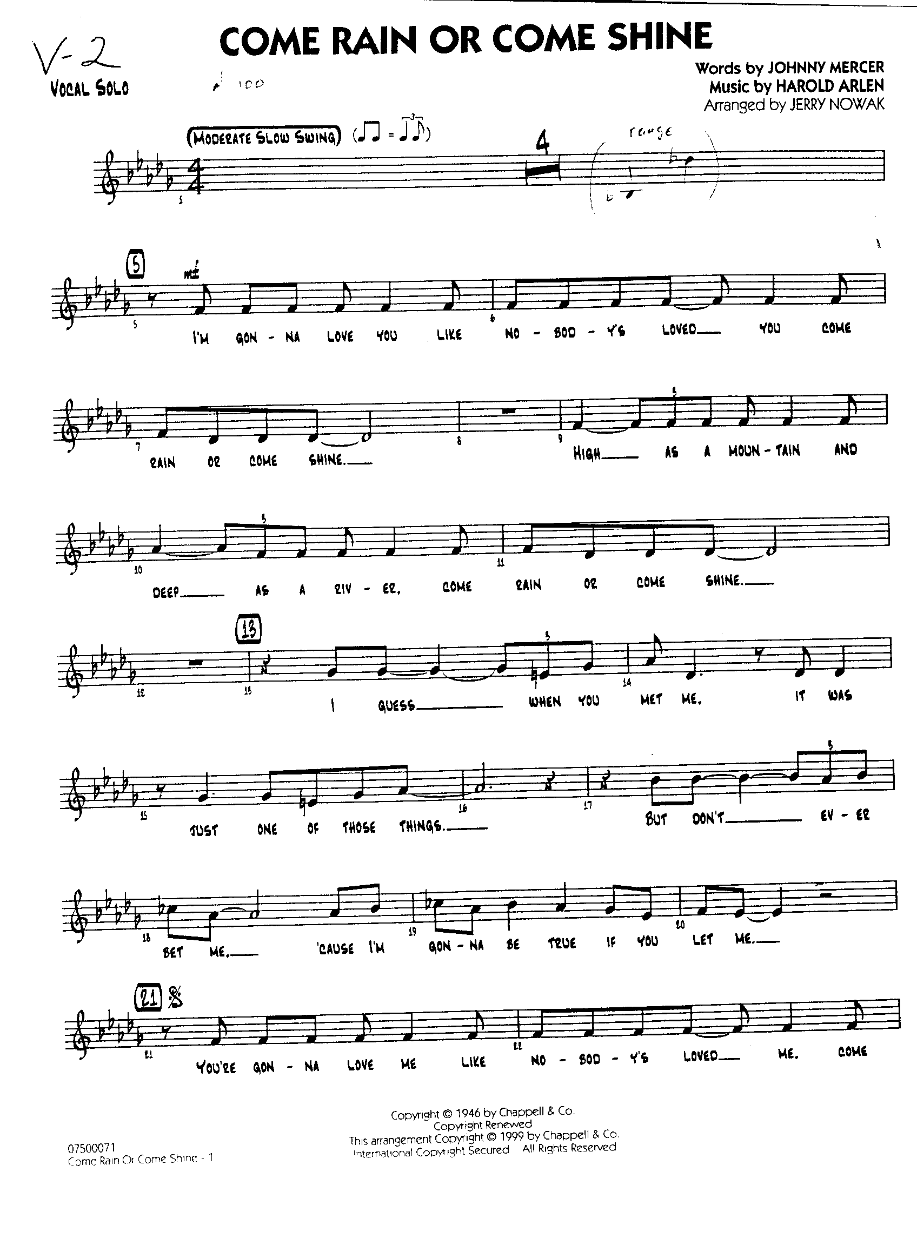
Come Rain Or Come Shine (J.Nowak)
Composed by Harold Arlen
Arranged by J.Nowak
- Ensemble: Big Band Vocal
- Style: Jazz Standard
- Pages: 60
- Difficulty: advanced
- Content: Sheet Music
- Format: PDF Download (Instant)
- Price: $24.99
"Come Rain Or Come Shine," a timeless declaration of unwavering devotion, emerged from the collaborative genius of composer Harold Arlen and lyricist Johnny Mercer. Penned in 1946 for the Broadway musical *St. Louis Woman*, this enduring ballad quickly transcended its theatrical origins to become a cornerstone of the Great American Songbook and a beloved jazz standard. Despite the musical's short run, the song's profound emotional depth and sophisticated harmonic structure resonated deeply, leading to early popular recordings by artists like Margaret Whiting and Helen Forrest & Dick Haymes. Its legacy was further cemented by iconic jazz interpretations from vocalists such as Ella Fitzgerald, Sarah Vaughan, and Frank Sinatra, as well as instrumentalists like Art Blakey and Bill Evans, each adding their unique stamp to its expressive melody and rich changes. This arrangement by J.Nowak captures the song's inherent romanticism within a medium swing tempo, set in a comfortable key for most vocalists. The musical character evokes a sense of heartfelt sincerity and steadfast commitment, balancing moments of tender introspection with powerful declarations. The arrangement maintains the original's poignant mood, allowing the vocalist to convey the emotional narrative of enduring love. Harmonically, the piece navigates through a series of engaging chord progressions, including the signature temporary key changes and ii-V movements that make "Come Rain Or Come Shine" a rewarding challenge for improvisers and an interesting listen for audiences. J.Nowak's distinctive arranging approach is evident in the thoughtful voicings and dynamic interplay between the big band sections, designed to support and elevate the featured vocalist without overpowering them. Expect rich saxophone soli sections that weave intricate counter-melodies, and powerful brass figures that punctuate key lyrical phrases. The arrangement likely features a well-crafted shout chorus, a hallmark of J.Nowak's style, providing an impactful instrumental statement before returning to the vocal. J.Nowak is known for creating arrangements that are both musically sophisticated and highly playable, often incorporating expressive techniques and clear melodic lines that enhance the overall performance. This particular arrangement emphasizes clarity and balance, ensuring that the vocalist remains central while the ensemble contributes a vibrant, swinging backdrop. The melody is primarily carried by the vocalist throughout the A and C sections, with the band offering supportive accompaniment and occasional unison or harmonized lines. A featured instrumental solo, typically for tenor saxophone or trumpet, provides an opportunity for improvisation over the song's compelling chord changes, offering a contrasting texture and showcasing an individual musician. Technical challenges include precise ensemble articulation in the swing figures, maintaining a consistent medium swing feel, and navigating the harmonic shifts during the solo section. The reward lies in the collective experience of performing a truly classic jazz standard with a dynamic big band, allowing both the vocalist and the ensemble to connect deeply with the song's emotional core and deliver a memorable performance. This arrangement is ideally suited for college, community, and professional big bands seeking a sophisticated yet accessible vocal feature. Its detailed scoring and engaging musicality provide ample opportunity for developing ensemble precision and expressive interpretation, making it a valuable addition to any repertoire. The arrangement's balance of challenge and reward makes it appropriate for groups looking to perform a classic jazz standard with authenticity and flair. To achieve an authentic performance of J.Nowak's "Come Rain Or Come Shine," focus on establishing a relaxed yet propulsive medium swing feel from the outset. The rhythm section should lay down a steady, grooving foundation, emphasizing a light ride cymbal pattern and a walking bass line. Articulation is key; brass sections should aim for crisp, unified attacks on accented notes, while saxophones should cultivate a warm, blended sound in soli passages. Pay close attention to dynamics, particularly in supporting the vocalist, ensuring that the band swells and recedes organically. Rehearsal should prioritize balancing the ensemble with the vocal soloist, ensuring the vocalist's phrasing and lyrical intent are always paramount. Encourage expressive phrasing from all sections, particularly in sustained chords and melodic lines, to convey the song's romantic mood. Consider brief, tasteful use of plunger mutes in the trumpet section during specific background figures to add color and texture. Q: What instruments and parts are included in this arrangement? A: This arrangement for big band with vocal includes standard instrumentation: 5 saxophones (2 Alto, 2 Tenor, 1 Baritone), 4 trumpets, 4 trombones, and a full rhythm section (piano, guitar, bass, drums), plus a dedicated vocal lead sheet. Q: What is the difficulty level of this arrangement? A: This arrangement is rated as medium-advanced, suitable for college, community, and professional big bands. It presents challenges in ensemble precision, dynamic control, and harmonic navigation for improvisers. Q: What is the musical style and historical context of "Come Rain Or Come Shine"? A: "Come Rain Or Come Shine" is a classic jazz standard and ballad, originally composed by Harold Arlen for the 1946 Broadway musical *St. Louis Woman*. It represents the golden era of American popular song and has been a staple of jazz repertoire for decades. Q: What makes J.Nowak's arrangement of "Come Rain Or Come Shine" unique? A: J.Nowak's arrangement is distinguished by its sophisticated voicings, dynamic interplay between sections, and a focus on supporting the vocalist while providing engaging instrumental features, including a well-crafted shout chorus, all within a highly playable framework. Q: What is the typical performance duration and tempo of this piece? A: The typical performance duration for this arrangement is approximately 3:30 to 4:30 minutes, depending on the length of the vocal and instrumental solos. It is performed at a medium swing tempo, allowing for expressive phrasing and a comfortable groove.
Musicians Also Search For
Come Rain Or Come Shine J.Nowak PDF • Come Rain Or Come Shine J.Nowak sheet music • Come Rain Or Come Shine arranged by J.Nowak • J.Nowak big band vocal charts • J.Nowak jazz arrangements PDF • Come Rain Or Come Shine Harold Arlen sheet music • Come Rain Or Come Shine Harold Arlen big band vocal arrangement • Harold Arlen big band vocal charts • Come Rain Or Come Shine big band vocal arrangement • Come Rain Or Come Shine big band vocal PDF download • Come Rain Or Come Shine jazz ensemble sheet music • big band vocal sheet music instant download • Come Rain Or Come Shine sheet music with parts • Come Rain Or Come Shine Jazz Standard chart • Jazz Standard big band vocal arrangements • buy Come Rain Or Come Shine sheet music online • download Come Rain Or Come Shine PDF • Come Rain Or Come Shine jazz chart • best J.Nowak big band vocal arrangements • Harold Arlen songs arranged by J.Nowak • Come Rain Or Come Shine printable sheet music • big band vocal repertoire PDF