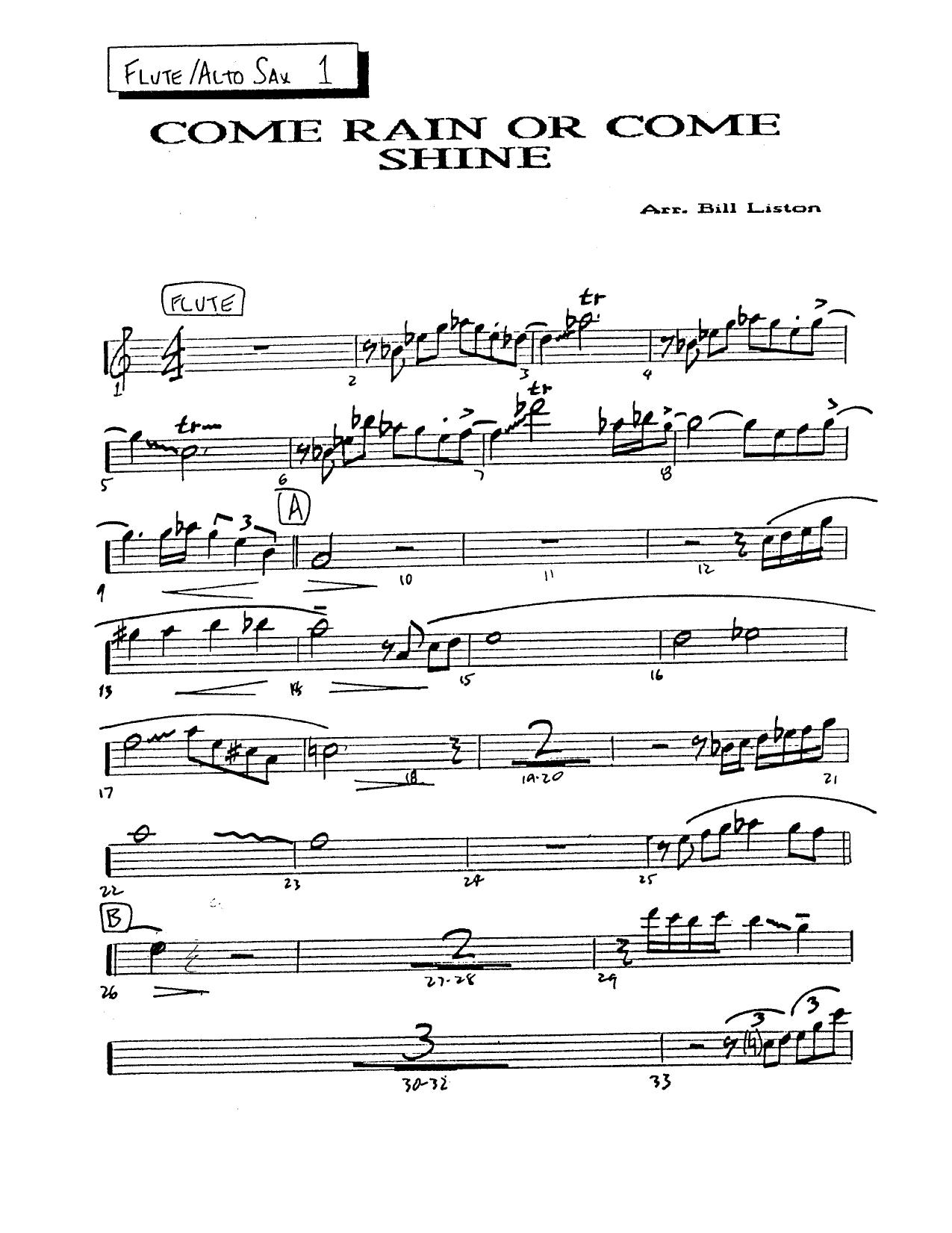
Come Rain Or Come Shine (B.Liston) vocal
Composed by Harold Arlen
Arranged by Bill Liston
- Ensemble: Big Band Vocal
- Style: Jazz Standard
- Pages: 47
- Instruments (16): Flute/Alto Sax 1, Flute/Alto Sax 2, Clarinet/Tenor Sax 1, Clarinet/Tenor Sax 2, Bari Sax/Bass Clarinet, Trumpet 1, Trumpet 2, Trumpet 3, Trumpet 4, Trombone 1, Trombone 2, Trombone 3, Trombone 4 (Bass), Vocal, Master Rhythm (Guitar, Bass, Keyboards), Drums
- Difficulty: medium
- Content: Individual Parts
- Format: PDF Download (Instant)
- Price: $24.99
Harold Arlen and Johnny Mercer’s "Come Rain Or Come Shine" stands as an enduring pillar of the Great American Songbook, first introduced in the 1946 Broadway musical *St. Louis Woman*. This timeless ballad quickly transcended its theatrical origins, becoming a quintessential jazz standard beloved by vocalists and instrumentalists alike. Its lyrical depth, exploring unwavering devotion through life's vicissitudes, combined with Arlen's sophisticated harmonic structure, has cemented its place in the jazz canon. Over the decades, it has been indelibly interpreted by legends such as Frank Sinatra, Judy Garland, Ray Charles, and Sarah Vaughan, each artist bringing their unique vocal artistry to its poignant narrative. The song’s inherent flexibility allows for a wide range of interpretations, from heartfelt ballads to swinging declarations, making it a perennial favorite for both performers and audiences. Bill Liston’s masterful arrangement of "Come Rain Or Come Shine" for big band and vocal soloist presents a vibrant, medium-up swing interpretation, set in the bright key of F Major. This chart immediately captures attention with its energetic yet sophisticated feel, evoking the classic big band era while offering a fresh, contemporary polish. Liston’s signature approach is evident in the rich, carefully voiced brass and saxophone sections, which provide a lush, supportive backdrop for the vocalist without ever overshadowing. The arrangement maintains a consistently uplifting and confident mood, building through dynamic contrasts and expertly crafted ensemble passages. It’s a celebration of the song’s optimistic core, delivered with precision and swing. Liston's treatment of this standard is characterized by several distinctive features that elevate it beyond a mere accompaniment. The arrangement opens with a driving ensemble introduction that sets the medium-up swing tempo, immediately engaging the listener. The melody is primarily carried by the vocal soloist, who is given ample space to interpret the lyrics with nuance. However, Liston interweaves clever ensemble fills and counter-melodies, particularly from the saxophone section, that add depth and interaction. A standout feature is a beautifully constructed saxophone soli section that offers a moment of instrumental brilliance, showcasing the section's blend and articulation. This leads into a powerful, yet controlled, shout chorus that builds excitement before returning to the vocal. The chart concludes with a strong, definitive big band flourish, leaving a lasting impression. This arrangement is ideally suited for college, community, and professional big bands seeking a challenging yet incredibly rewarding vocal feature. The technical demands are moderate to advanced, requiring strong section playing, precise articulation, and a solid understanding of swing rhythm. The brass ranges are accessible for most experienced players, while the saxophone soli requires tight ensemble work. The chart offers significant opportunities for a vocalist to shine, supported by a dynamic and engaging big band. Its blend of classic big band aesthetics with Liston’s arranging prowess makes it a compelling addition to any concert program, guaranteed to be a crowd-pleaser and a joy for musicians to perform. Conductors should aim for a consistent medium-up swing tempo, around 144-152 BPM, ensuring a light yet driving feel. The rhythm section must establish a solid groove from the outset, with the bass providing a walking line and the drums maintaining a crisp ride cymbal pattern. Pay close attention to the dynamic markings; Liston uses them effectively to shape the arrangement's energy, particularly in the build-up to the shout chorus. The saxophone soli requires careful rehearsal to achieve tight unison and precise articulation, emphasizing a unified, flowing sound. Brass players should focus on clean attacks and releases, especially in the punchy ensemble figures. Encourage the vocalist to interpret the lyrics with conviction and swing, using the band's support to enhance their performance. Balance between the vocalist and the ensemble is paramount, ensuring the voice is always prominent without sacrificing the band's power. Q: What instruments and parts are included in this arrangement? A: This arrangement includes parts for a standard big band lineup: 5 saxophones (AATTB), 4 trombones, 4 trumpets, piano, bass, drums, and a vocal soloist. Q: What is the difficulty level of this arrangement? A: This arrangement is rated as Medium-Advanced, suitable for college, advanced community, or professional big bands. It requires solid section playing, good articulation, and a strong rhythm section. Q: What musical style and historical context does this arrangement represent? A: This is a medium-up swing arrangement of the classic jazz standard "Come Rain Or Come Shine," originally from 1946. It embodies the energetic and sophisticated sound of the post-WWII big band era. Q: What makes Bill Liston's arrangement of "Come Rain Or Come Shine" unique? A: Liston's arrangement features a vibrant medium-up swing feel, rich ensemble voicings, a sophisticated saxophone soli, and a powerful shout chorus, all expertly crafted to support and showcase a vocal soloist. Q: What is the approximate performance duration and tempo of this piece? A: The approximate performance duration is 3:30-4:00 minutes, depending on the vocalist's interpretation and any optional solo extensions. The recommended tempo is a medium-up swing, around 144-152 beats per minute.
Questions and answers
- What is included in the Come Rain Or Come Shine (B.Liston) vocal PDF?
- The verified current file contains individual parts across 47 pages.
- How many instruments or parts are listed for Come Rain Or Come Shine (B.Liston) vocal?
- The verified instrumentation list contains 16 entries for this Big Band Vocal arrangement.
- Who is credited for Come Rain Or Come Shine (B.Liston) vocal?
- Composer: Harold Arlen. Arranger: Bill Liston.
- What difficulty is listed for Come Rain Or Come Shine (B.Liston) vocal?
- The verified difficulty level is medium.
- What style is listed for Come Rain Or Come Shine (B.Liston) vocal?
- The catalog lists the style as Jazz Standard.
- Can I preview Come Rain Or Come Shine (B.Liston) vocal before buying?
- Yes. The product page provides a preview generated from the current PDF file.
- How is Come Rain Or Come Shine (B.Liston) vocal delivered?
- After successful payment, the digital PDF is made available for download. The displayed price is $24.99.
Musicians Also Search For
Come Rain Or Come Shine Bill Liston PDF • Come Rain Or Come Shine Bill Liston sheet music • Come Rain Or Come Shine arranged by Bill Liston • Bill Liston big band vocal charts • Bill Liston jazz arrangements PDF • Come Rain Or Come Shine Harold Arlen sheet music • Come Rain Or Come Shine Harold Arlen big band vocal arrangements • Harold Arlen big band vocal charts • Come Rain Or Come Shine big band vocal arrangements • Come Rain Or Come Shine big band vocal PDF download • Come Rain Or Come Shine jazz sheet music • big band vocal sheet music download • Come Rain Or Come Shine individual parts download • Come Rain Or Come Shine sheet music PDF • Come Rain Or Come Shine Jazz Standard charts • Jazz Standard big band vocal arrangements • buy Come Rain Or Come Shine sheet music • download Come Rain Or Come Shine PDF • Come Rain Or Come Shine jazz charts • best Bill Liston big band vocal arrangements • Harold Arlen arranged by Bill Liston • Come Rain Or Come Shine printable sheet music • big band vocal repertoire PDF