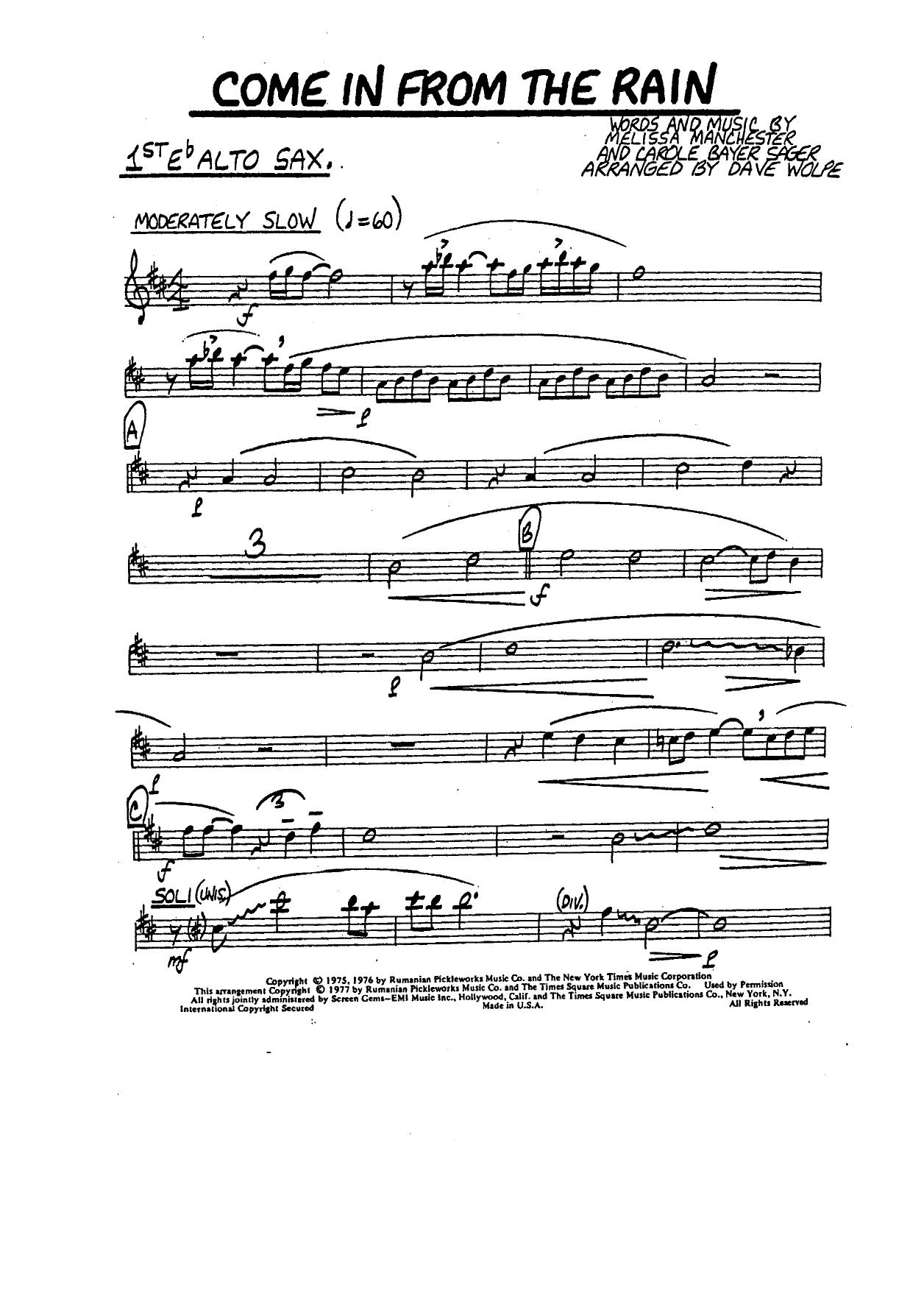
Come In From The Rain (D.Wolpe) sheet music preview

Come In From The Rain (D.Wolpe)

Composed by Carole Bayer Sager

Arranged by Dave Wolpe

  • Ensemble: Big Band
  • Pages: 35
  • Instruments (17): 1st Eb Alto Sax, 2nd Eb Alto Sax, 1st Bb Tenor Sax, 2nd Bb Tenor Sax, Eb Baritone Sax, 1st Bb Trumpet, 2nd Bb Trumpet, 3rd Bb Trumpet, 4th Bb Trumpet, 1st Trombone, 2nd Trombone, 3rd Trombone, Bass Trombone, Piano, Guitar, Bass, Drums
  • Difficulty: medium
  • Content: Individual Parts
  • Format: PDF Download (Instant)
  • Price: $24.99

Originally written in 1975 by Carole Bayer Sager and Melissa Manchester, "Come In From The Rain" emerged as a signature ballad of the mid-1970s pop-soul and adult contemporary landscape, later cemented into the standard repertoire by powerhouse vocalists and instrumental interpreters alike. Melodically rich and emotionally vulnerable, the composition captures a poignant sense of shelter, comfort, and emotional reclamation. Translating this iconic vocal-centric masterpiece into a full big band chart requires a deft hand that understands how to balance lush harmonic voicings with conversational interplay among sections, making it an enduring favorite for jazz ensembles seeking a powerful expressive focal point. Dave Wolpe’s arrangement approaches the material with a warm, flowing ballad or light swing feel that relies heavily on transparent textures and sophisticated chord extensions. Wolpe, renowned for his idiomatic writing for traditional 17-piece big bands, builds the arrangement around rich saxophone solis and delicate brass padding that mimic the gentle, sweeping motion of the original lyric. Rather than relying on high-octane pyrotechnics, the emotional weight is carried by dynamic contouring, subtle rubato pacing within phrases, and lush block-chord voicings that envelop the ensemble in a blanket of sophisticated modern-jazz harmony. The melodic narrative shifts gracefully across the ensemble, utilizing the alto and tenor saxophones to echo the vocal line's pleading lyricism while the brass sections provide warm, muted colorations. While often performed with a featured vocalist, the instrumental lines are inherently vocalized, demanding exquisite breath control and phrasing from every player. The technical challenges lie less in finger dexterity and much more in tone production, intonation during dense harmonic clusters, and maintaining a unified macro-dynamic arc that swells naturally toward the piece’s expressive peaks. Intermediate to advanced high school, college, and community jazz orchestras will find this chart exceptionally rewarding. It serves as an ideal vehicle for teaching stylistic maturity, blend, balance, and lyrical interpretation outside of the standard up-tempo swinger or funk chart. Ensembles performing this work gain a masterclass in dynamic restraint and emotional delivery, ensuring audiences are captivated by the sheer beauty of Wolpe's orchestration. Conducting and performing this arrangement successfully hinges on restraint, careful balance, and breath control. Establish a relaxed, flowing tempo feel right from the downbeat, avoiding any tendency to rush the rubato-leaning transitions. The primary technical challenge for the brass and reed sections is maintaining pristine intonation through Wolpe’s lush, extended jazz voicings, particularly during soft dynamic plateaus. Reeds should focus on a warm, breathy sub-tone approach in the quieter passages to mirror a vocal quality, while the rhythm section must keep the time feel buoyant yet unobtrusive—the piano and guitar should comp sparsely, utilizing modern chord voicings that prioritize color over rhythmic clutter. Drummers should approach the chart with a delicate brush or light stick touch on the ride cymbal, using gentle rimshots and subtle cymbal swells to outline structural phrasing without overpowering the horns. Rehearsal should begin by isolating the chordal harmony choruses independently of the melody to lock in intonation. Work extensively on dynamic shading; ensure that the ensemble's crescendos peak naturally without forcing the tone quality, allowing the rich harmonic layers to bloom organically. Q: What instruments and parts are included in this big band arrangement? A: The chart is scored for a standard 17-piece big band instrumentation, featuring 2 alto saxophones, 2 tenor saxophones, baritone saxophone, 4 trumpets, 4 trombones, piano, guitar, bass, and drumset parts across 35 pages of comprehensive score and parts. Q: What is the difficulty level of this Dave Wolpe chart? A: This arrangement is graded as medium or Grade 3 to 4, making it highly accessible yet musically stimulating for high school, college, and community big bands with solid foundational players. Q: What is the musical style and historical background of the piece? A: Rooted in Carole Bayer Sager and Melissa Manchester's 1975 classic pop-ballad standard, Wolpe's setting transforms the tune into a lush, sophisticated jazz ballad designed for expressive big band performance. Q: What makes this specific arrangement unique? A: Wolpe's distinct approach emphasizes vocal-like phrasing, transparent textures, and sophisticated harmonic extensions that give the horns a rich, choir-like depth uncommon in standard utility big band charts. Q: What is the performance duration and tempo feel of the arrangement? A: The piece is performed at a relaxed, flowing ballad tempo feel, typically running around 3 to 4 minutes depending on the conductor's choice of rubato pacing and expressive breathing room.

Questions and answers

What is included in the Come In From The Rain (D.Wolpe) PDF?
The verified current file contains individual parts across 35 pages.
How many instruments or parts are listed for Come In From The Rain (D.Wolpe)?
The verified instrumentation list contains 17 entries for this Big Band arrangement.
Who is credited for Come In From The Rain (D.Wolpe)?
Composer: Carole Bayer Sager. Arranger: Dave Wolpe.
What difficulty is listed for Come In From The Rain (D.Wolpe)?
The verified difficulty level is medium.
Can I preview Come In From The Rain (D.Wolpe) before buying?
Yes. The product page provides a preview generated from the current PDF file.
How is Come In From The Rain (D.Wolpe) delivered?
After successful payment, the digital PDF is made available for download. The displayed price is $24.99.

Musicians Also Search For

Come In From The Rain Dave Wolpe PDFCome In From The Rain Dave Wolpe sheet musicCome In From The Rain arranged by Dave WolpeDave Wolpe big band chartsDave Wolpe jazz arrangements PDFCome In From The Rain Carole Bayer Sager sheet musicCome In From The Rain Carole Bayer Sager big band arrangementsCarole Bayer Sager big band chartsCome In From The Rain big band arrangementsCome In From The Rain big band PDF downloadCome In From The Rain jazz sheet musicbig band sheet music downloadCome In From The Rain individual parts downloadCome In From The Rain sheet music PDFbuy Come In From The Rain sheet musicdownload Come In From The Rain PDFCome In From The Rain jazz chartsbest Dave Wolpe big band arrangementsCarole Bayer Sager arranged by Dave WolpeCome In From The Rain printable sheet musicbig band repertoire PDF

All arrangements by Dave Wolpe All Carole Bayer Sager sheet music