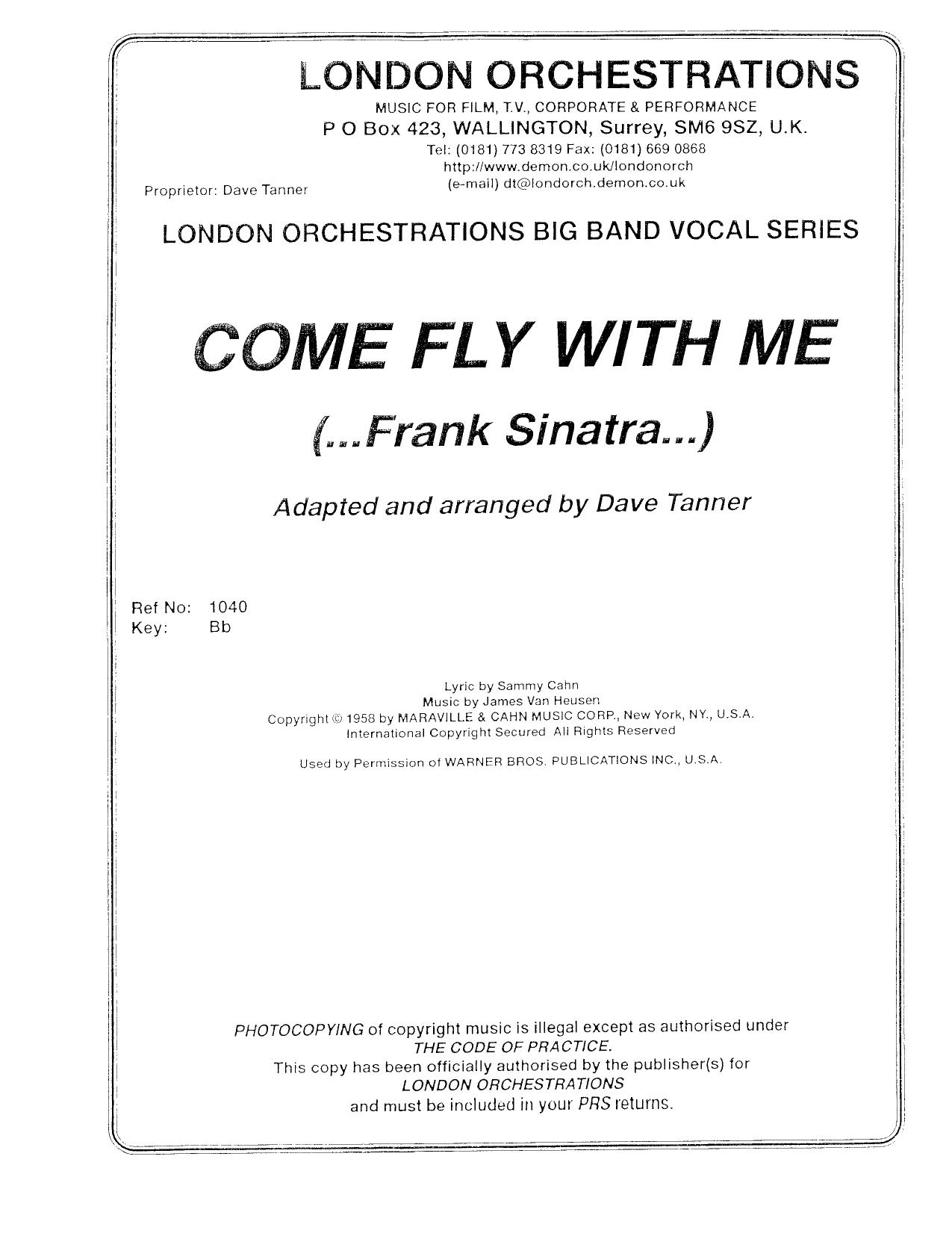
Come Fly Witn Me (F.Sinatra)
Composed by Jimmy Van Heusen
Arranged by Frank Sinatra & Nelson Riddle
- Ensemble: Big Band
- Pages: 45
- Instruments (18): Conductor, Vocal, Alto 1, Alto 2, Tenor 1 / Flute, Tenor 2, Baritone, Trumpet 1, Trumpet 2, Trumpet 3, Trumpet 4, Trombone 1, Trombone 2, Trombone 3 / 4, Piano, Guitar, Bass, Drums
- Difficulty: medium
- Content: Individual Parts
- Format: PDF Download (Instant)
- Price: $24.99
Written by Sammy Cahn and Jimmy Van Heusen, "Come Fly With Me" stands as one of the definitive swinging anthems of the mid-century American popular songbook, famously recorded by Frank Sinatra with definitive arrangements by Nelson Riddle for his 1958 Capitol Records concept album of the same name. This era represents the pinnacle of the sophisticated vocal-jazz idiom, where lush orchestral coloring met driving, high-energy big band swing. The song captures the boundless optimism and jet-set glamour of the late 1950s, urging listeners to cast off routine and embark on a romantic, globetrotting adventure. Its enduring status as a jazz standard rests on its irresistible rhythmic drive, sophisticated harmonic movement, and soaring, adventurous melodic contour. Propelled by an exuberant, bright-tempo medium-swing feel in 4/4 time, the music exudes unbridled optimism, sophistication, and suave swagger. The harmonic language navigates clever modulations and rich major-seventh and extended chord voicings that give the progression a buoyant, lifting sensation. Nelson Riddle’s masterclass in arrangement is instantly recognizable here through his ingenious use of cascading woodwind counterlines, playful brass punches, and a driving rhythm section that mimics the rhythm of a taking-off airplane. Riddle infuses the chart with cinematic flair, balancing delicate, shimmering textures behind the thematic statements with a muscular, brass-heavy shout chorus that builds an incredible wave of kinetic energy. Tailored for a compact 7-instrument ensemble (featuring Alto Saxophone, Tenor Saxophone, Trumpet, Trombone, Piano, Bass, and Drums), this 45-page publication cleverly condenses Riddle's massive full-orchestral canvas into a nimble, punchy chamber-jazz format without sacrificing any of its original punch. The horn parts trade witty countermelodies and tight, harmonized solis that mimic the call-and-response dynamics of a full 17-piece big band. The rhythm section bears a significant responsibility: the pianist must anchor the groove with crisp, comping shell-voicings reminiscent of Bill Miller, while the drummer drives the chart forward with an authentic, feather-light ride cymbal press roll and sharp accents on the bridge. Technical challenges lie primarily in maintaining a precise, unhurried swing subdivision at faster tempos, balancing dynamic contrasts between the lush background figures and punchy ensemble hits, and executing clean articulation across all horns. Advanced high school ensembles, collegiate combos, and professional-grade small big bands will find this arrangement an exceptional vehicle for showcasing stylistic versatility and historical awareness. Performing this chart offers musicians a masterclass in classic Rat Pack phrasing, requiring players to lock in their articulation—specifically the treatment of dotted eighth-sixteenth figures and triplet feels—to capture that authentic Riddle bounce. It serves as a show-stopping program opener or a high-energy centerpiece that demands both technical precision and deep stylistic engagement. Success with this arrangement hinges on achieving an authentic, buoyant medium-swing feel that avoids rushing, even as the excitement builds. The tempo should remain steady and forward-moving, letting the underlying triplet feel drive the rhythm naturally. Horn players must pay close attention to dynamic markings, ensuring that background figures remain supportive and never overpower the primary melodic voice, whether it is carried by the alto or tenor saxophone. Articulation is paramount: treat short notes with a crisp, dry staccato and long notes with a warm, sustained breath support, avoiding excessive heavy accents unless specifically indicated. The piano and bass must lock into a tight, conversational pocket, treating the chordal accompaniment with sparse, rhythmic jabs rather than dense, heavy block chords. Rehearsal time should be dedicated first to isolating the complex interweaving counterlines between the saxophones and brass, ensuring clean intonation and unified phrasing before integrating the full rhythm section groove. Q: What instruments and parts are included in this publication? A: This arrangement is scored for a 7-instrument ensemble, comprising Alto Saxophone, Tenor Saxophone, Trumpet, Trombone, Piano, Bass, and Drums across a comprehensive 45-page score and part set. Q: What is the difficulty level of this chart? A: It is pitched at an advanced level, best suited for skilled high school musicians, collegiate groups, and professional small bands due to its demanding tempo, tight ensemble interplay, and stylistic reading requirements. Q: What is the historical style and background of this piece? A: Rooted in the 1958 Capitol Records recording, it reflects the golden era of vocal jazz and Nelson Riddle’s iconic, swinging arranging style written for Frank Sinatra. Q: What makes this particular arrangement unique? A: It brilliantly condenses a lush, full-orchestral Nelson Riddle masterwork into a nimble 7-piece instrumentation while preserving the signature counterlines, soaring harmonies, and cinematic energy of the original. Q: What is the typical performance duration and tempo feel? A: The arrangement runs approximately 3 minutes and is performed at a bright, energetic medium-swing tempo designed to evoke the swinging jet-set aesthetic of the 1950s.
Questions and answers
- What is included in the Come Fly Witn Me (F.Sinatra) PDF?
- The verified current file contains a conductor score and individual parts across 45 pages.
- How many instruments or parts are listed for Come Fly Witn Me (F.Sinatra)?
- The verified instrumentation list contains 18 entries for this Big Band arrangement.
- Who is credited for Come Fly Witn Me (F.Sinatra)?
- Composer: Jimmy Van Heusen. Arranger: Frank Sinatra & Nelson Riddle.
- What difficulty is listed for Come Fly Witn Me (F.Sinatra)?
- The verified difficulty level is medium.
- Can I preview Come Fly Witn Me (F.Sinatra) before buying?
- Yes. The product page provides a preview generated from the current PDF file.
- How is Come Fly Witn Me (F.Sinatra) delivered?
- After successful payment, the digital PDF is made available for download. The displayed price is $24.99.
Musicians Also Search For
Come Fly Witn Me Frank Sinatra & Nelson Riddle PDF • Come Fly Witn Me Frank Sinatra & Nelson Riddle sheet music • Come Fly Witn Me arranged by Frank Sinatra & Nelson Riddle • Frank Sinatra & Nelson Riddle big band charts • Frank Sinatra & Nelson Riddle jazz arrangements PDF • Come Fly Witn Me Jimmy Van Heusen sheet music • Come Fly Witn Me Jimmy Van Heusen big band arrangements • Jimmy Van Heusen big band charts • Come Fly Witn Me big band arrangements • Come Fly Witn Me big band PDF download • Come Fly Witn Me jazz sheet music • big band sheet music download • Come Fly Witn Me conductor score PDF • Come Fly Witn Me individual parts download • Come Fly Witn Me sheet music PDF • buy Come Fly Witn Me sheet music • download Come Fly Witn Me PDF • Come Fly Witn Me jazz charts • best Frank Sinatra & Nelson Riddle big band arrangements • Jimmy Van Heusen arranged by Frank Sinatra & Nelson Riddle • Come Fly Witn Me printable sheet music • big band repertoire PDF