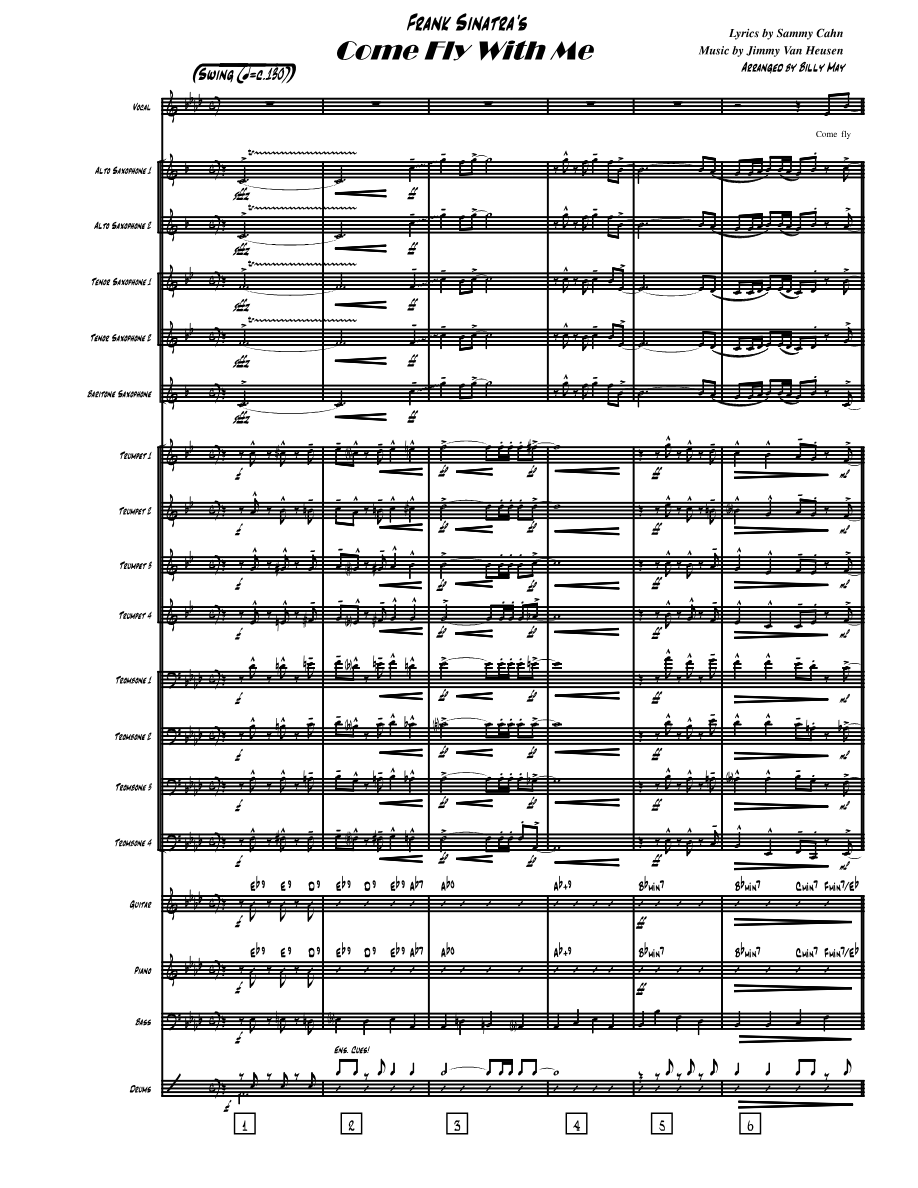
Come Fly With Me (B.May) sheet music preview

Come Fly With Me (B.May)

Composed by Jimmy Van Heusen

Arranged by Billy May

  • Ensemble: Big Band
  • Style: Jazz Standard
  • Pages: 65
  • Instruments (18): Vocal, Alto Saxophone 1, Alto Saxophone 2, Tenor Saxophone 1, Tenor Saxophone 2, Baritone Saxophone, Trumpet 1, Trumpet 2, Trumpet 3, Trumpet 4, Trombone 1, Trombone 2, Trombone 3, Bass Trombone, Guitar, Piano, Bass, Drums
  • Difficulty: advanced
  • Content: Individual Parts
  • Format: PDF Download (Instant)
  • Price: $24.99

"Come Fly With Me," penned by Jimmy Van Heusen with lyrics by Sammy Cahn, debuted in 1957 as the title track for Frank Sinatra's iconic album. This quintessential jazz standard immediately captured the optimistic and adventurous spirit of the post-war era, becoming synonymous with sophisticated travel and the golden age of vocal jazz. Its enduring popularity stems from its infectious melody, engaging harmonic progression, and a narrative that perfectly encapsulates the allure of global exploration and romance. The piece quickly solidified its place in the Great American Songbook, a testament to its timeless appeal and its ability to inspire countless interpretations by jazz luminaries. Billy May's masterful big band arrangement of "Come Fly With Me" captures the song's inherent ebullience with his signature blend of precision, power, and playful swing. Set in a bright, medium-up tempo 4/4 swing feel, this chart immediately establishes a buoyant energy, driven by a crisp rhythm section. May's harmonic language is rich yet accessible, employing his characteristic "slurpy" brass voicings and tight saxophone soli passages that glide effortlessly. The overall mood is one of sophisticated excitement and lighthearted adventure, making it an ideal opener or a vibrant centerpiece for any concert program. The arrangement maintains a consistent, uplifting key, allowing the melody to soar without unnecessary harmonic complexity, while still offering moments of delightful chromaticism. May's distinctive arranging style is evident throughout this 18-instrument chart. The vocal line, the heart of the arrangement, is expertly supported by lush, often sustained, saxophone pads and punctuating brass figures. Soli sections are meticulously crafted, particularly for the saxophones, showcasing May's knack for creating intricate yet cohesive melodic lines within the ensemble. Expect powerful shout choruses where the full band erupts with thrilling, tightly voiced brass figures and driving saxophone lines, providing exhilarating peaks. While there are no extended improvised solo sections, the arrangement often features short, melodic fills and counter-melodies from the lead alto and trumpet, adding flashes of individual brilliance within the ensemble texture. The chart's technical demands are moderate to challenging, requiring strong section playing, precise articulation, and excellent dynamic control to fully realize May's vision. Performing this arrangement is a deeply rewarding experience for a well-rehearsed big band. The melody is predominantly carried by the vocalist, with the ensemble providing dynamic and textural support, often echoing melodic fragments or setting up phrases. Key moments include the tightly voiced brass interjections and the soaring saxophone soli that provide counterpoint to the vocal. The technical challenges lie in achieving the characteristic "May sound"—impeccable blend, precise attacks and releases, and a unified swing feel across all sections. The chart is ideally suited for college-level ensembles and advanced community bands, as well as professional groups seeking an authentic and vibrant big band rendition of this classic. Its clarity and iconic sound make it a fantastic learning tool for understanding classic big band arranging techniques. Conductors should emphasize a consistent, driving medium-up swing feel from the outset, ensuring the rhythm section lays down a solid, unhurried groove. Articulation is paramount; brass players should focus on sharp, precise attacks for short notes and a smooth, connected approach for May's characteristic "slurpy" legato phrases. Saxophone soli sections require meticulous attention to blend and intonation, aiming for a unified, almost vocal quality. Pay close attention to dynamic contrasts, particularly between the vocal line and the ensemble accompaniment, and build intensity gradually towards the shout choruses. While no specific mutes are explicitly called for, a tight, controlled plunger effect on brass interjections can enhance the authentic May sound. Rehearsal time should be dedicated to syncing brass and sax figures, ensuring clean releases, and perfecting the overall ensemble balance to allow the vocalist to shine. Q: What instruments are included in this arrangement? A: This arrangement is scored for an 18-instrument big band, including a Vocal part, Alto Saxophone 1 & 2, Tenor Saxophone 1 & 2, Baritone Saxophone, Trumpet 1-4, Trombone 1-4, Guitar, Piano, Bass, and Drums. Q: What is the difficulty level of this "Come Fly With Me" arrangement? A: This arrangement is considered moderately challenging, suitable for college-level, advanced community, and professional big bands. It requires strong section playing, precise articulation, and a good understanding of swing dynamics. Q: What is the musical style and historical context of this arrangement? A: This is a classic big band jazz standard arrangement in a medium-up swing style, reflecting the sophisticated vocal jazz and big band sound of the late 1950s, particularly associated with Frank Sinatra and Billy May. Q: What makes Billy May's arrangement of "Come Fly With Me" unique? A: Billy May's signature style is evident through his "slurpy" brass voicings, tight saxophone soli sections, powerful shout choruses, and his ability to create a vibrant, cohesive sound that perfectly complements the vocal. Q: What is the typical performance tempo and duration for this piece? A: The arrangement is designed for a bright, medium-up 4/4 swing tempo. The exact duration will vary slightly based on the chosen tempo and any optional vocal ad-libs, but typically ranges from 3 to 4 minutes.

Questions and answers

What is included in the Come Fly With Me (B.May) PDF?
The verified current file contains a conductor score and individual parts across 65 pages.
How many instruments or parts are listed for Come Fly With Me (B.May)?
The verified instrumentation list contains 18 entries for this Big Band arrangement.
Who is credited for Come Fly With Me (B.May)?
Composer: Jimmy Van Heusen. Arranger: Billy May.
What difficulty is listed for Come Fly With Me (B.May)?
The verified difficulty level is advanced.
What style is listed for Come Fly With Me (B.May)?
The catalog lists the style as Jazz Standard.
Can I preview Come Fly With Me (B.May) before buying?
Yes. The product page provides a preview generated from the current PDF file.
How is Come Fly With Me (B.May) delivered?
After successful payment, the digital PDF is made available for download. The displayed price is $24.99.

Musicians Also Search For

Come Fly With Me Billy May PDFCome Fly With Me Billy May sheet musicCome Fly With Me arranged by Billy MayBilly May big band chartsBilly May jazz arrangements PDFCome Fly With Me Jimmy Van Heusen sheet musicCome Fly With Me Jimmy Van Heusen big band arrangementsJimmy Van Heusen big band chartsCome Fly With Me big band arrangementsCome Fly With Me big band PDF downloadCome Fly With Me jazz sheet musicbig band sheet music downloadCome Fly With Me conductor score PDFCome Fly With Me individual parts downloadCome Fly With Me sheet music PDFCome Fly With Me Jazz Standard chartsJazz Standard big band arrangementsbuy Come Fly With Me sheet musicdownload Come Fly With Me PDFCome Fly With Me jazz chartsbest Billy May big band arrangementsJimmy Van Heusen arranged by Billy MayCome Fly With Me printable sheet musicbig band repertoire PDF

All arrangements by Billy May All Jimmy Van Heusen sheet music