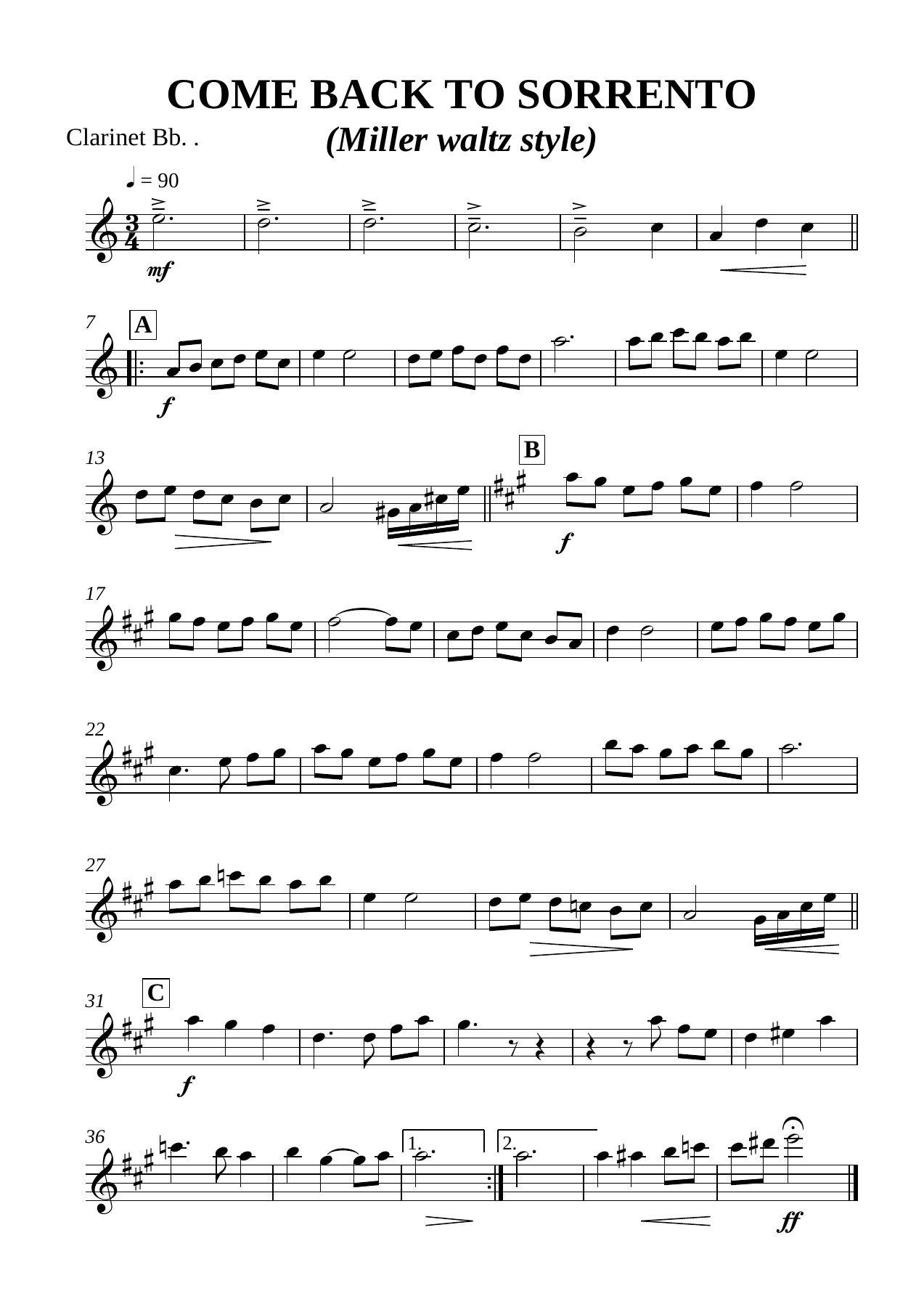
Come Back To Sorrento (G.Miller Style.Waltz (G.Miller)
Composed by Ernesto De Curtis
Arranged by G. Miller
- Ensemble: Big Band
- Style: Waltz
- Pages: 22
- Instruments (17): Clarinet Bb., Alto Sax. 1, Alto Sax. 2, Tenor Sax. 1, Tenor Sax. 2, Trumpet 1, Trumpet 2, Trumpet 3, Trumpet 4, Trombone 1, Trombone 2, Trombone 3, Trombone 4, Electric Guitar, Piano, Bass, Percussion
- Difficulty: medium
- Content: Individual Parts
- Format: PDF Download (Instant)
- Price: $24.99
Ernesto De Curtis's timeless Neapolitan song, "Torna a Surriento" (Come Back To Sorrento), composed in 1902, emerged from the rich tradition of Italian art songs and folk melodies. While not originally a jazz standard, its enduring melodic beauty and harmonic simplicity have made it a favorite for interpretation across various genres, including classical, pop, and, notably, jazz. This particular arrangement, crafted in the distinctive style of G. Miller, reimagines the classic as a sophisticated big band waltz, evoking the golden age of swing orchestras while retaining the original's romantic essence. It bridges the early 20th-century European romanticism with mid-century American big band sophistication, offering a unique perspective on a beloved melody. G. Miller's treatment of "Come Back To Sorrento" is a masterclass in elegant orchestration and stylistic authenticity. The arrangement is set in a medium-slow waltz tempo, typically around quarter note = 108-116 bpm, establishing a graceful, flowing feel from the outset. The key of C minor (with relative E-flat major sections) provides a melancholic yet tender backdrop, perfectly suiting the song's nostalgic lyrics, even without a vocalist. Miller's signature voicings are immediately apparent: lush, close-knit saxophone section harmonies blend seamlessly with powerful, yet controlled, brass punches. The arrangement features a compelling interplay between sections, with the melody often introduced by the lead alto saxophone, then passed to the full saxophone section in a rich soli, and later reinforced by the brass. There are no extended improvised solos in this arrangement, focusing instead on the ensemble's precision and blend, a hallmark of the G. Miller style where the collective sound is paramount. The arrangement's structure is classic big band, featuring a lyrical introduction, several thematic statements, and a dynamic build-up towards a climactic shout chorus. Miller masterfully uses dynamics and articulation to shape the emotional arc of the piece, from tender piano passages to soaring fortissimo declarations. Technical challenges primarily revolve around achieving a unified ensemble sound, precise articulation in the waltz feel, and maintaining consistent intonation within the dense voicings. The brass sections will need strong breath support and control for sustained phrases, while the saxophones must execute intricate soli passages with clarity and blend. The rewarding aspect of performing this piece lies in its inherent musicality and the opportunity for a band to showcase its expressive capabilities and stylistic command of the classic big band waltz. This arrangement is ideally suited for college-level jazz ensembles, advanced community big bands, and professional groups seeking a polished, elegant, and melodically rich addition to their repertoire. While high school bands with strong lead players and a solid understanding of ensemble playing could tackle it, the nuanced dynamics, precise articulation, and harmonic sophistication demand a mature musical approach. Its 22 pages of meticulously scored parts ensure every musician has a significant contribution, making it an engaging and educational piece for developing musicians while offering a satisfying performance for experienced players. Conductors should emphasize a consistent, flowing medium-slow waltz feel (quarter note = 108-116 bpm) throughout, avoiding any tendency to rush or drag. The primary technical challenge lies in achieving unified articulation and precise intonation, particularly in the saxophone solis and brass sustained chords. Encourage brass players to use a warm, broad tone, with controlled vibrato. Saxophones should focus on blending seamlessly within their section and maintaining a lyrical quality. Dynamics are crucial; ensure the band observes the subtle crescendos and decrescendos to shape the phrases effectively. There are no specific mute requirements beyond standard cup and straight mutes for brass, to be used judiciously for color. Rehearsal time should be dedicated to balancing the rich voicings and ensuring the melody always projects clearly, regardless of which section carries it. Q: What instruments are included in this arrangement? A: This arrangement is scored for a standard 17-piece big band: Alto Saxophone 1 & 2, Tenor Saxophone 1 & 2, Baritone Saxophone, Trumpet 1-4, Trombone 1-4, Piano, Bass, and Drums. Q: What is the difficulty level of "Come Back To Sorrento (G.Miller Style.Waltz (G.Miller)"? A: This arrangement is considered advanced intermediate to advanced, suitable for college-level jazz ensembles, advanced community big bands, and professional groups due to its nuanced dynamics, precise articulation demands, and sophisticated voicings. Q: What is the musical style and historical context of this arrangement? A: This is a big band waltz arrangement of Ernesto De Curtis's 1902 Neapolitan song "Torna a Surriento," reimagined in the classic G. Miller style, evoking the elegant swing era of the mid-20th century. Q: What makes this G. Miller arrangement unique compared to other versions of "Come Back To Sorrento"? A: This arrangement stands out for its distinctive G. Miller-style big band waltz treatment, featuring lush, close-voiced saxophone solis, powerful brass sections, and a focus on ensemble precision and blend rather than improvised solos, all within a medium-slow waltz tempo. Q: What is the approximate performance duration and tempo for this piece? A: The approximate performance duration for this arrangement is typically around 3-4 minutes, played at a medium-slow waltz tempo, generally between quarter note = 108-116 bpm.
Questions and answers
- What is included in the Come Back To Sorrento (G.Miller Style.Waltz (G.Miller) PDF?
- The verified current file contains a conductor score and individual parts across 22 pages.
- How many instruments or parts are listed for Come Back To Sorrento (G.Miller Style.Waltz (G.Miller)?
- The verified instrumentation list contains 17 entries for this Big Band arrangement.
- Who is credited for Come Back To Sorrento (G.Miller Style.Waltz (G.Miller)?
- Composer: Ernesto De Curtis. Arranger: G. Miller.
- What difficulty is listed for Come Back To Sorrento (G.Miller Style.Waltz (G.Miller)?
- The verified difficulty level is medium.
- What style is listed for Come Back To Sorrento (G.Miller Style.Waltz (G.Miller)?
- The catalog lists the style as Waltz.
- Can I preview Come Back To Sorrento (G.Miller Style.Waltz (G.Miller) before buying?
- Yes. The product page provides a preview generated from the current PDF file.
- How is Come Back To Sorrento (G.Miller Style.Waltz (G.Miller) delivered?
- After successful payment, the digital PDF is made available for download. The displayed price is $24.99.
Musicians Also Search For
Come Back To Sorrento G. Miller PDF • Come Back To Sorrento G. Miller sheet music • Come Back To Sorrento arranged by G. Miller • G. Miller big band charts • G. Miller jazz arrangements PDF • Come Back To Sorrento Ernesto De Curtis sheet music • Come Back To Sorrento Ernesto De Curtis big band arrangements • Ernesto De Curtis big band charts • Come Back To Sorrento big band arrangements • Come Back To Sorrento big band PDF download • Come Back To Sorrento jazz sheet music • big band sheet music download • Come Back To Sorrento conductor score PDF • Come Back To Sorrento individual parts download • Come Back To Sorrento sheet music PDF • Come Back To Sorrento Waltz charts • Waltz big band arrangements • buy Come Back To Sorrento sheet music • download Come Back To Sorrento PDF • Come Back To Sorrento jazz charts • best G. Miller big band arrangements • Ernesto De Curtis arranged by G. Miller • Come Back To Sorrento printable sheet music • big band repertoire PDF