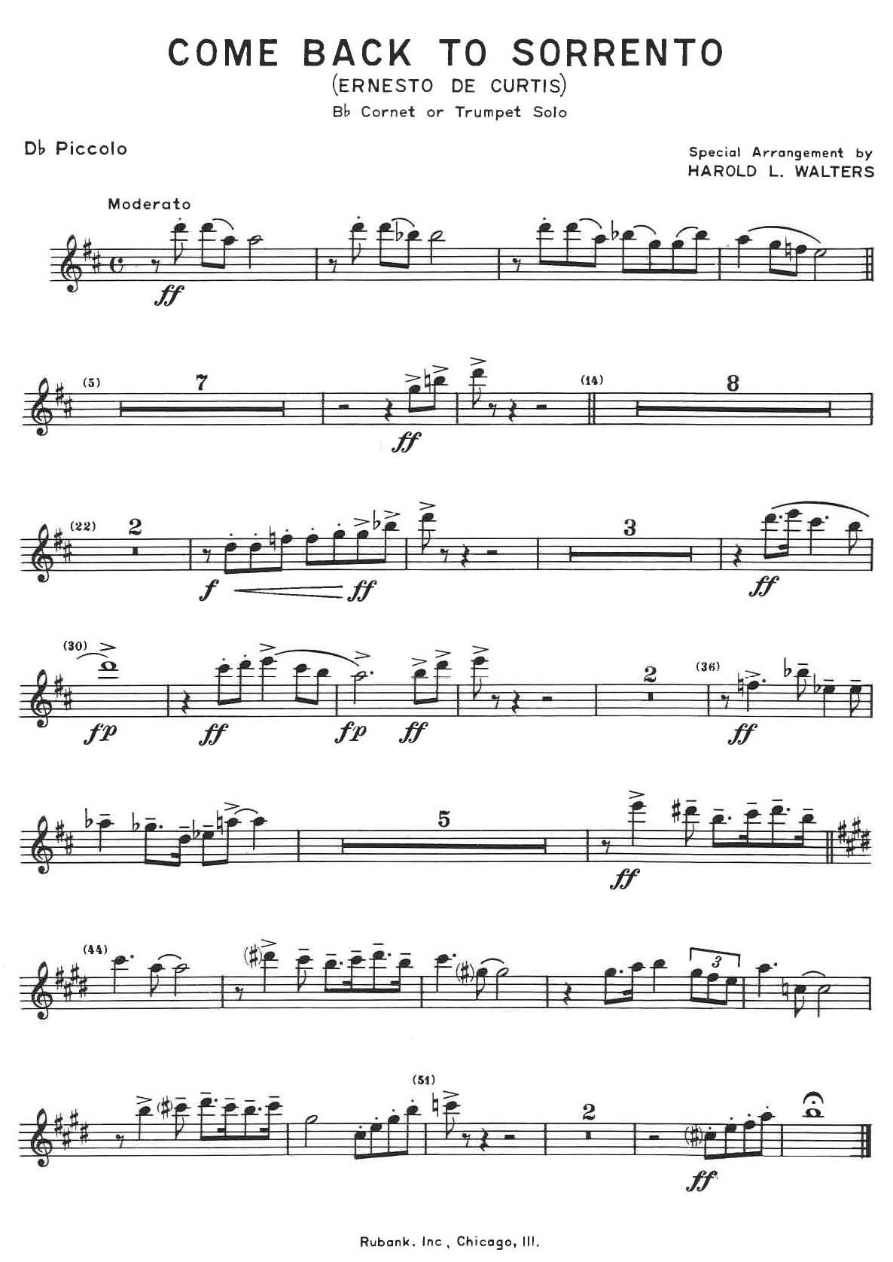
Come Back To Sorrento (Ernesto De Curtis) sheet music preview

Come Back To Sorrento (Ernesto De Curtis)

Composed by Ernesto De Curtis

Arranged by E.D.Curtis

  • Ensemble: Concert Band
  • Pages: 32
  • Instruments (40): Solo Bb Cornet or Trumpet, Db Piccolo, 1st C Flute, 2nd C Flute, C Piccolo, 1st Oboe, 2nd Oboe, Bassoon, String Bass, Eb Clarinet, 1st Bb Clarinet, 2nd Bb Clarinet, 3rd Bb Clarinet, Alto Clarinet, Bass Clarinet, 1st Alto Saxophone, 2nd Alto Saxophone, Tenor Saxophone, Baritone Saxophone, 1st F Horn, 2nd F Horn, 1st Eb Horn, 2nd Eb Horn, 3rd F Horn, 4th F Horn, 3rd Eb Horn, 4th Eb Horn, 1st Bb Cornet (Accompaniment), 2nd Bb Cornet, 3rd Bb Cornet, 1st Trombone, 2nd Trombone, 3rd Trombone, Baritone (Bass Clef), Baritone (Treble Clef), Basses, Drums, Bell Lyra, Vibes, Tympani
  • Difficulty: medium
  • Content: Individual Parts
  • Format: PDF Download (Instant)
  • Price: $22.99

Ernesto De Curtis's timeless Neapolitan song, "Torna a Surriento" (Come Back To Sorrento), composed in 1902, stands as a cornerstone of the Italian classical and popular music canon. Originally penned for a visit by Prime Minister Giuseppe Zanardelli, its poignant melody and romantic lyrics quickly transcended its initial purpose, becoming a global phenomenon. While not inherently a jazz standard, its enduring melodic beauty and harmonic flexibility have made it a frequent subject for interpretation across various genres, including numerous jazz and popular vocal renditions throughout the 20th century. This particular arrangement by E.D.Curtis reimagines this beloved classic through a sophisticated jazz lens, transforming its operatic origins into a vibrant, expressive concert band piece. This E.D.Curtis arrangement unfolds as a medium-slow, lyrical jazz ballad, primarily in the key of G minor, with judicious modulations that add harmonic richness without sacrificing accessibility. The overall mood is one of tender longing and nostalgic beauty, characteristic of the original, but infused with a contemporary jazz sensibility. The piece opens with a delicate, almost ethereal introduction, setting a reflective tone before the iconic melody emerges. E.D.Curtis masterfully employs extended harmonies and subtle rhythmic displacements, lending a sophisticated jazz feel to the familiar lines. The energy builds gradually, moving from introspective passages to moments of lush, full-ensemble voicing, culminating in a powerful yet controlled climax before receding into a serene coda. E.D.Curtis's distinctive approach is evident in the artful reharmonization and intelligent orchestration for concert band. The arranger avoids a literal transcription, instead crafting a coherent jazz narrative. The melody is initially carried by the clarinet, often supported by warm, sustained harmonies in the flutes and oboe, creating a rich, blended timbre. Later, the melody passes to the flute and then to the full woodwind section, showcasing the ensemble's lyrical capabilities. While there isn't a dedicated improvised solo section, E.D.Curtis integrates jazz-inflected counter-melodies and obbligato lines within the ensemble, particularly in the oboe and bass clarinet, which demand expressive playing. The arrangement features intricate inner voice movement and judicious use of dynamic contrasts, requiring careful attention to balance and blend. The technical challenges lie more in achieving a unified jazz articulation and phrasing than in rapid virtuosic passages, making it rewarding for bands focused on musicality and ensemble cohesion. This arrangement is ideally suited for advanced high school, collegiate, and community concert bands. Its demands on expressive playing, nuanced dynamics, and sophisticated harmonic understanding make it an excellent vehicle for developing musical maturity. The blend of familiar melody with fresh jazz harmonies provides an engaging experience for both performers and audiences, offering a unique take on a classical favorite. It challenges musicians to interpret a lyrical line with jazz inflection and to contribute to a cohesive, richly textured soundscape. Conductors should emphasize a medium-slow, expressive tempo, maintaining a consistent pulse without rushing the lyrical lines. The primary challenge lies in achieving a unified jazz articulation and phrasing across the concert band, particularly in the woodwind sections. Encourage players to think "long" and "connected" for melodic phrases, with a slight jazz inflection on eighth notes where appropriate, even in the absence of a strict swing feel. Dynamic contrasts are crucial; observe the subtle crescendos and decrescendos meticulously to build and release tension. Pay close attention to the balance between the melody and supporting harmonic voices, ensuring the main line always sings through. The bass clarinet and bassoon parts provide a foundational warmth and rhythmic anchor, and their blend with the lower brass (if present in the full instrumentation) is vital. Rehearsal time should be dedicated to shaping phrases, achieving precise intonation in the extended harmonies, and ensuring a smooth transition between melodic statements in different sections of the band. No special techniques like plunger mutes or falls are required; focus is on pure, expressive tone and blend. Q: What instruments are included in this arrangement? A: This arrangement is scored for concert band, specifically including Flute, Oboe, Clarinet, Bass Clarinet, and Bassoon, among others, totaling 15 distinct instrumental parts. Q: What is the difficulty level of this arrangement? A: This arrangement is rated as suitable for advanced high school, collegiate, and community concert bands, requiring strong lyrical playing, sophisticated harmonic understanding, and attention to nuanced dynamics. Q: What is the musical style and historical context of "Come Back To Sorrento"? A: "Come Back To Sorrento" is a classic Neapolitan song from 1902 by Ernesto De Curtis. This arrangement reimagines it in a medium-slow, lyrical jazz ballad style for concert band, blending its romantic origins with contemporary jazz harmonies. Q: What makes E.D.Curtis's arrangement of "Come Back To Sorrento" unique? A: E.D.Curtis's arrangement is distinctive for its sophisticated reharmonization, intelligent orchestration for concert band, and its ability to infuse a classic lyrical melody with a contemporary jazz sensibility without resorting to a traditional swing feel or improvised solos. Q: What is the approximate performance duration or tempo of this piece? A: The piece is a medium-slow, lyrical jazz ballad. While exact duration can vary with interpretation, it typically falls within a 4-5 minute performance time.

Questions and answers

What is included in the Come Back To Sorrento (Ernesto De Curtis) PDF?
The verified current file contains individual parts across 32 pages.
How many instruments or parts are listed for Come Back To Sorrento (Ernesto De Curtis)?
The verified instrumentation list contains 40 entries for this Concert Band arrangement.
Who is credited for Come Back To Sorrento (Ernesto De Curtis)?
Composer: Ernesto De Curtis. Arranger: E.D.Curtis.
What difficulty is listed for Come Back To Sorrento (Ernesto De Curtis)?
The verified difficulty level is medium.
Can I preview Come Back To Sorrento (Ernesto De Curtis) before buying?
Yes. The product page provides a preview generated from the current PDF file.
How is Come Back To Sorrento (Ernesto De Curtis) delivered?
After successful payment, the digital PDF is made available for download. The displayed price is $22.99.

Musicians Also Search For

Come Back To Sorrento E.D.Curtis PDFCome Back To Sorrento E.D.Curtis sheet musicCome Back To Sorrento arranged by E.D.CurtisE.D.Curtis concert band chartsE.D.Curtis jazz arrangements PDFCome Back To Sorrento Ernesto De Curtis sheet musicCome Back To Sorrento Ernesto De Curtis concert band arrangementsErnesto De Curtis concert band chartsCome Back To Sorrento concert band arrangementsCome Back To Sorrento concert band PDF downloadCome Back To Sorrento jazz sheet musicconcert band sheet music downloadCome Back To Sorrento individual parts downloadCome Back To Sorrento sheet music PDFbuy Come Back To Sorrento sheet musicdownload Come Back To Sorrento PDFCome Back To Sorrento jazz chartsbest E.D.Curtis concert band arrangementsErnesto De Curtis arranged by E.D.CurtisCome Back To Sorrento printable sheet musicconcert band repertoire PDF

All arrangements by E.D.Curtis All Ernesto De Curtis sheet music