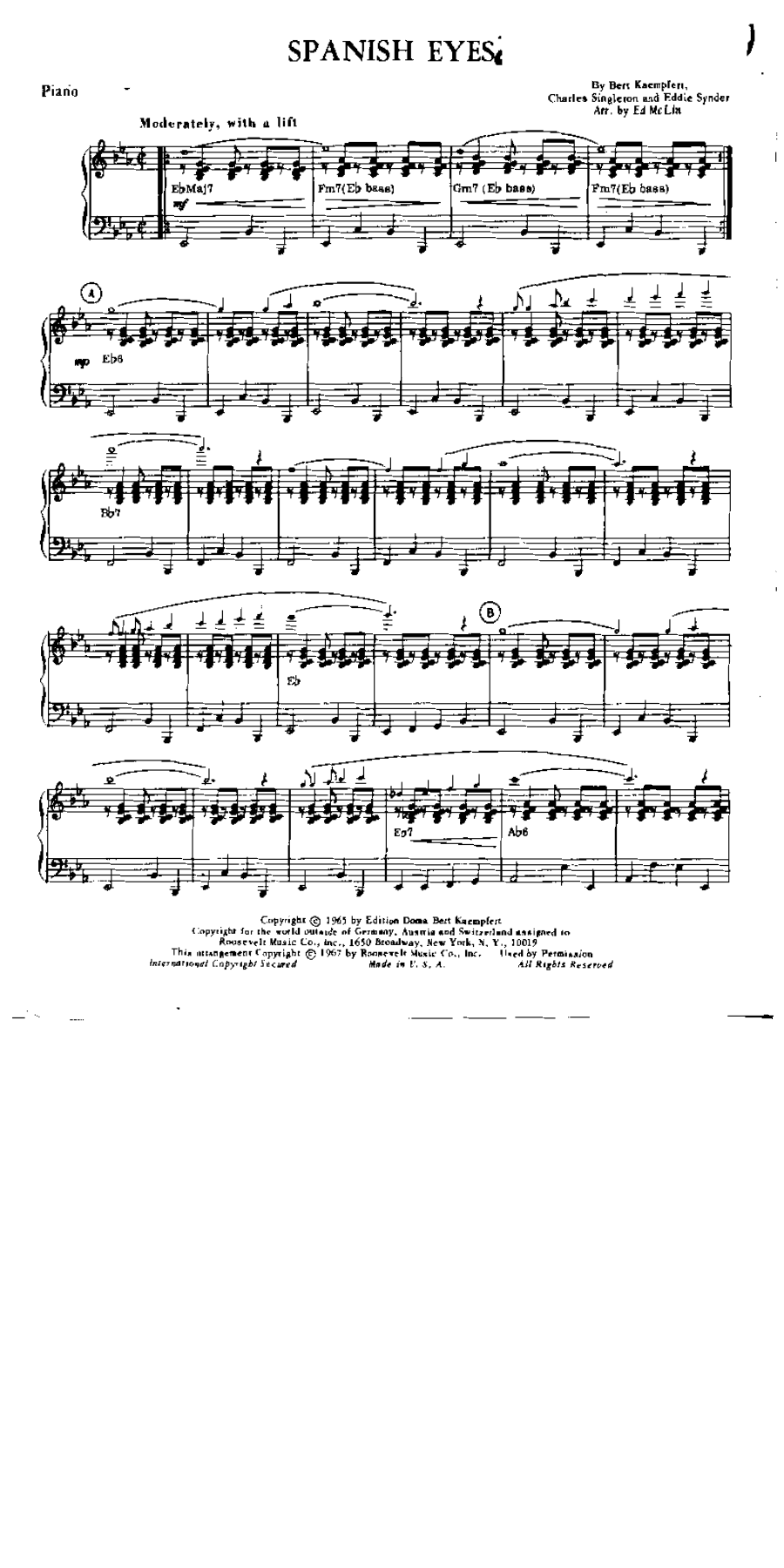
Combo - 6 Horn - Spanish Eyes (E.McLin)
Composed by Bert Kaempfert, Charles Singleton and Eddie Snyder
Arranged by Ed McLin
- Ensemble: Small Ensemble
- Style: Latin Jazz
- Pages: 10
- Difficulty: easy
- Content: Sheet Music
- Format: PDF Download (Instant)
- Price: $12.99
"Spanish Eyes," originally an instrumental titled "Moon Over Naples" composed by Bert Kaempfert, emerged in 1965 as a quintessential piece of the easy listening and pop-jazz era. Kaempfert recorded the instrumental in September 1964 for his album "The Magic Music Of Far Away Places," released in 1965. The addition of romantic lyrics by Charles Singleton and Eddie Snyder transformed it into "Spanish Eyes," famously popularized by Al Martino in late 1965, reaching number 15 on the Billboard Hot 100 and spending four weeks atop the Billboard Easy Listening chart in early 1966. This enduring melody quickly became a global phenomenon, with over 500 recorded versions, solidifying its status as a beloved standard that evokes a sense of romantic longing and exotic allure. The original instrumental, characterized by Kaempfert's distinctive orchestral sound featuring prominent muted trumpets and lush strings, set a sophisticated yet accessible mood that transcended genres. Ed McLin's arrangement for 6 horns masterfully reinterprets this classic, infusing it with a vibrant Latin Jazz sensibility. While retaining the original's romantic core, McLin reimagines the piece with a medium Latin groove, shifting the emotional landscape from a reflective ballad to an engaging, danceable number. The arrangement is set in a comfortable key, likely E minor or A minor to facilitate the Latin feel, allowing for rich harmonic textures without excessive technical demands. McLin's approach is characterized by his ability to blend traditional jazz voicings with the rhythmic complexities of Latin music, creating a sound that is both authentic and fresh. Expect carefully crafted soli sections that highlight the ensemble's blend, punctuated by rhythmic figures that drive the piece forward. This arrangement features the melody gracefully passed between different horn sections, ensuring equitable distribution of melodic interest and providing opportunities for various instruments to shine. There are dedicated sections for improvised solos, typically over a vamp or a modified chord progression, allowing individual musicians to express themselves within the Latin framework. Technical challenges are thoughtfully integrated, focusing on rhythmic precision in the ensemble passages and maintaining a consistent Latin feel throughout. The rewarding aspect of performing this chart lies in its infectious groove and the opportunity to convey both the inherent romance of the original and the energetic pulse of Latin jazz. It's a piece that engages both performers and audiences, creating a memorable musical experience. Designed for small ensembles, this arrangement is particularly well-suited for college, community, and advanced high school jazz bands. Its 6-horn configuration (typically trumpet, alto sax, tenor sax, trombone, baritone sax, and an optional additional horn) provides a full sound without requiring a large big band. The charts are written to be accessible yet challenging enough to foster musical growth, making it an excellent vehicle for developing rhythmic accuracy, ensemble blend, and improvisational skills within the Latin Jazz idiom. The detailed voicings and clear structure make it an ideal choice for groups looking to explore the rich tapestry of Latin-influenced jazz standards. Approaching Ed McLin's "Spanish Eyes" requires a keen focus on rhythmic integrity and stylistic authenticity. The primary technical challenge lies in maintaining a consistent and authentic medium Latin groove, particularly in the rhythm section. Drummers should emphasize a strong cascara or cowbell pattern, while bassists lay down a solid tumbao. Horn players must articulate rhythmic figures precisely, ensuring a unified attack and release, especially in the soli sections. Pay close attention to syncopation, which is crucial for the Latin feel, avoiding a straight eighth-note interpretation. The tempo should be held steadily at a medium pace, allowing the groove to breathe and the melodic lines to sing without feeling rushed. Encourage a relaxed yet energetic feel. No special techniques like plungers or falls are explicitly required, but tasteful use of vibrato and dynamic contrasts will enhance the expressive quality of the piece. Rehearsal tips include isolating rhythmic sections without horns to solidify the rhythm section's foundation, then adding horns to focus on blend and articulation. Emphasize listening across sections to achieve tight ensemble playing, and encourage soloists to immerse themselves in the Latin harmonic and rhythmic language. Q: What instruments/parts are included in this arrangement? A: This arrangement is for a 6-horn combo, typically including trumpet, alto saxophone, tenor saxophone, trombone, baritone saxophone, and one additional flexible horn part, plus a full rhythm section (piano, bass, drums, guitar). Q: What is the difficulty level of this arrangement? A: This arrangement is suitable for college, community, and advanced high school jazz ensembles, offering a rewarding challenge that focuses on rhythmic precision, ensemble blend, and improvisational skills within the Latin Jazz style. Q: What is the musical style and historical context of "Spanish Eyes"? A: This arrangement is in the Latin Jazz style, based on the classic song "Spanish Eyes," which originated as Bert Kaempfert's instrumental "Moon Over Naples" in 1965 and was popularized with lyrics by Al Martino. Q: What makes Ed McLin's arrangement of "Spanish Eyes" unique? A: Ed McLin's arrangement distinguishes itself by transforming the original's romantic ballad feel into an engaging medium Latin groove, featuring distinctive voicings, well-crafted soli sections, and opportunities for improvisation within a 6-horn combo setting. Q: What is the typical performance duration or tempo for this piece? A: The arrangement is designed for a medium Latin groove, which typically translates to a tempo around 120-140 beats per minute, resulting in a performance duration of approximately 3-4 minutes, depending on the length of improvised solos.
Musicians Also Search For
Combo - 6 Horn - Spanish Eyes Ed McLin PDF • Combo - 6 Horn - Spanish Eyes Ed McLin sheet music • Combo - 6 Horn - Spanish Eyes arranged by Ed McLin • Ed McLin small ensemble charts • Ed McLin jazz arrangements PDF • Combo - 6 Horn - Spanish Eyes Bert Kaempfert, Charles Singleton and Eddie Snyder sheet music • Combo - 6 Horn - Spanish Eyes Bert Kaempfert, Charles Singleton and Eddie Snyder small ensemble arrangement • Bert Kaempfert, Charles Singleton and Eddie Snyder small ensemble charts • Combo - 6 Horn - Spanish Eyes small ensemble arrangement • Combo - 6 Horn - Spanish Eyes small ensemble PDF download • Combo - 6 Horn - Spanish Eyes jazz ensemble sheet music • small ensemble sheet music instant download • Combo - 6 Horn - Spanish Eyes sheet music with parts • Combo - 6 Horn - Spanish Eyes Latin Jazz chart • Latin Jazz small ensemble arrangements • buy Combo - 6 Horn - Spanish Eyes sheet music online • download Combo - 6 Horn - Spanish Eyes PDF • Combo - 6 Horn - Spanish Eyes jazz chart • best Ed McLin small ensemble arrangements • Bert Kaempfert, Charles Singleton and Eddie Snyder songs arranged by Ed McLin • Combo - 6 Horn - Spanish Eyes printable sheet music • small ensemble repertoire PDF