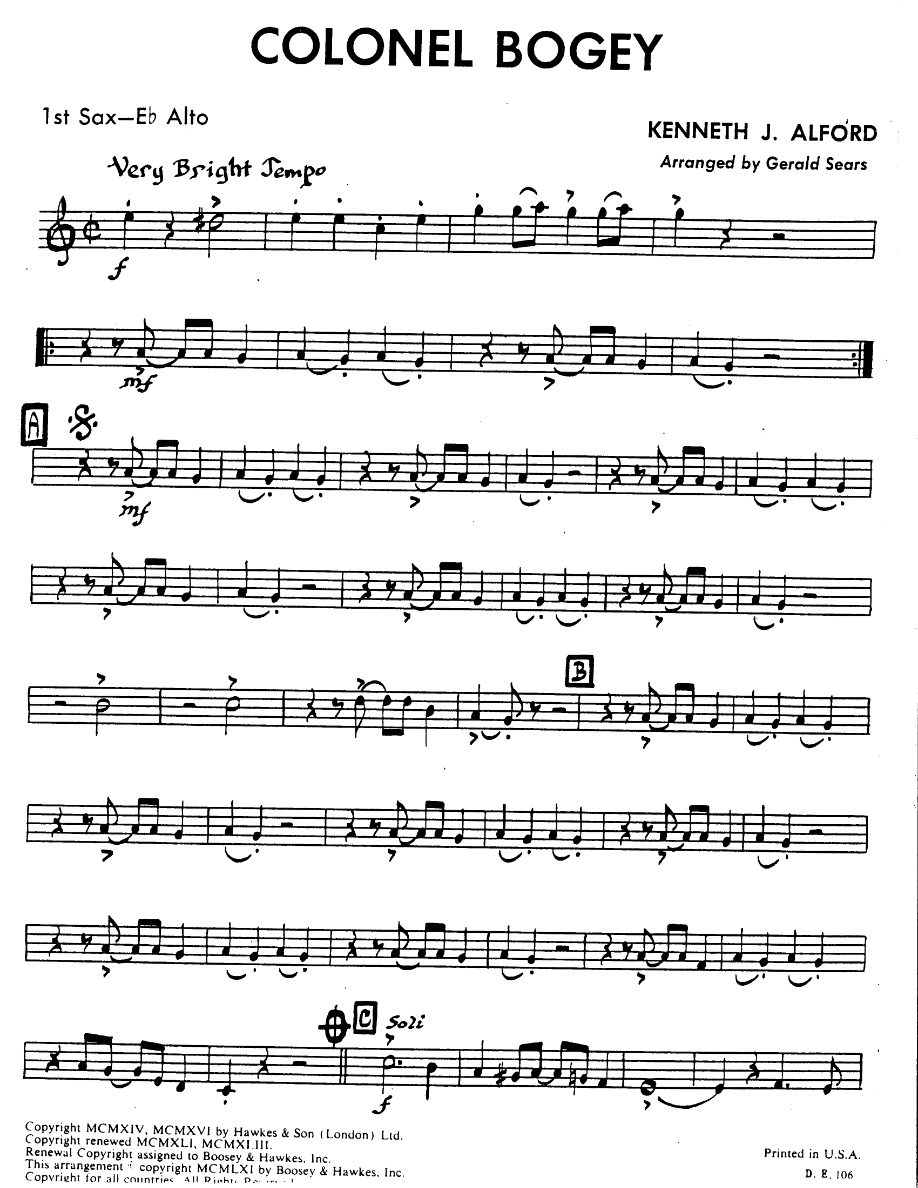
Colonel Bogey (G.Sears)
Composed by Kenneth J. Alford
Arranged by G. Sears
- Ensemble: Big Band Dance
- Style: Jive
- Pages: 36
- Instruments (17): Alto Saxophone 1, Alto Saxophone 2, Tenor Saxophone 1, Tenor Saxophone 2, Baritone Saxophone, Trumpet 1, Trumpet 2, Trumpet 3, Trumpet 4, Trombone 1, Trombone 2, Trombone 3, Bass Trombone, Piano, Bass, Drums, Guitar
- Difficulty: medium
- Content: Individual Parts
- Format: PDF Download (Instant)
- Price: $24.99
Kenneth J. Alford's iconic "Colonel Bogey March," originally composed in 1914, has transcended its military band origins to become a global cultural touchstone. While not a jazz standard in its original form, its memorable melody and rousing spirit made it ripe for reinterpretation across various genres. The march gained immense popular recognition and solidified its place in the public consciousness through its prominent feature in the 1957 film "The Bridge on the River Kwai," where it was famously whistled by Allied prisoners of war. This cinematic association cemented its identity as a symbol of resilience and defiance, imbuing the tune with an emotional weight that extends beyond its martial cadence. G. Sears' arrangement reimagines this familiar melody through the vibrant lens of Jive, a dance-oriented swing style that flourished from the 1930s to the 1950s, characterized by its energetic tempos, syncopated rhythms, and infectious feel. This arrangement of "Colonel Bogey" is a high-octane Jive excursion, set at a brisk tempo that demands precision and enthusiasm from all sections. The musical character is undeniably upbeat and celebratory, designed to evoke the exhilarating energy of a 1940s dance hall. Sears masterfully transforms the march's stately 2/4 feel into a driving 4/4 swing, maintaining the melodic integrity while infusing it with a distinctly rhythmic propulsion. The key of Bb major provides a bright, accessible foundation, allowing the brass to shine with clarity and power. The arrangement's mood is one of joyous exuberance, perfect for setting a lively atmosphere and engaging both performers and audiences with its infectious groove and familiar, yet freshly presented, themes. G. Sears' distinctive arranging style shines through in this treatment, particularly in the clever re-harmonization and rhythmic displacement of the original melody. The piece opens with a punchy, unison brass statement of the main theme, quickly transitioning into a full ensemble swing feel. Sears employs tight, driving soli sections for the saxophones, showcasing their collective agility and precise articulation. The brass sections are given ample opportunity to deliver powerful, sustained chords and accented figures, building dynamic tension. A standout feature is the clever interplay between sections, with call-and-response passages that keep the arrangement dynamically interesting. While there isn't an extended open solo section, the arrangement features brief, impactful improvised breaks for the lead alto saxophone and first trumpet, allowing for individual expression within the tightly structured Jive framework. The arrangement culminates in a powerful shout chorus that brings the entire ensemble together for a thrilling, high-energy finish, solidifying its identity as a true big band showpiece. Performing this arrangement is a rewarding experience for a big band that thrives on precision, energy, and a strong sense of swing. The primary technical challenges lie in maintaining the brisk tempo with rhythmic accuracy, especially in the unison and soli passages, and executing the dynamic contrasts effectively. The brass sections will need strong chops for sustained figures and powerful accents, while the saxophones require clean articulation for the fast soli lines. This arrangement is well-suited for college-level big bands, advanced high school ensembles, and community jazz orchestras looking for a vibrant, audience-pleasing chart that offers both technical challenge and immense musical satisfaction. Its familiar melody, combined with Sears' exciting Jive interpretation, makes it an excellent choice for concerts, dances, and festivals where an energetic and engaging performance is desired. This Jive arrangement of "Colonel Bogey" demands a driving, consistent 4/4 swing feel from the outset. Emphasize a light, buoyant eighth-note feel rather than a heavy, straight swing, especially in the rhythm section. The brisk tempo (circa 180-200 bpm) is crucial for capturing the authentic Jive energy; avoid dragging. Technical challenges include precise articulation in the fast saxophone soli sections and strong, unified brass attacks on accented figures. Conductors should focus on clear cues for dynamic shifts, particularly building into the powerful shout chorus. Encourage the rhythm section to maintain a relentless, yet flexible, groove, allowing the horns to play over the top. The brief improvised breaks for lead alto and first trumpet should be concise and stylistically appropriate, maintaining the high-energy Jive character. Rehearsal time should be dedicated to cleaning up unison rhythms, balancing brass and sax voicings, and ensuring a tight, unified ensemble sound in the climactic sections. Q: What instruments and parts are included in this arrangement? A: This arrangement is scored for a standard 17-piece big band, including Alto Saxophone 1 & 2, Tenor Saxophone 1 & 2, Baritone Saxophone, Trumpet 1-4, Trombone 1-4, Piano, Bass, Drums, and Guitar. Q: What is the difficulty level of "Colonel Bogey (G.Sears)"? A: This arrangement is considered advanced intermediate to advanced. It requires strong rhythmic precision, clean articulation, and good ensemble blend, making it suitable for college-level big bands, advanced high school ensembles, and community jazz orchestras. Q: What is the musical style and historical context of this arrangement? A: This is a Jive arrangement of Kenneth J. Alford's "Colonel Bogey March." It transforms the original 1914 march into an energetic 4/4 swing style popular from the 1930s-1950s, known for its danceable rhythms and upbeat character. Q: What makes G. Sears' arrangement of "Colonel Bogey" unique? A: G. Sears' treatment is distinctive for its high-energy Jive reinterpretation, clever re-harmonization, tight saxophone soli sections, and powerful brass writing, transforming a familiar march into a vibrant big band showpiece with brief improvised breaks. Q: What is the approximate performance duration and recommended tempo for this piece? A: The typical performance duration for this arrangement is approximately 3-4 minutes. It should be performed at a brisk Jive tempo, generally in the range of 180-200 beats per minute, to capture its intended energetic feel.
Musicians Also Search For
Colonel Bogey G. Sears PDF • Colonel Bogey G. Sears sheet music • Colonel Bogey arranged by G. Sears • G. Sears big band dance charts • G. Sears jazz arrangements PDF • Colonel Bogey Kenneth J. Alford sheet music • Colonel Bogey Kenneth J. Alford big band dance arrangement • Kenneth J. Alford big band dance charts • Colonel Bogey big band dance arrangement • Colonel Bogey big band dance PDF download • Colonel Bogey jazz ensemble sheet music • big band dance sheet music instant download • Colonel Bogey individual parts download • Colonel Bogey sheet music with parts • Colonel Bogey Jive chart • Jive big band dance arrangements • buy Colonel Bogey sheet music online • download Colonel Bogey PDF • Colonel Bogey jazz chart • best G. Sears big band dance arrangements • Kenneth J. Alford songs arranged by G. Sears • Colonel Bogey printable sheet music • big band dance repertoire PDF