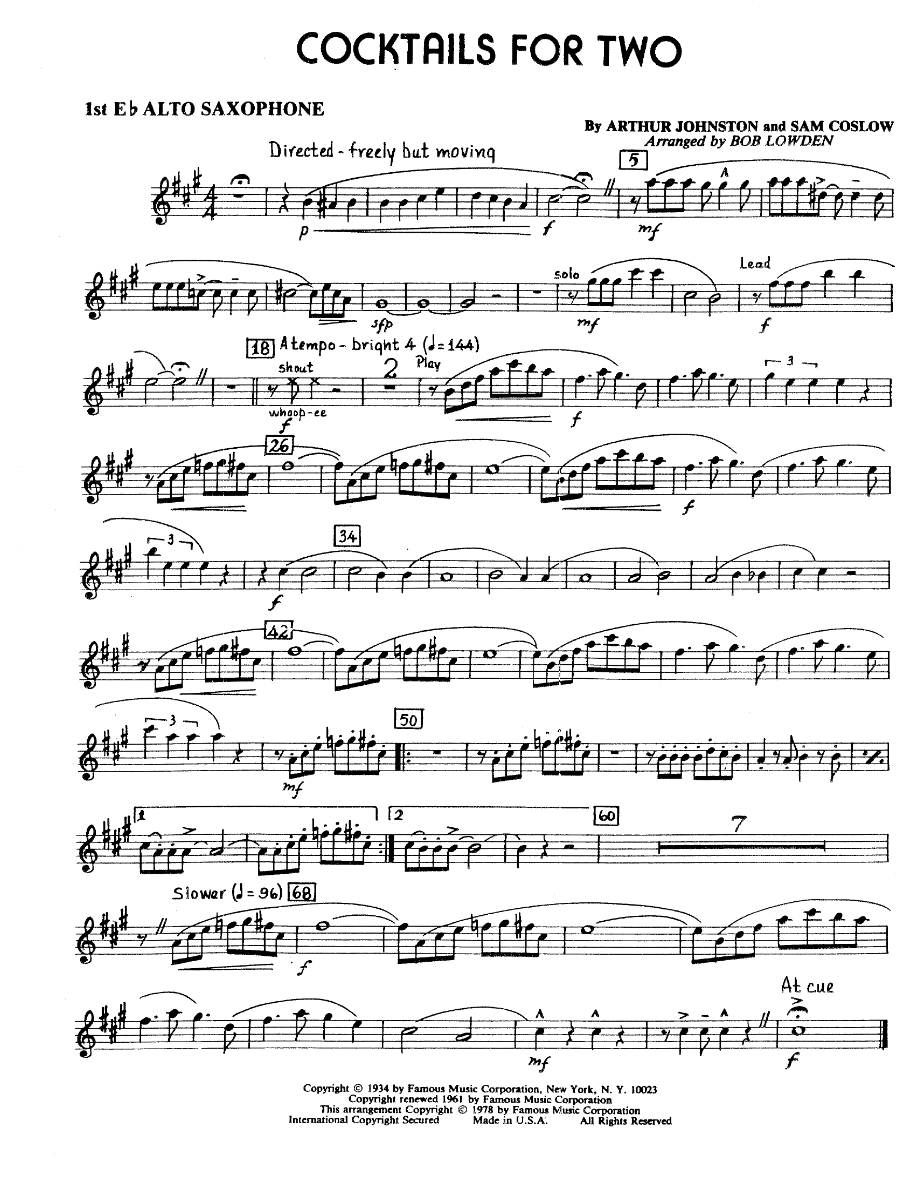
Cocktails For Two (B.Lowden)
Composed by Arthur Johnston
Arranged by Bob Lowden
- Ensemble: Big Band
- Style: Jazz Standard
- Pages: 27
- Instruments (18): 1st Eb Alto Saxophone, 2nd Eb Alto Saxophone, 1st Bb Tenor Saxophone, 2nd Bb Tenor Saxophone, Eb Baritone Saxophone, 1st Bb Trumpet, 2nd Bb Trumpet, 3rd Bb Trumpet, 4th Bb Trumpet, 1st Trombone, 2nd Trombone, 3rd Trombone, 4th Trombone, Drum Set, Sound Effects, Bass, Guitar, Piano
- Difficulty: medium
- Content: Individual Parts
- Format: PDF Download (Instant)
- Price: $24.99
"Cocktails For Two," originally penned by Arthur Johnston with lyrics by Sam Coslow, first captivated audiences in 1934 as part of the film *Murder at the Vanities*. This iconic tune quickly transcended its cinematic origins to become a quintessential jazz standard, emblematic of the sophisticated, often bittersweet, romanticism prevalent in the American Songbook era. Its enduring appeal lies in its elegant melody and harmonic richness, which have made it a favorite for countless vocalists and instrumentalists alike, solidifying its place in the jazz canon. While many associate the song with Spike Jones' comedic 1944 novelty version, its true jazz essence lies in its lush, sentimental character, offering a canvas for intricate harmonic exploration and expressive improvisation. Bob Lowden's big band arrangement of "Cocktails For Two" masterfully reinterprets this classic as a medium swing, 4/4 chart, primarily in the key of F major. The mood is one of sophisticated nostalgia, evoking the golden age of big band jazz with a relaxed yet engaging energy. Lowden's signature approach to big band writing is immediately evident, characterized by his ability to craft arrangements that are both accessible and musically rewarding. He frequently employs rich, often close-voiced, harmonies within the saxophone and brass sections, creating a full and resonant sound that is a hallmark of his style. This particular arrangement showcases his flair for developing melodic lines across the ensemble, ensuring that every section contributes to the overall narrative of the piece. The arrangement opens with a classic big band introduction, setting the medium swing feel before the melody is introduced by the lead alto saxophone, often doubled by the trumpet section for a bright, clear statement. Lowden skillfully alternates between full ensemble voicings and more intimate sectional soli passages, particularly within the saxophone section, which features a beautifully crafted soli that highlights their collective precision and blend. A featured solo opportunity is provided for the tenor saxophone, offering space for melodic improvisation over the standard changes, followed by a dynamically layered shout chorus that builds in intensity, showcasing the full power of the big band. The chart navigates through subtle dynamic shifts and carefully placed accents, culminating in a satisfying full ensemble finish. This arrangement is ideally suited for college-level jazz ensembles, advanced high school bands, and community big bands seeking a sophisticated yet playable chart. Its moderate technical demands, combined with ample opportunities for musical expression and ensemble cohesion, make it an excellent choice for developing a band's swing feel, blend, and dynamic control. The rewarding interplay between sections and the classic big band sound it produces ensure that both performers and audiences will appreciate Lowden's thoughtful treatment of this timeless jazz standard. Conductors should establish a relaxed, medium swing tempo (around quarter note = 120-132 BPM) from the outset, emphasizing a smooth, legato swing eighth-note feel rather than a rushed or overly aggressive approach. Pay close attention to dynamic contrasts, particularly in the soli sections and the build-up to the shout chorus, ensuring a clear distinction between piano and forte passages. The saxophone soli requires precise articulation and blend to achieve Lowden's intended rich harmonic texture. Brass players should focus on warm, controlled tones, especially in the sustained chords, and ensure clean attacks and releases. The tenor saxophone soloist should be encouraged to play melodically and expressively over the changes, maintaining the overall sophisticated mood. Rehearsal time should also be dedicated to the ensemble's rhythmic precision during the shout chorus, ensuring all sections lock into a unified groove and dynamic swell. No special techniques like plunger mutes or doits are explicitly notated, allowing for a focus on fundamental big band execution. Q: What instruments and parts are included in this arrangement? A: This arrangement is scored for a standard 18-piece big band, including Alto Saxophone 1, Alto Saxophone 2, Tenor Saxophone 1, Tenor Saxophone 2, Baritone Saxophone, Trumpet 1, Trumpet 2, Trumpet 3, Trumpet 4, Trombone 1, Trombone 2, Trombone 3, Bass Trombone, Guitar, Piano, Bass, Drums, and a conductor score. Q: What is the difficulty level of "Cocktails For Two (B.Lowden)"? A: This arrangement is considered to be of medium difficulty, suitable for college-level jazz ensembles, advanced high school bands, and community big bands. It presents moderate technical challenges with ample opportunities for musical expression and ensemble development. Q: What is the musical style and historical context of this piece? A: This is a medium swing big band arrangement of "Cocktails For Two," a classic jazz standard from the American Songbook era, originally composed by Arthur Johnston in 1934. It embodies the sophisticated, romantic sound of the 1930s and 40s big band tradition. Q: What makes Bob Lowden's arrangement of "Cocktails For Two" unique? A: Lowden's arrangement is characterized by his rich, often close-voiced harmonies, a beautifully crafted saxophone soli, and a dynamically layered shout chorus. It balances accessibility with musical depth, providing a classic big band sound while offering a fresh interpretation of the standard. Q: What is the typical performance duration and tempo for this arrangement? A: The performance duration typically ranges from 3 to 4 minutes, depending on the tempo and the length of the improvised solo. The recommended tempo is a relaxed medium swing, around 120-132 beats per minute.
Questions and answers
- What is included in the Cocktails For Two (B.Lowden) PDF?
- The verified current file contains a conductor score and individual parts across 27 pages.
- How many instruments or parts are listed for Cocktails For Two (B.Lowden)?
- The verified instrumentation list contains 18 entries for this Big Band arrangement.
- Who is credited for Cocktails For Two (B.Lowden)?
- Composer: Arthur Johnston. Arranger: Bob Lowden.
- What difficulty is listed for Cocktails For Two (B.Lowden)?
- The verified difficulty level is medium.
- What style is listed for Cocktails For Two (B.Lowden)?
- The catalog lists the style as Jazz Standard.
- Can I preview Cocktails For Two (B.Lowden) before buying?
- Yes. The product page provides a preview generated from the current PDF file.
- How is Cocktails For Two (B.Lowden) delivered?
- After successful payment, the digital PDF is made available for download. The displayed price is $24.99.
Musicians Also Search For
Cocktails For Two Bob Lowden PDF • Cocktails For Two Bob Lowden sheet music • Cocktails For Two arranged by Bob Lowden • Bob Lowden big band charts • Bob Lowden jazz arrangements PDF • Cocktails For Two Arthur Johnston sheet music • Cocktails For Two Arthur Johnston big band arrangements • Arthur Johnston big band charts • Cocktails For Two big band arrangements • Cocktails For Two big band PDF download • Cocktails For Two jazz sheet music • big band sheet music download • Cocktails For Two conductor score PDF • Cocktails For Two individual parts download • Cocktails For Two sheet music PDF • Cocktails For Two Jazz Standard charts • Jazz Standard big band arrangements • buy Cocktails For Two sheet music • download Cocktails For Two PDF • Cocktails For Two jazz charts • best Bob Lowden big band arrangements • Arthur Johnston arranged by Bob Lowden • Cocktails For Two printable sheet music • big band repertoire PDF