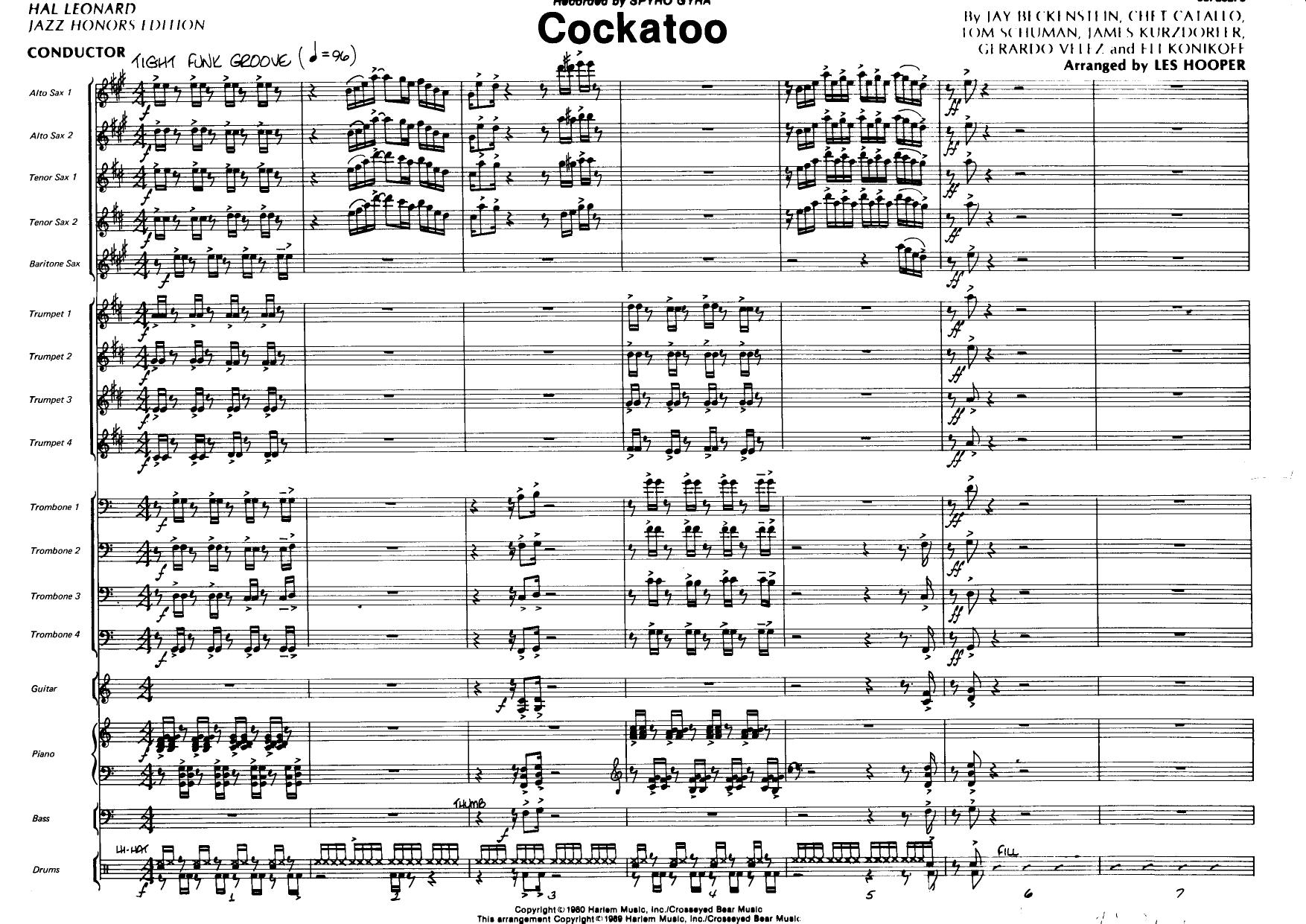
Cockatoo (L.Hooper)
Composed by Les Hooper
Arranged by Les Hooper
- Ensemble: Big Band
- Pages: 43
- Instruments (17): Alto Sax 1, Alto Sax 2, Tenor Sax 1, Tenor Sax 2, Baritone Sax, Trumpet 1, Trumpet 2, Trumpet 3, Trumpet 4, Trombone 1, Trombone 2, Trombone 3, Trombone 4, Guitar, Piano, Bass, Drums
- Difficulty: medium
- Content: Individual Parts
- Format: PDF Download (Instant)
- Price: $24.99
Originating from the sophisticated landscape of late-70s and 1980s contemporary jazz and fusion, "Cockatoo" reflects the vibrant compositional voice of Les Hooper. While fusion monoliths like Spiro Gyra originally popularized high-energy rhythmic motifs of this era, Hooper reinterprets the idiom specifically for the acoustic and electric parameters of the modern big band. This chart captures an era where traditional swing sensibilities merged seamlessly with electric funk, rock-inflected backbeats, and complex harmonic extensions. It stands out in contemporary libraries as a masterclass in translating small-group fusion intricacies into massive, brass-heavy ensemble textures without losing its nimble, avian-inspired lightness and agility. Driven by an infectious, high-octane funk-rock groove, the piece operates at a brisk tempo that demands precision and stamina. The mood is electric, playful, and relentlessly driving, evoking the brilliant colors and sharp movements suggested by its title. Harmonically rich and rhythmically intricate, the chart utilizes crisp syncopation, unexpected chromatic shifts, and layered ostinatos that keep both performers and listeners on the edge of their seats. The dynamic profile is wide, shifting effortlessly from tight, punchy unison lines to soaring, open-air ensemble climaxes that radiate kinetic energy. Hooper’s signature arranging style is stamped across every measure through sophisticated voicings and ingenious distribution of thematic material. Rather than relying on simple block-chord harmonization, the arranger weaves interlocking counterpoint between the saxophones and brass, creating a transparent yet powerful texture. Soli sections are constructed with a linear fluidity characteristic of West Coast contemporary writing, while the shout choruses build vertical density incrementally, layering upper-structure triads over dominant pedal points. The result is a sound that feels both intellectually stimulating and viscerally exciting, showcasing Hooper's trademark gift for modern big band orchestration. Melodic responsibilities are shared dynamically across the entire ensemble, though the woodwinds frequently pilot the rapid, articulated head figures. Featured solo space allows improvisers to stretch out over contemporary modal and funk changes, providing an ideal vehicle for advanced performers. Technical challenges center around the razor-sharp articulation required for rapid sixteenth-note figures, precise control of syncopated ensemble hits, and maintaining a steady, driving groove beneath shifting meters. Advanced high school, collegiate, and professional jazz ensembles will find this 43-page work deeply rewarding, as it pushes section interplay and rhythmic synchronization to exhilarating new heights. Succeeding with this arrangement requires meticulous attention to articulation and subdivision. The tempo must remain relentlessly steady; rhythm section players should lock in a tight, unyielding funk-rock groove where the eighth notes are strictly even rather than swung. Drummers should model their approach on fusion-style playing, utilizing crisp cross-stick patterns on the verses and driving ride-cymbal or open hi-hat energy on the choruses. Brass players must focus on clean, precise attack and release on short accented notes, ensuring that ensemble brass stabs do not clip the underlying rhythm. Saxophones should practice their linear unison passages slowly with a metronome to guarantee immaculate intonation and clean finger technique before ramping up to performance tempo. Conductor focus should center on balancing the interwoven counterpoint lines so that secondary counter-melodies do not obscure the primary thematic material. Encourage soloists to lean into modern pentatonic and altered vocabulary that matches the contemporary harmonic landscape of the chart. Q: What instruments and parts are included in this arrangement? A: The 43-page publication includes a comprehensive full conductor score alongside standard big band instrumentation for 17 instruments, covering Alto Saxophone 1 & 2, Tenor Saxophone 1 & 2, Baritone Saxophone, trumpet and trombone parts, and a full rhythm section. Q: What is the difficulty level of this chart? A: This arrangement is graded as medium-advanced, making it ideal for accomplished high school top bands, university jazz ensembles, and professional or community big bands looking for a technical and stylistic challenge. Q: What musical style and historical era does "Cockatoo" represent? A: Composed in the late 20th century, the piece represents the intersection of jazz-rock fusion and big band funk, drawing stylistic lineage from contemporary instrumental groups of the 1980s. Q: What makes this specific arrangement by Les Hooper unique? A: Hooper uniquely translates intricate fusion-era ostinatos and syncopated grooves into dynamic big band orchestration, utilizing sophisticated contrapuntal lines and transparent brass voicings rather than standard swing block-chords. Q: Does the chart feature solo opportunities and what is its performance profile? A: Yes, the arrangement features dedicated open solo space for ensemble members, coupled with a brisk, high-energy tempo feel designed to drive modern jazz repertoire programs.
Questions and answers
- What is included in the Cockatoo (L.Hooper) PDF?
- The verified current file contains a conductor score and individual parts across 43 pages.
- How many instruments or parts are listed for Cockatoo (L.Hooper)?
- The verified instrumentation list contains 17 entries for this Big Band arrangement.
- Who is credited for Cockatoo (L.Hooper)?
- Composer: Les Hooper. Arranger: Les Hooper.
- What difficulty is listed for Cockatoo (L.Hooper)?
- The verified difficulty level is medium.
- Can I preview Cockatoo (L.Hooper) before buying?
- Yes. The product page provides a preview generated from the current PDF file.
- How is Cockatoo (L.Hooper) delivered?
- After successful payment, the digital PDF is made available for download. The displayed price is $24.99.
Musicians Also Search For
Cockatoo Les Hooper PDF • Cockatoo Les Hooper sheet music • Cockatoo arranged by Les Hooper • Les Hooper big band charts • Les Hooper jazz arrangements PDF • Cockatoo Les Hooper big band arrangements • Cockatoo big band arrangements • Cockatoo big band PDF download • Cockatoo jazz sheet music • big band sheet music download • Cockatoo conductor score PDF • Cockatoo individual parts download • Cockatoo sheet music PDF • buy Cockatoo sheet music • download Cockatoo PDF • Cockatoo jazz charts • best Les Hooper big band arrangements • Cockatoo printable sheet music • big band repertoire PDF