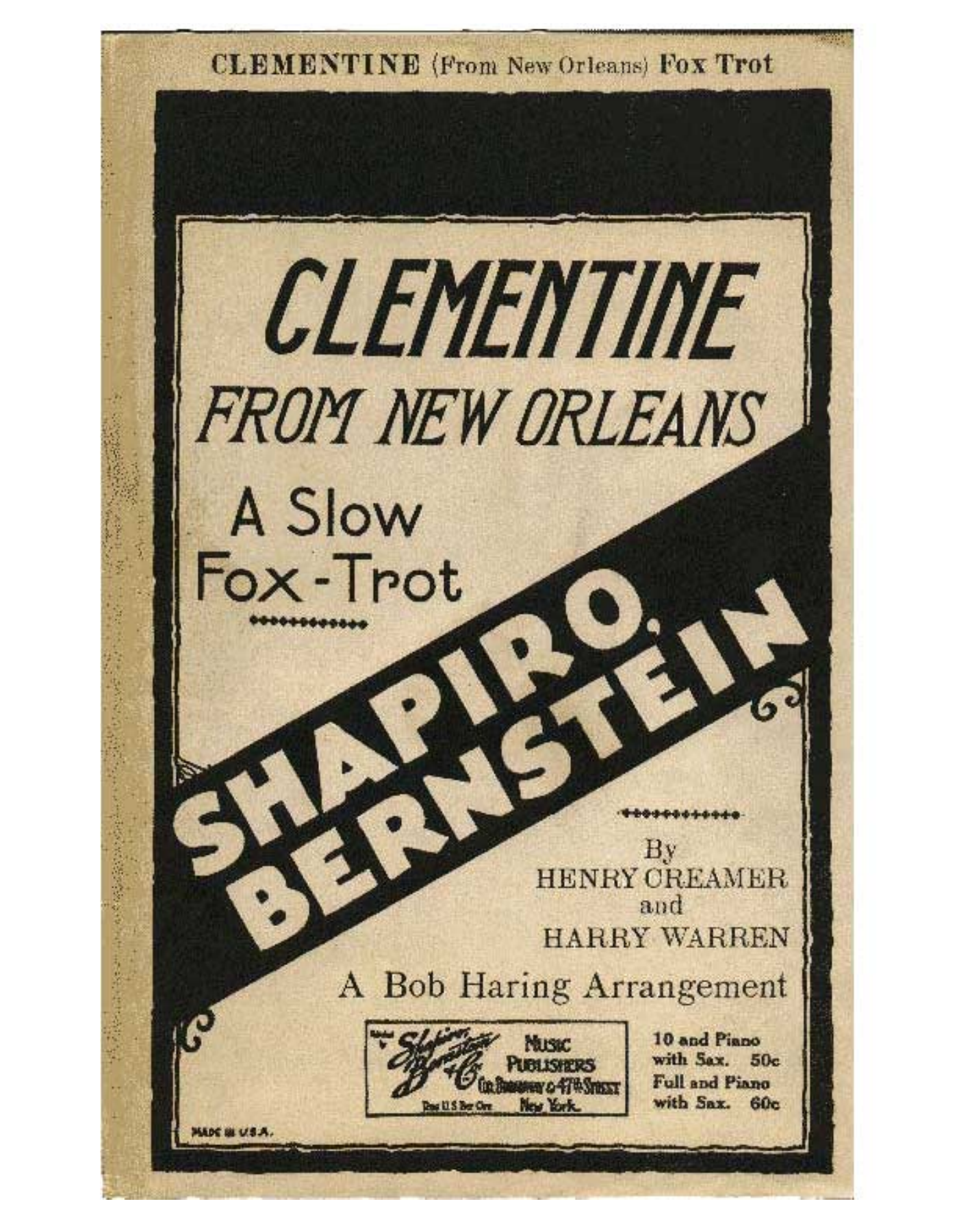
Clementine (B.Haring)
Composed by Percy Montrose
Arranged by B. Haring
- Ensemble: Big Band Dance
- Style: Foxtrot
- Pages: 59
- Instruments (16): 1st Saxophone Eb Alto, 2nd Saxophone Bb Tenor, 3rd Saxophone Eb Alto, 1st Trumpet in Bb, 2nd Bb Trumpet, Trombone, Piano, Banjo, Bass (Tuba), Drums, Flute, 1st Clarinet in Bb, 1st Violin, 2nd Violin, Viola, Cello
- Difficulty: advanced
- Content: Individual Parts
- Format: PDF Download (Instant)
- Price: $24.99
The enduring charm of "Clementine (Oh My Darling, Clementine)" takes on a vibrant new life in B. Haring's masterful foxtrot arrangement for big band. While the original tune, composed by Percy Montrose in 1884, is deeply rooted in American folk tradition, its simple, memorable melody has made it a staple across genres, often appearing in early jazz and dance band repertoires. Haring’s treatment transports this classic into the golden age of big band dance music, evoking the sophisticated yet accessible soundscapes of the 1930s and 40s. This arrangement is a delightful nod to an era when dance halls buzzed with the energy of live orchestras, transforming a familiar folk melody into an elegant, toe-tapping foxtrot. Haring's "Clementine" unfolds at a medium-bright tempo, firmly established in a 4/4 foxtrot feel, typically around 120-130 BPM. The arrangement is primarily in the key of F Major, offering a bright and inviting sonic palette. The mood is one of lighthearted sophistication and gentle swing, perfect for setting a refined yet engaging atmosphere. Haring's signature approach to this style is evident in the meticulous voicings and dynamic contrasts. Expect lush saxophone soli sections that glide effortlessly, punctuated by crisp brass figures. The arrangement cleverly weaves the familiar melody through various sections, ensuring that while the harmonic and rhythmic textures are rich, the core tune remains recognizable and endearing. Distinctive to Haring's writing are the carefully crafted ensemble passages and the judicious use of counterpoint. The opening statement features the melody initially carried by the saxophones, providing a warm and inviting texture. Throughout the piece, Haring employs call-and-response between the brass and reeds, building excitement towards a well-structured shout chorus that showcases the full power of the big band without sacrificing clarity. While there are no explicitly designated improvised solo sections, the arrangement’s character is built on ensemble precision and dynamic control, offering ample opportunity for individual players to shine within their sections. Technical challenges include maintaining a consistent foxtrot groove, accurate articulation in the brass, and seamless blend within the saxophone section. The rewarding aspect lies in achieving a cohesive, polished performance that captures the elegance and buoyancy of the era. This arrangement is ideally suited for college-level big bands, advanced community ensembles, and professional dance orchestras looking for a sophisticated yet accessible piece for their repertoire. Its blend of historical charm, engaging musicality, and well-written parts makes it an excellent choice for concerts, dances, or educational settings where the nuances of classic big band foxtrot can be explored. The 59 pages of meticulously notated parts ensure that every musician has a significant and enjoyable role in bringing this timeless melody to life. Achieving the authentic foxtrot feel for "Clementine" is paramount; aim for a consistent, relaxed 4/4 pulse around 120-130 BPM, emphasizing a smooth, flowing quarter-note feel rather than a driving swing. Articulation in the brass should be crisp but not overly aggressive, with attention to short, detached notes balanced by sustained phrases. The saxophone soli sections require precise blend and intonation to create a unified, warm sound. Conductors should focus on dynamic shaping, particularly in the call-and-response passages, ensuring clear separation between sections. Rehearsal time should be dedicated to balancing the ensemble, especially in the denser shout chorus, and ensuring rhythmic precision across all parts. No special techniques like plunger mutes or falls are explicitly notated, allowing the focus to remain on ensemble clarity and groove. Q: What instruments are included in this arrangement of "Clementine (B.Haring)"? A: This arrangement is scored for a standard 17-piece big band dance ensemble, including Alto Saxophone 1, Alto Saxophone 2, Tenor Saxophone 1, Tenor Saxophone 2, Baritone Saxophone, Trumpet 1, Trumpet 2, Trumpet 3, Trumpet 4, Trombone 1, Trombone 2, Trombone 3, Trombone 4, Piano, Bass, Guitar, and Drums. Q: What is the difficulty level of this arrangement? A: This arrangement is suitable for college-level big bands, advanced community ensembles, and professional dance orchestras. It requires good ensemble precision, dynamic control, and a solid understanding of big band articulation and phrasing. Q: What musical style and historical context does this arrangement represent? A: This is a foxtrot arrangement of the traditional American folk song "Oh My Darling, Clementine," composed by Percy Montrose in 1884. B. Haring's treatment places it firmly in the big band dance music style of the 1930s-1940s, offering a sophisticated yet accessible sound. Q: What makes B. Haring's arrangement of "Clementine" unique? A: Haring's arrangement is distinctive for its elegant foxtrot feel, lush saxophone voicings, crisp brass figures, and well-structured ensemble passages that transform a simple folk melody into a polished big band piece, capturing the charm of a bygone era. Q: What is the typical performance duration or tempo for this piece? A: The arrangement is designed to be played at a medium-bright foxtrot tempo, typically around 120-130 BPM. The exact performance duration will depend on the chosen tempo, but it generally falls into the standard big band chart length of approximately 2.5 to 3.5 minutes.
Questions and answers
- What is included in the Clementine (B.Haring) PDF?
- The verified current file contains a conductor score and individual parts across 59 pages.
- How many instruments or parts are listed for Clementine (B.Haring)?
- The verified instrumentation list contains 16 entries for this Big Band Dance arrangement.
- Who is credited for Clementine (B.Haring)?
- Composer: Percy Montrose. Arranger: B. Haring.
- What difficulty is listed for Clementine (B.Haring)?
- The verified difficulty level is advanced.
- What style is listed for Clementine (B.Haring)?
- The catalog lists the style as Foxtrot.
- Can I preview Clementine (B.Haring) before buying?
- Yes. The product page provides a preview generated from the current PDF file.
- How is Clementine (B.Haring) delivered?
- After successful payment, the digital PDF is made available for download. The displayed price is $24.99.
Musicians Also Search For
Clementine B. Haring PDF • Clementine B. Haring sheet music • Clementine arranged by B. Haring • B. Haring big band dance charts • B. Haring jazz arrangements PDF • Clementine Percy Montrose sheet music • Clementine Percy Montrose big band dance arrangements • Percy Montrose big band dance charts • Clementine big band dance arrangements • Clementine big band dance PDF download • Clementine jazz sheet music • big band dance sheet music download • Clementine conductor score PDF • Clementine individual parts download • Clementine sheet music PDF • Clementine Foxtrot charts • Foxtrot big band dance arrangements • buy Clementine sheet music • download Clementine PDF • Clementine jazz charts • best B. Haring big band dance arrangements • Percy Montrose arranged by B. Haring • Clementine printable sheet music • big band dance repertoire PDF