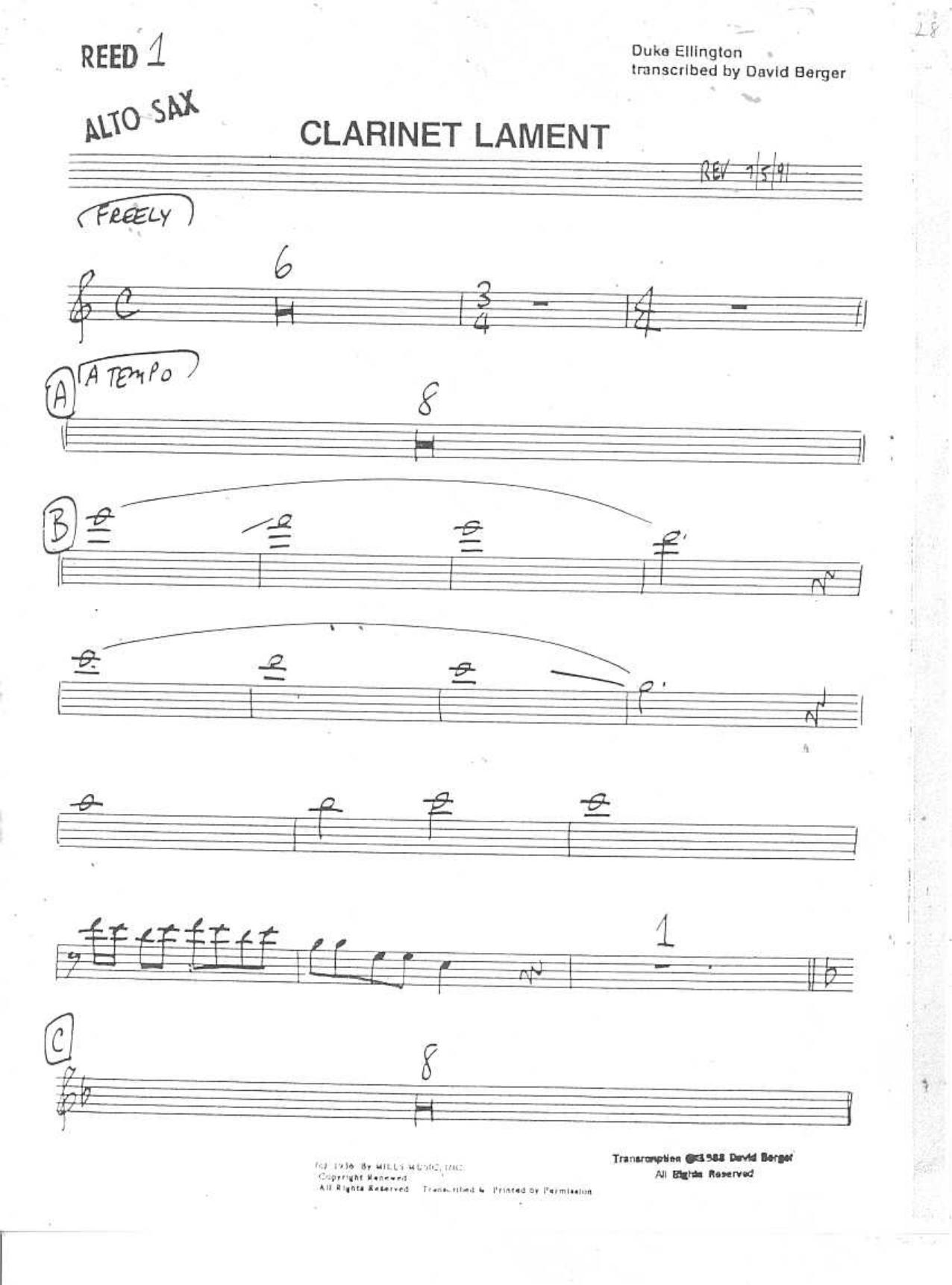
Clarinet Lament (D.Ellington) sheet music preview

Clarinet Lament (D.Ellington)

Composed by Duke Ellington

Arranged by Duke Ellington & B.Strayhorn.D.Berger

  • Ensemble: Big Band
  • Pages: 28
  • Instruments (15): Reed 1 Alto Sax, Reed 2 Alto Sax, Reed 3 Clarinet, Reed 4 Alto Sax, Reed 5 Baritone Sax, Trumpet 1, Trumpet 2, Trumpet 3, Trombone 1, Trombone 2, Trombone 3 (Valve), Piano, Bass, Drums, Guitar
  • Difficulty: medium
  • Content: Individual Parts
  • Format: PDF Download (Instant)
  • Price: $24.99

Duke Ellington’s compositional genius reached its zenith through his lifelong collaboration with Billy Strayhorn and the rich legacy preserved and interpreted by scholars like David Berger. "Clarinet Lament," originally conceived as a vehicle for the incomparable New Orleans-rooted clarinetist Barney Bigard within the classic 1930s Ellington Orchestra, stands as a masterclass in mood, texture, and orchestral color. Emerging from the height of the swing era, this piece breaks away from standard dance-band formulas to explore the intersection of early jazz idioms and sophisticated, modern harmonic voicings. It reflects Ellington's unique philosophy of writing specifically for the distinct tonal personalities of his sidemen, resulting in a composition where the boundary between composed orchestration and spontaneous blues expression dissolves entirely. Evoking a sultry, contemplative atmosphere, this arrangement unfolds at a smoldering, unhurried tempo that allows every nuance of Ellington’s dense harmonic language to breathe. Rooted in a deep, shadowy key center, the mood swings between haunting melancholy and simmering, low-register intensity. The texture is characterized by signature Ellingtonian voicings—often utilizing low-interval clusters, unorthodox saxophone and brass pairings, and eerie, atmospheric flourishes. The energy is restrained yet palpable, building tension not through sheer volume, but through rhythmic suspension, subtle dynamic shading, and the unmistakable, rolling pulse of a heavy, relaxed swing feel. David Berger’s meticulous transcription and adaptation, working from the foundational aesthetics established by Ellington and Strayhorn, captures the exact blueprint of the classic masterwork while optimizing it for modern big bands. The arrangement highlights a 9-instrument core ensemble structure (featuring Alto Sax, Tenor Sax, Baritone Sax, Trumpet, Trombone, and rhythm sections) that retains the transparency and bite of the original 1930s Victor recordings. The melody weaves fluidly through the reed section, demanding absolute stylistic unity, lyrical phrasing, and a mastery of expressive pitch-bending reminiscent of the early jazz masters. Solos are designed to showcase individual improvisational flair over a sophisticated blues form, while the ensemble sections require acute listening to balance the intricate counterpoint and rich, stacked harmonies that define the Ellington-Strayhorn canon. Advanced high school, collegiate, and professional jazz ensembles will find this 28-page arrangement to be an invaluable, highly rewarding addition to their repertoire. Because success relies heavily on stylistic authenticity—specifically the transition between sultry, blues-drenched lyricism and crisp, integrated ensemble swing—it serves as an exceptional pedagogical tool for teaching section blend, jazz articulation, and historical stylistic awareness. Performing this piece challenges musicians to look beyond the printed page, requiring an ensemble-wide commitment to capturing the sultry, dramatic flair that made the Ellington Orchestra the most sophisticated big band in jazz history. Achieving an authentic reading of "Clarinet Lament" requires strict adherence to a relaxed, behind-the-beat medium swing feel. Conductors should emphasize that rhythmic precision does not mean stiffness; the eighth notes must have an easy, conversational bounce, particularly in the rhythm section's foundational groove. The primary technical challenge lies in the reed section's intonation and balance, as the close-harmony voicings require precise tuning to let the overtones ring. Players should utilize subtle vibrato and master the art of dynamic tapering to mimic the vocal qualities of early jazz brass and reeds. Mute usage, where applicable, must be tightly coordinated for maximum textural contrast. Rehearsal time should be heavily invested in isolating the counterpoint lines before assembling the full ensemble, ensuring that background figures never obscure the primary melodic voice. Encourage soloists to study Barney Bigard's original phrasing, focusing on blues inflection, economical note choices, and dramatic space rather than rapid-fire execution. Q: What instruments and parts are included in this arrangement? A: This 28-page chart is scored for a 9-instrument ensemble comprising Alto Saxophone, Tenor Saxophone, Baritone Saxophone, Trumpet, Trombone, and a complete rhythm section, meticulously balanced to recreate the classic Ellington sound. Q: What is the difficulty level of this chart? A: This arrangement is best suited for advanced high school, collegiate, and professional jazz ensembles due to its demands for stylistic authenticity, intricate ensemble blend, and mature phrasing. Q: What is the historical style and context of "Clarinet Lament"? A: Originally written by Duke Ellington to showcase clarinetist Barney Bigard during the 1930s swing era, the piece merges traditional New Orleans jazz roots with sophisticated, modern harmonic structures. Q: What makes this specific arrangement by Ellington, Strayhorn, and Berger unique? A: It combines Ellington and Strayhorn’s timeless compositional framework with David Berger’s authoritative transcription work, offering an authentic yet accessible window into the inner workings of the historic Ellington Orchestra. Q: What is the recommended tempo and performance duration? A: The piece is performed at a sultry, unhurried medium-swing tempo, typically lasting around 3 to 4 minutes depending on the length and number of improvised solos taken.

Questions and answers

What is included in the Clarinet Lament (D.Ellington) PDF?
The verified current file contains individual parts across 28 pages.
How many instruments or parts are listed for Clarinet Lament (D.Ellington)?
The verified instrumentation list contains 15 entries for this Big Band arrangement.
Who is credited for Clarinet Lament (D.Ellington)?
Composer: Duke Ellington. Arranger: Duke Ellington & B.Strayhorn.D.Berger.
What difficulty is listed for Clarinet Lament (D.Ellington)?
The verified difficulty level is medium.
Can I preview Clarinet Lament (D.Ellington) before buying?
Yes. The product page provides a preview generated from the current PDF file.
How is Clarinet Lament (D.Ellington) delivered?
After successful payment, the digital PDF is made available for download. The displayed price is $24.99.

Musicians Also Search For

Clarinet Lament Duke Ellington & B.Strayhorn.D.Berger PDFClarinet Lament Duke Ellington & B.Strayhorn.D.Berger sheet musicClarinet Lament arranged by Duke Ellington & B.Strayhorn.D.BergerDuke Ellington & B.Strayhorn.D.Berger big band chartsDuke Ellington & B.Strayhorn.D.Berger jazz arrangements PDFClarinet Lament Duke Ellington sheet musicClarinet Lament Duke Ellington big band arrangementsDuke Ellington big band chartsClarinet Lament big band arrangementsClarinet Lament big band PDF downloadClarinet Lament jazz sheet musicbig band sheet music downloadClarinet Lament individual parts downloadClarinet Lament sheet music PDFbuy Clarinet Lament sheet musicdownload Clarinet Lament PDFClarinet Lament jazz chartsbest Duke Ellington & B.Strayhorn.D.Berger big band arrangementsDuke Ellington arranged by Duke Ellington & B.Strayhorn.D.BergerClarinet Lament printable sheet musicbig band repertoire PDF

All arrangements by Duke Ellington & B.Strayhorn.D.Berger All Duke Ellington sheet music