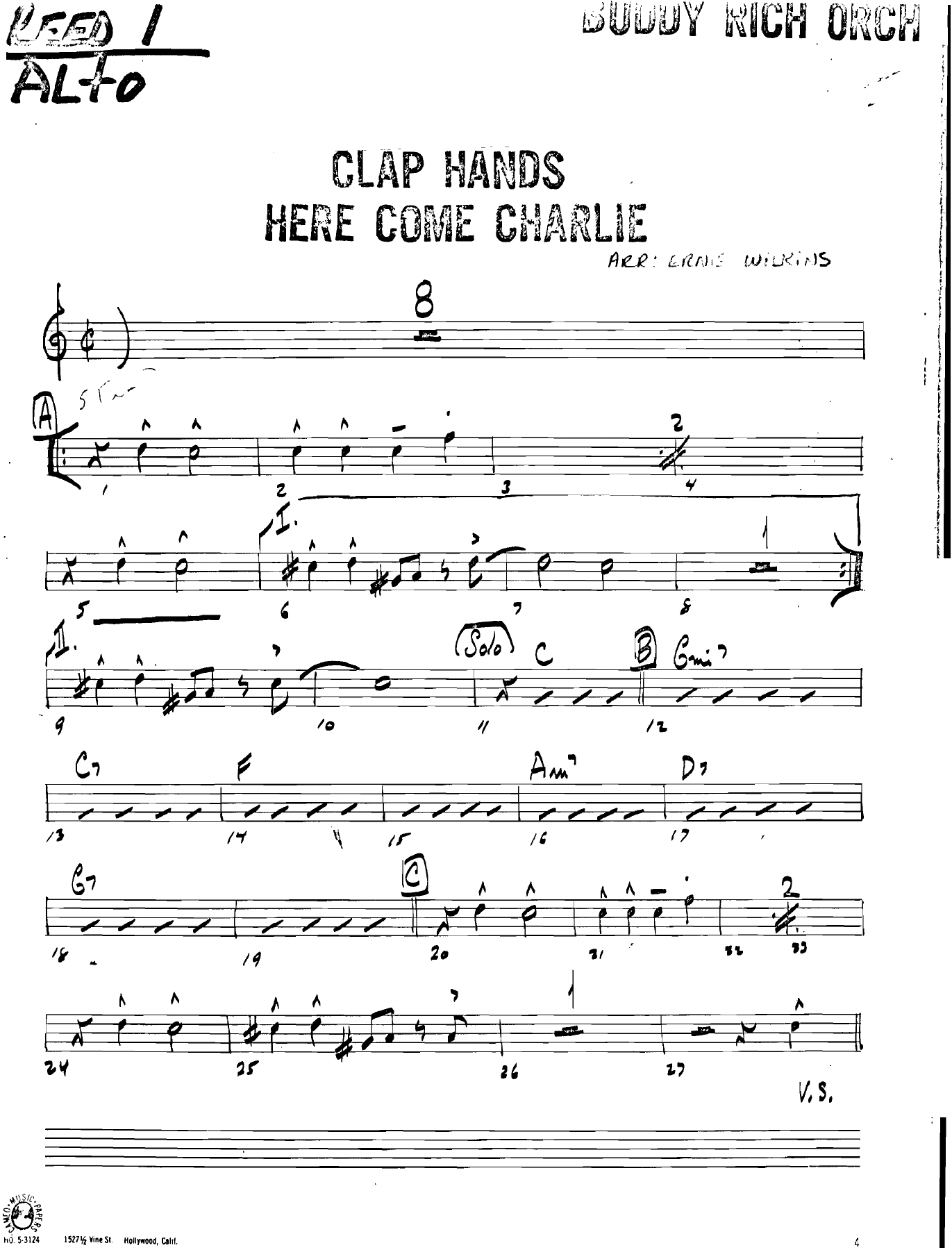
Clap Hands Here Comes Charlie (E.Wilkins)
Composed by Joseph Meyer, Billy Rose, Ballard MacDonald
Arranged by Buddy Rich
- Ensemble: Big Band
- Style: Jazz Standard
- Pages: 51
- Instruments (16): Alto Saxophone 1, Alto Saxophone 2, Tenor Saxophone 1, Tenor Saxophone 2, Baritone Saxophone, Trumpet 1, Trumpet 2, Trumpet 3, Trumpet 4, Trombone 1, Trombone 2, Trombone 3, Piano, Guitar, Bass, Drums
- Difficulty: advanced
- Content: Individual Parts
- Format: PDF Download (Instant)
- Price: $24.99
"Clap Hands Here Comes Charlie," originally penned by Joseph Meyer, Billy Rose, and Ballard MacDonald, emerged from the vibrant Tin Pan Alley era, first published in 1926. While not an immediate jazz standard, its catchy melody and optimistic lyrics made it a popular tune in the swing era, later embraced by jazz luminaries. It gained significant traction through iconic recordings by Ella Fitzgerald, whose effervescent interpretations solidified its place in the jazz canon, showcasing its potential for both vocal and instrumental improvisation. The piece embodies the joyful, often carefree spirit of the 1920s and 30s, characterized by its accessible harmonic structure and memorable melodic lines, making it a perennial favorite for musicians and audiences alike. This particular big band arrangement, attributed to the legendary Buddy Rich, transforms the classic into a dynamic showcase for a full 17-piece ensemble. Rich's approach to "Clap Hands Here Comes Charlie" is unmistakably rooted in the high-energy, precision-driven swing that defined his own formidable orchestra. Expect a medium-up swing tempo, maintaining the original's bright, optimistic mood but infused with Rich's signature intensity and sophisticated rhythmic drive. The arrangement likely features crisp, tightly voiced brass sections, often employing Rich's characteristic block chord voicings that provide a powerful, unified sound. Soli sections for the saxophones are anticipated, demonstrating intricate melodic interplay and technical prowess, while the brass will undoubtedly deliver punchy, articulate figures that propel the ensemble forward. Performance of this arrangement offers a rewarding challenge for a well-rehearsed college or community big band, and is certainly suitable for professional ensembles. The melodic responsibilities are typically shared, with the lead alto saxophone often carrying the initial statement, followed by rich ensemble voicings. Featured solo opportunities are integral, providing space for improvisation over the standard's accessible changes, likely for tenor saxophone or trumpet, allowing individual musicians to shine within the collective power of the band. Technical demands will include precise articulation, dynamic control across the full range of the instruments, and maintaining a consistent, driving swing feel. The true reward lies in executing Rich's intricate ensemble passages with clarity and energy, culminating in a powerful shout chorus that exemplifies the thrilling sound of a cohesive big band. This arrangement is designed to capture the excitement and sophistication inherent in Buddy Rich's musical legacy, making it a standout addition to any big band's repertoire. Conductors should emphasize a consistent, medium-up swing feel from the outset, focusing on a strong rhythmic foundation from the rhythm section to support the intricate horn lines. Key technical challenges include precise articulation in the brass sections, particularly during the fast-moving soli passages and shout choruses, where clarity and unified attacks are paramount. Saxophone soli sections require careful attention to blend and balance, ensuring that the melodic contours are clearly defined. Rehearsal time should be dedicated to isolating these ensemble passages, utilizing rhythmic exercises to achieve tight synchronization. Dynamic contrast is crucial; encourage musicians to play with conviction through the full dynamic range, from subtle piano sections to the full-throttle fortissimo of the shout chorus. While no specific special techniques like plunger mutes are explicitly indicated, encouraging stylistic falls and doits in the brass and saxophones will enhance the authentic big band sound. Q: What instruments and parts are included in this arrangement? A: This arrangement is scored for a standard 17-piece big band, including Alto Saxophone 1, Alto Saxophone 2, Tenor Saxophone 1, Tenor Saxophone 2, Baritone Saxophone, Trumpet 1, Trumpet 2, Trumpet 3, Trumpet 4, Trombone 1, Trombone 2, Trombone 3, Bass Trombone, Piano, Bass, Drums, and Guitar. Q: What is the difficulty level of this arrangement? A: This arrangement is suitable for well-rehearsed college, community, and professional big bands. It presents challenges in terms of precise articulation, dynamic control, and maintaining a consistent, driving swing feel, requiring experienced musicians. Q: What is the musical style and historical context of "Clap Hands Here Comes Charlie"? A: "Clap Hands Here Comes Charlie" is a classic jazz standard from the Tin Pan Alley era (1926), embodying the joyful, optimistic spirit of the 1920s and 30s. This arrangement by Buddy Rich transforms it into a high-energy, precision-driven medium-up swing piece for big band. Q: What makes Buddy Rich's arrangement of "Clap Hands Here Comes Charlie" unique? A: Buddy Rich's distinctive approach is evident in the arrangement's high-energy medium-up swing tempo, tightly voiced brass sections with characteristic block chord voicings, intricate saxophone soli passages, and a powerful, driving shout chorus that reflects his orchestra's signature sound. Q: What is the typical performance duration or tempo for this arrangement? A: While exact duration can vary with improvisation, this arrangement is designed for a medium-up swing tempo, typically resulting in a performance duration of approximately 3 to 5 minutes, depending on the number and length of improvised solos.
Questions and answers
- What is included in the Clap Hands Here Comes Charlie (E.Wilkins) PDF?
- The verified current file contains individual parts across 51 pages.
- How many instruments or parts are listed for Clap Hands Here Comes Charlie (E.Wilkins)?
- The verified instrumentation list contains 16 entries for this Big Band arrangement.
- Who is credited for Clap Hands Here Comes Charlie (E.Wilkins)?
- Composer: Joseph Meyer, Billy Rose, Ballard MacDonald. Arranger: Buddy Rich.
- What difficulty is listed for Clap Hands Here Comes Charlie (E.Wilkins)?
- The verified difficulty level is advanced.
- What style is listed for Clap Hands Here Comes Charlie (E.Wilkins)?
- The catalog lists the style as Jazz Standard.
- Can I preview Clap Hands Here Comes Charlie (E.Wilkins) before buying?
- Yes. The product page provides a preview generated from the current PDF file.
- How is Clap Hands Here Comes Charlie (E.Wilkins) delivered?
- After successful payment, the digital PDF is made available for download. The displayed price is $24.99.
Musicians Also Search For
Clap Hands Here Comes Charlie Buddy Rich PDF • Clap Hands Here Comes Charlie Buddy Rich sheet music • Clap Hands Here Comes Charlie arranged by Buddy Rich • Buddy Rich big band charts • Buddy Rich jazz arrangements PDF • Clap Hands Here Comes Charlie Joseph Meyer, Billy Rose, Ballard MacDonald sheet music • Clap Hands Here Comes Charlie Joseph Meyer, Billy Rose, Ballard MacDonald big band arrangements • Joseph Meyer, Billy Rose, Ballard MacDonald big band charts • Clap Hands Here Comes Charlie big band arrangements • Clap Hands Here Comes Charlie big band PDF download • Clap Hands Here Comes Charlie jazz sheet music • big band sheet music download • Clap Hands Here Comes Charlie individual parts download • Clap Hands Here Comes Charlie sheet music PDF • Clap Hands Here Comes Charlie Jazz Standard charts • Jazz Standard big band arrangements • buy Clap Hands Here Comes Charlie sheet music • download Clap Hands Here Comes Charlie PDF • Clap Hands Here Comes Charlie jazz charts • best Buddy Rich big band arrangements • Joseph Meyer, Billy Rose, Ballard MacDonald arranged by Buddy Rich • Clap Hands Here Comes Charlie printable sheet music • big band repertoire PDF