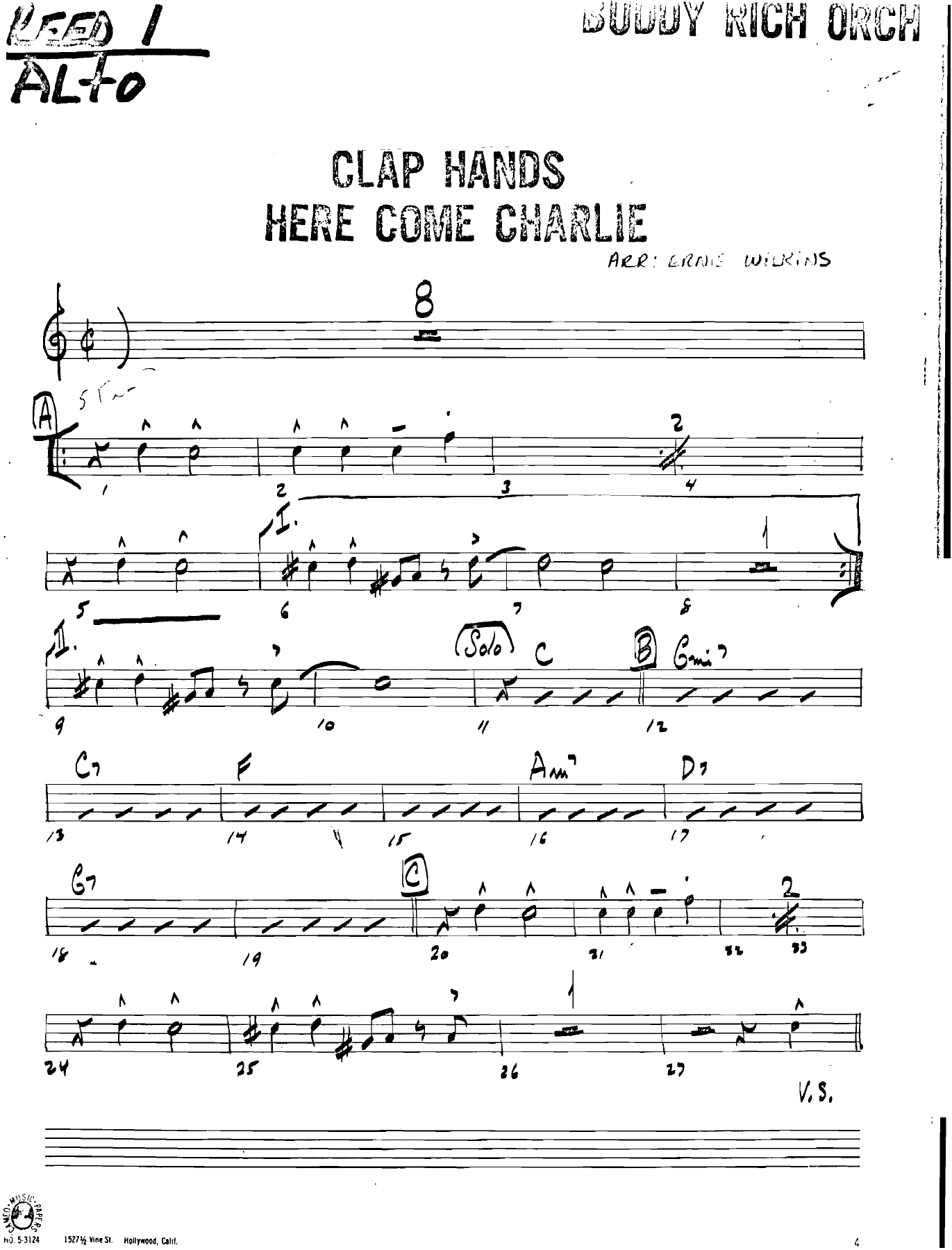
Clap Hands Here Comes Charlie (E.Wilkins)
Composed by Joseph Meyer, Ballard MacDonald, Billy Rose
Arranged by Ernie Wilkins
- Ensemble: Big Band
- Style: Jazz Standard
- Pages: 51
- Instruments (16): Alto Saxophone 1, Alto Saxophone 2, Tenor Saxophone 3, Tenor Saxophone 4, Baritone Saxophone 5, 1st Trumpet, 2nd Trumpet, 3rd Trumpet, 4th Trumpet, 1st Trombone, 2nd Trombone, 3rd Trombone, Piano, Guitar, Bass, Drums
- Difficulty: advanced
- Content: Individual Parts
- Format: PDF Download (Instant)
- Price: $24.99
Emerging from the vibrant songwriting era of the mid-1920s, "Clap Hands Here Comes Charlie" stands as a quintessential artifact of the Swing Era’s transition into the modern big band idiom. Originally composed in 1925 by Joseph Meyer, Ballard MacDonald, and Billy Rose, the tune gained immortal status through the powerhouse recordings of Chick Webb and his Orchestra. However, it was the "New Testament" era of the Count Basie Orchestra that truly redefined the piece for modern ensembles. This specific iteration, crafted by the legendary Ernie Wilkins, captures the sophisticated grit and relentless drive that defined the mid-century jazz landscape, transforming a simple novelty-adjacent melody into a masterclass of rhythmic displacement and ensemble precision. The musical character of this arrangement is defined by an unrelenting, high-octane up-tempo swing feel. Set in a bright 4/4 meter, the piece exudes an infectious, celebratory energy that demands both technical facility and a deep-seated sense of "pocket." While the original song had a lighthearted, almost vaudevillian quality, Wilkins reimagines it as a sophisticated vehicle for section interplay. The mood is one of controlled intensity; it is a high-speed chase through the blues-inflected harmonies of the Kansas City tradition, evoking the atmosphere of a packed ballroom at the Savoy. Ernie Wilkins’ approach to the orchestration is a textbook example of his signature "block" voicing technique and his unparalleled ability to write for the saxophone section. Rather than treating the ensemble as a monolithic block, Wilkins utilizes intricate call-and-response patterns between the brass and reeds, often pitting the trumpets’ rhythmic stabs against the fluid, linear motion of the woodwinds. The arrangement is anchored by a sophisticated sax soli that requires exceptional synchronization and a shared concept of phrasing. Musicians will recognize the "Wilkins touch" in the way he builds the shout chorus—layering harmonic tension and rhythmic density until the ensemble reaches a powerful, resonant climax that showcases the full dynamic range of the 16-piece instrumentation. Performance duties are distributed across the ensemble, though the saxophone section carries a significant portion of the melodic weight during the intricate soli sections. Featured solo space is typically allotted for tenor saxophone and trumpet, providing a platform for improvisers to navigate the changes at a demanding tempo. The primary technical challenges lie in the rhythmic precision of the syncopated figures and the endurance required for the brass players in the upper registers during the final shout. This arrangement is ideally suited for advanced collegiate ensembles and professional big bands. Its complexity and tempo requirements make it a formidable festival piece or a high-impact closer for a concert set, offering a rewarding challenge for musicians who have mastered the nuances of the swing idiom. Navigating this Ernie Wilkins arrangement requires a meticulous balance of speed and relaxation. The tempo should be established at a bright swing (quarter note = 220+ BPM), but conductors must ensure the rhythm section maintains a "laid-back" feel within that speed to avoid a frantic performance. The saxophone section should prioritize unified articulation in the soli sections, focusing on the "weight" of the swing eighth notes rather than just the speed. Brass players should approach the rhythmic punches with a crisp, "fat" attack, ensuring that falls and doits are executed with uniform length and intensity. Rehearsal time should be dedicated to the transition into the shout chorus, where the ensemble must maintain pitch center despite the increasing volume and harmonic density. Encourage the drummer to drive the ensemble with a strong "four-on-the-floor" bass drum pulse and consistent hi-hat "chick" to anchor the syncopated horn lines. Q: What is the specific instrumentation required for this Ernie Wilkins arrangement? A: This arrangement is scored for a 16-piece big band, consisting of a standard saxophone section (Alto 1, Alto 2, Tenor 3, Tenor 4, Baritone 5) and a robust brass and rhythm complement. While the 51-page score provides comprehensive parts for all sections, the focus remains on the interplay between the five woodwinds and the seven brass players. Q: What is the difficulty level of "Clap Hands Here Comes Charlie"? A: This is an advanced-level arrangement (Grade 5+) intended for professional musicians or highly proficient collegiate jazz ensembles. The combination of a demanding up-tempo swing feel, intricate saxophone solis, and high-register brass requirements makes it a significant technical challenge. Q: How does the style of this version differ from the 1920s original? A: While the 1925 original was a popular song of the flapper era, this Ernie Wilkins arrangement is a mid-century "New Testament" swing chart. It replaces the early jazz novelty feel with sophisticated block voicings, extended jazz harmonies, and the driving, blues-based aesthetic associated with the Count Basie Orchestra. Q: What makes this Ernie Wilkins arrangement unique compared to other versions? A: This version is distinguished by Wilkins' masterful saxophone section writing and his ability to create a "wall of sound" shout chorus that feels both massive and agile. His use of rhythmic displacement and modern harmonic extensions elevates the simple melody into a complex, high-energy orchestral jazz work. Q: What is the typical performance duration and recommended tempo? A: A standard performance of this arrangement lasts approximately 3 to 4 minutes, depending on the length of the improvised solos. The recommended tempo is a bright swing, typically ranging from 220 to 240 BPM, which is essential for capturing the intended energy and drive of the piece.
Questions and answers
- What is included in the Clap Hands Here Comes Charlie (E.Wilkins) PDF?
- The verified current file contains individual parts across 51 pages.
- How many instruments or parts are listed for Clap Hands Here Comes Charlie (E.Wilkins)?
- The verified instrumentation list contains 16 entries for this Big Band arrangement.
- Who is credited for Clap Hands Here Comes Charlie (E.Wilkins)?
- Composer: Joseph Meyer, Ballard MacDonald, Billy Rose. Arranger: Ernie Wilkins.
- What difficulty is listed for Clap Hands Here Comes Charlie (E.Wilkins)?
- The verified difficulty level is advanced.
- What style is listed for Clap Hands Here Comes Charlie (E.Wilkins)?
- The catalog lists the style as Jazz Standard.
- Can I preview Clap Hands Here Comes Charlie (E.Wilkins) before buying?
- Yes. The product page provides a preview generated from the current PDF file.
- How is Clap Hands Here Comes Charlie (E.Wilkins) delivered?
- After successful payment, the digital PDF is made available for download. The displayed price is $24.99.
Musicians Also Search For
Clap Hands Here Comes Charlie Ernie Wilkins PDF • Clap Hands Here Comes Charlie Ernie Wilkins sheet music • Clap Hands Here Comes Charlie arranged by Ernie Wilkins • Ernie Wilkins big band charts • Ernie Wilkins jazz arrangements PDF • Clap Hands Here Comes Charlie Joseph Meyer, Ballard MacDonald, Billy Rose sheet music • Clap Hands Here Comes Charlie Joseph Meyer, Ballard MacDonald, Billy Rose big band arrangements • Joseph Meyer, Ballard MacDonald, Billy Rose big band charts • Clap Hands Here Comes Charlie big band arrangements • Clap Hands Here Comes Charlie big band PDF download • Clap Hands Here Comes Charlie jazz sheet music • big band sheet music download • Clap Hands Here Comes Charlie individual parts download • Clap Hands Here Comes Charlie sheet music PDF • Clap Hands Here Comes Charlie Jazz Standard charts • Jazz Standard big band arrangements • buy Clap Hands Here Comes Charlie sheet music • download Clap Hands Here Comes Charlie PDF • Clap Hands Here Comes Charlie jazz charts • best Ernie Wilkins big band arrangements • Joseph Meyer, Ballard MacDonald, Billy Rose arranged by Ernie Wilkins • Clap Hands Here Comes Charlie printable sheet music • big band repertoire PDF