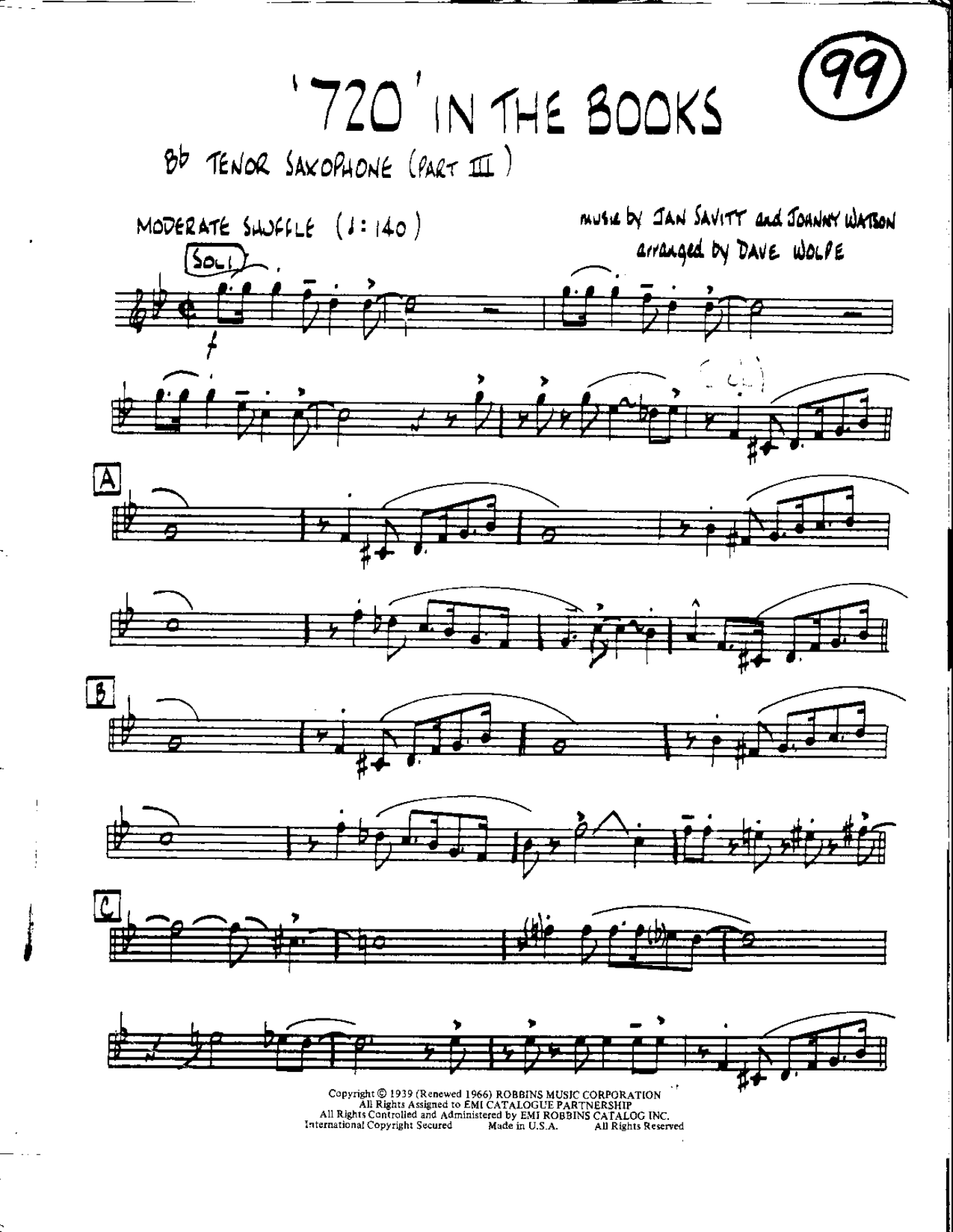
Circle 99-720 in the Books-Tenor (comp. Jan Savitt)
Composed by Jan Savitt, Edgar Battle, Teddy McRae
Arranged by Unknown Arranger
- Ensemble: Small Ensemble
- Style: Swing
- Pages: 3
- Difficulty: easy
- Content: Sheet Music
- Format: PDF Download (Instant)
- Price: $12.99
The vibrant landscape of early swing jazz is often defined by its infectious rhythms and memorable melodies, and "Circle 99-720 in the Books-Tenor" stands as a testament to this golden era. Composed by the collaborative genius of Jan Savitt, Edgar Battle, and Teddy McRae, this tune hails from a period when big band and small ensemble swing reigned supreme, capturing the effervescent spirit of the late 1930s and early 1940s. While not a universally recognized "standard" in the same vein as a Gershwin tune, its inclusion in the repertoire of influential bandleaders like Jan Savitt, known for his "Top Hatters" orchestra, marks it as a significant, albeit perhaps lesser-known, gem from a pivotal time in jazz history. Savitt's ensembles were celebrated for their polished arrangements and tight ensemble playing, and this composition embodies the sophisticated yet danceable qualities that made swing music so universally appealing. This particular arrangement of "Circle 99-720 in the Books-Tenor" presents a medium-up swing feel, typically hovering around 180-200 BPM, in the key of F major. The musical character is decidedly bright and energetic, evoking the joyous, uninhibited atmosphere of a bustling dance hall or a lively club performance. Its driving rhythm section provides a solid foundation for the interplay between melodic voices, characterized by crisp articulations and a buoyant forward momentum. The piece maintains a consistent, uplifting mood throughout, with a clear focus on melodic clarity and rhythmic precision, designed to ignite both the performers and the audience with its undeniable swing. The Unknown Arranger's treatment of "Circle 99-720 in the Books-Tenor" is a masterclass in capturing the authentic small-ensemble swing sound while offering rewarding challenges. The arrangement features the tenor saxophone prominently, carrying the initial melody statement with a smooth, lyrical yet rhythmically incisive delivery. A notable characteristic is the clever use of call-and-response figures between the lead melodic voice and the accompanying horns, creating a dynamic conversational texture. There are well-crafted soli sections that showcase the ensemble's tightness and blend, particularly in the brass and saxophones, often employing classic swing-era voicings that are both harmonically rich and historically accurate. The arrangement provides ample space for improvisation, with clearly marked solo sections over the form, allowing individual players to shine within the ensemble context. Technical challenges include maintaining precise articulation at a brisk tempo, navigating intricate rhythmic figures, and achieving a cohesive ensemble blend, especially in the soli passages. The reward lies in performing a genuinely swinging piece that feels authentic to its era, offering a deeply satisfying musical experience. This arrangement is ideally suited for college-level jazz ensembles, advanced high school groups, or community bands with experienced musicians. Its demands for rhythmic accuracy, stylistic understanding, and improvisational facility make it an excellent vehicle for developing musicianship and ensemble cohesion. The compact nature of a small ensemble arrangement also makes it highly versatile for various performance settings, from intimate club gigs to concert stages. Bands seeking to explore the nuances of classic swing in a focused, engaging format will find this piece particularly rewarding, offering both a historical lesson and an exhilarating performance opportunity. Conductors should emphasize a consistent, driving medium-up swing feel from the rhythm section, ensuring the bass walk is solid and the drums provide a crisp, articulate ride cymbal pattern. The primary technical challenge lies in achieving precise ensemble articulation, particularly in the brass and saxophone soli sections; encourage players to listen across sections for unified attacks and releases. The initial tenor saxophone melody should be played with a confident, lyrical swagger, balancing rhythmic accuracy with expressive phrasing. Soloists should be encouraged to embrace the swing idiom, focusing on melodic development and rhythmic invention over the provided chord changes. No special techniques like plunger mutes or falls are explicitly notated, but stylistic embellishments (e.g., subtle scoops or falls at phrase endings) can be encouraged to enhance authenticity. Rehearsal time should be dedicated to isolating soli passages, working on intonation and blend, and ensuring the rhythm section locks in tightly with the melodic lines. Q: What instruments are included in this arrangement? A: This is a small ensemble arrangement, typically including parts for Trumpet, Alto Saxophone, Tenor Saxophone (featured melody), Trombone, Piano, Bass, and Drums. Specific instrumentation may vary slightly, but these are the core components. Q: What is the difficulty level of "Circle 99-720 in the Books-Tenor"? A: This arrangement is rated as advanced intermediate to advanced, suitable for college-level jazz ensembles, experienced high school bands, or proficient community groups. It requires solid instrumental technique, rhythmic precision, and stylistic understanding. Q: What is the historical context and musical style of this piece? A: "Circle 99-720 in the Books-Tenor" is a swing-era composition from the late 1930s/early 1940s, co-written by Jan Savitt. It embodies the medium-up swing style popular during that period, characterized by its infectious rhythm and melodic clarity. Q: What makes this arrangement unique compared to other swing charts? A: This arrangement uniquely features the tenor saxophone as the primary melodic voice, offering a distinct timbre. It showcases well-crafted soli sections with authentic swing-era voicings and provides ample space for improvisation within a tight, small-ensemble format. Q: What is the typical performance duration and tempo for this arrangement? A: The performance duration typically ranges from 3 to 4 minutes, depending on the number and length of improvised solos. The recommended tempo is a medium-up swing, generally between 180 and 200 beats per minute.
Musicians Also Search For
Circle 99-720 in the Books-Tenor Unknown Arranger PDF • Circle 99-720 in the Books-Tenor Unknown Arranger sheet music • Circle 99-720 in the Books-Tenor arranged by Unknown Arranger • Unknown Arranger small ensemble charts • Unknown Arranger jazz arrangements PDF • Circle 99-720 in the Books-Tenor Jan Savitt, Edgar Battle, Teddy McRae sheet music • Circle 99-720 in the Books-Tenor Jan Savitt, Edgar Battle, Teddy McRae small ensemble arrangement • Jan Savitt, Edgar Battle, Teddy McRae small ensemble charts • Circle 99-720 in the Books-Tenor small ensemble arrangement • Circle 99-720 in the Books-Tenor small ensemble PDF download • Circle 99-720 in the Books-Tenor jazz ensemble sheet music • small ensemble sheet music instant download • Circle 99-720 in the Books-Tenor sheet music with parts • Circle 99-720 in the Books-Tenor Swing chart • Swing small ensemble arrangements • buy Circle 99-720 in the Books-Tenor sheet music online • download Circle 99-720 in the Books-Tenor PDF • Circle 99-720 in the Books-Tenor jazz chart • best Unknown Arranger small ensemble arrangements • Jan Savitt, Edgar Battle, Teddy McRae songs arranged by Unknown Arranger • Circle 99-720 in the Books-Tenor printable sheet music • small ensemble repertoire PDF