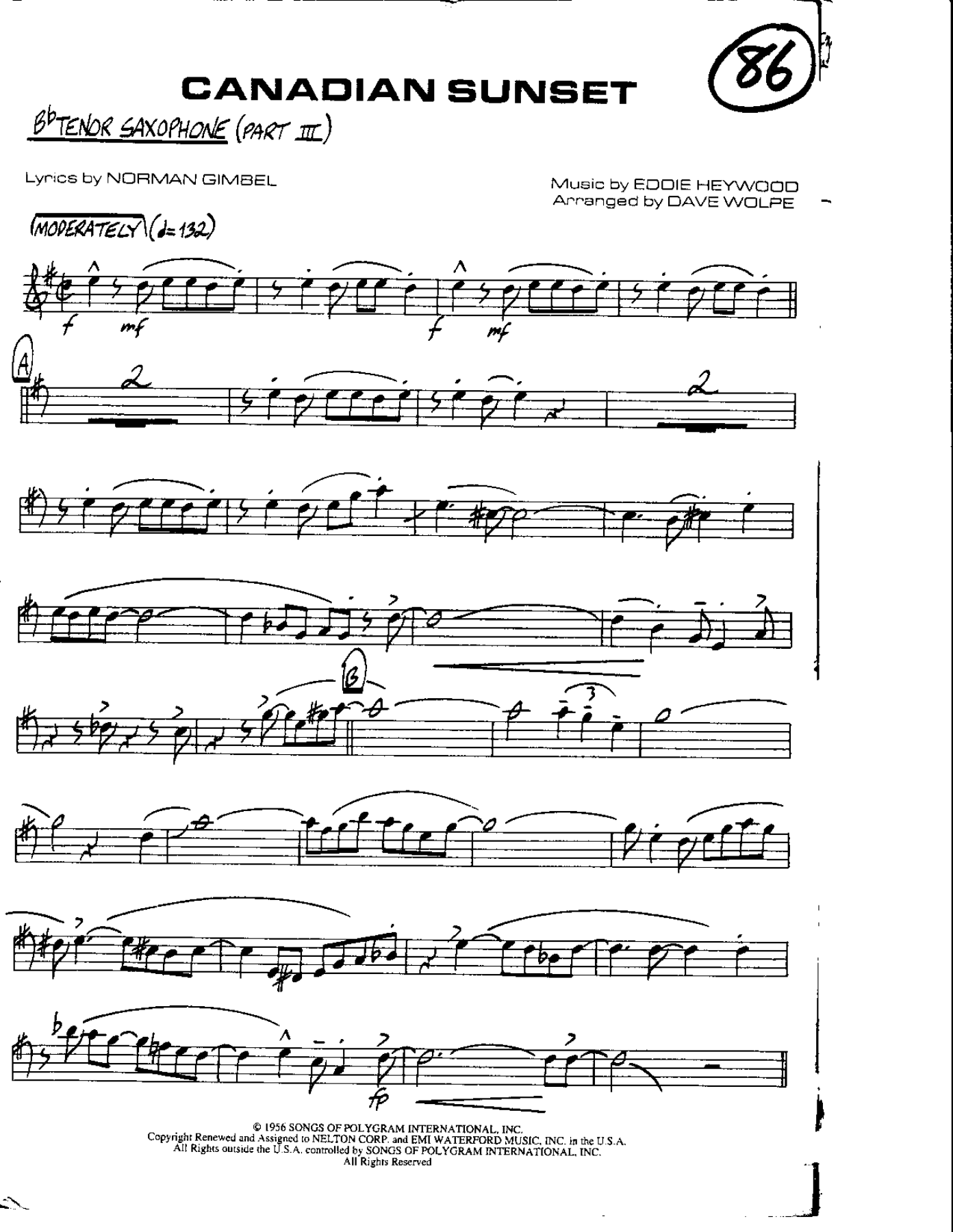
Circle 86-Canandian Sunset-Tenor
Composed by Traditional
Arranged by Unknown Arranger
- Ensemble: Small Ensemble
- Style: Ballad
- Pages: 3
- Difficulty: easy
- Content: Sheet Music
- Format: PDF Download (Instant)
- Price: $12.99
The traditional melody, "Canadian Sunset," though often associated with the 1950s pop and easy listening era, possesses a timeless quality that has allowed it to transcend genres and find a home in the jazz repertoire. While the original composer is listed as 'Traditional,' the tune gained widespread recognition and became a staple through the instrumental recording by Hugo Winterhalter and his Orchestra in 1956, featuring guitarist Eddie Heywood. Its evocative, wistful melody and lush harmonic possibilities quickly made it a favorite among jazz balladeers and instrumentalists, embodying the romantic and introspective spirit of mid-20th century jazz. This particular arrangement, "Circle 86-Canadian Sunset-Tenor," focuses on the lyrical beauty of the tune, presenting it as a heartfelt ballad designed to showcase the expressive capabilities of a small ensemble. This rendition of "Canadian Sunset" is conceived as a slow, reflective ballad, typically performed in 4/4 time around a tempo of 50-60 beats per minute. The primary key is not specified, but the arrangement's character suggests a comfortable, perhaps minor, or modal setting that enhances its melancholic yet beautiful mood. The overall energy is one of gentle introspection, inviting both performers and listeners into a serene soundscape. The arrangement is crafted to evoke a sense of longing and nostalgia, with harmonies that are rich and supportive without being overly complex, allowing the melody to truly sing. It's a piece that demands sensitivity and emotional depth, rather than technical fireworks, making it a rewarding experience for musicians who appreciate subtlety and nuance. While the arranger remains unknown, their approach to "Circle 86-Canadian Sunset-Tenor" demonstrates a clear understanding of ballad aesthetics for a small ensemble. The arrangement likely features the tenor saxophone carrying the primary melodic statement, often presented with a warm, sustained tone. Expect carefully voiced chords in the accompanying instruments—perhaps piano, bass, and drums—that provide a lush harmonic bed. There may be subtle counter-melodies or obbligato lines that weave around the main theme, adding texture and interest without detracting from the soloist. The arrangement avoids overt shout choruses or complex modulations, instead focusing on developing the emotional arc through dynamic control and sensitive phrasing. The beauty lies in its simplicity and directness, allowing the inherent elegance of the "Canadian Sunset" melody to shine through. Performance details for this arrangement center around the tenor saxophone as the featured voice. The melody is predominantly carried by the tenor, offering ample opportunity for expressive phrasing and interpretation. While specific solo sections are not detailed, the ballad format often implies space for improvisation over the form, or at least significant melodic embellishment. Technical challenges are less about rapid-fire scales and more about breath control, sustained tone, precise intonation, and emotional projection. The reward lies in crafting a truly moving musical statement, where every note counts. This arrangement is ideally suited for college-level jazz ensembles, advanced high school groups, or community bands looking to develop their ballad playing and expressive capabilities. Its small ensemble format also makes it perfect for professional combos seeking a refined and heartfelt addition to their repertoire, emphasizing musicality over sheer virtuosity. Conductors should emphasize a unified, sustained tone throughout the ensemble, particularly from the rhythm section, to create a cohesive harmonic foundation for the tenor saxophone. The primary technical challenge for the tenor lies in maintaining breath support for long phrases and executing smooth, expressive vibrato. Encourage musicians to listen intently to each other, allowing for subtle dynamic swells and decays that enhance the emotional narrative. The tempo should be a very slow ballad, around quarter note = 50-60 bpm, with a focus on a relaxed, unhurried feel. Avoid any sense of rushing. No special techniques like plunger mutes or falls are indicated; the emphasis is on pure, lyrical sound. Rehearsal time should be dedicated to shaping phrases, achieving precise intonation on sustained notes, and ensuring the rhythm section provides a sensitive, supportive cushion without overpowering the soloist. Q: What instruments are included in the "Circle 86-Canandian Sunset-Tenor" arrangement? A: This arrangement is designed for a small ensemble, with the tenor saxophone featured prominently. Specific instrumentation beyond the tenor would typically include a standard jazz rhythm section (piano, bass, drums), and potentially one or two other melodic instruments to provide harmonic support. Q: What is the difficulty level of this arrangement? A: This arrangement is considered intermediate to advanced. While not technically demanding in terms of speed, it requires strong musicianship, excellent breath control, precise intonation, and a mature sense of phrasing and emotional expression, particularly from the featured tenor soloist. Q: What is the musical style and historical context of "Canadian Sunset"? A: "Canadian Sunset" is a classic jazz ballad, originally gaining popularity in the mid-1950s through instrumental recordings. It embodies the romantic and melancholic mood characteristic of that era's easy listening and jazz standards, often evoking a sense of nostalgia. Q: What makes this specific arrangement unique? A: This arrangement stands out for its focus on the lyrical beauty of the "Canadian Sunset" melody, specifically tailored to showcase the expressive capabilities of a tenor saxophone within a small ensemble setting. It prioritizes emotional depth and sensitive interpretation over complex technical passages or overt jazz idioms. Q: What is the typical performance duration or tempo for this piece? A: As a slow ballad, "Circle 86-Canandian Sunset-Tenor" is typically performed at a very relaxed tempo, around 50-60 beats per minute. The exact duration will depend on the number of choruses and any improvised sections, but a typical performance would likely range from 4 to 6 minutes.
Musicians Also Search For
Circle 86-Canandian Sunset-Tenor Unknown Arranger PDF • Circle 86-Canandian Sunset-Tenor Unknown Arranger sheet music • Circle 86-Canandian Sunset-Tenor arranged by Unknown Arranger • Unknown Arranger small ensemble charts • Unknown Arranger jazz arrangements PDF • Circle 86-Canandian Sunset-Tenor Traditional sheet music • Circle 86-Canandian Sunset-Tenor Traditional small ensemble arrangement • Traditional small ensemble charts • Circle 86-Canandian Sunset-Tenor small ensemble arrangement • Circle 86-Canandian Sunset-Tenor small ensemble PDF download • Circle 86-Canandian Sunset-Tenor jazz ensemble sheet music • small ensemble sheet music instant download • Circle 86-Canandian Sunset-Tenor sheet music with parts • Circle 86-Canandian Sunset-Tenor Ballad chart • Ballad small ensemble arrangements • buy Circle 86-Canandian Sunset-Tenor sheet music online • download Circle 86-Canandian Sunset-Tenor PDF • Circle 86-Canandian Sunset-Tenor jazz chart • best Unknown Arranger small ensemble arrangements • Traditional songs arranged by Unknown Arranger • Circle 86-Canandian Sunset-Tenor printable sheet music • small ensemble repertoire PDF