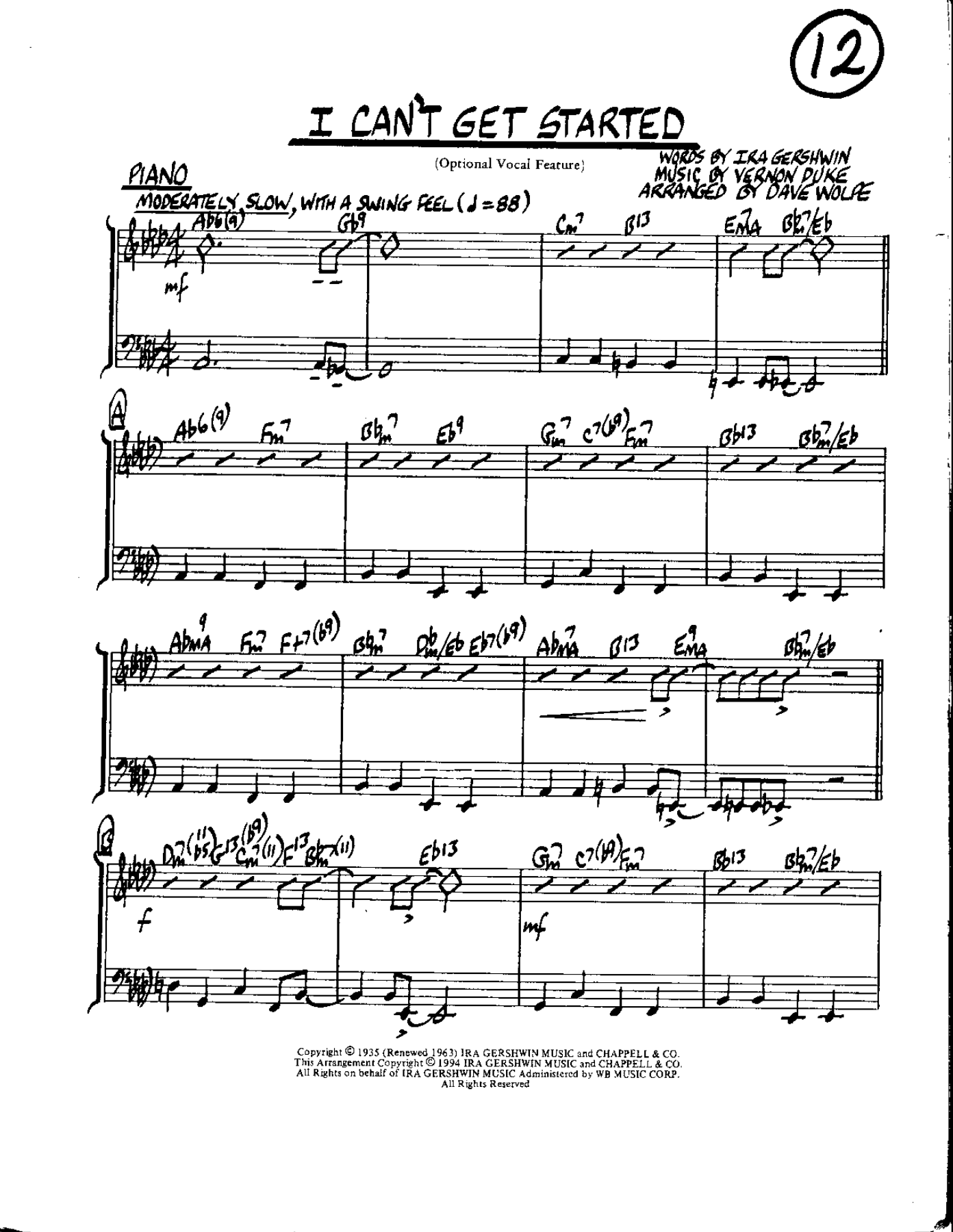
Circle 12-I can't get Started-Piano (comp. Vernon Duke)
Composed by Vernon Duke
Arranged by Dave Wolpe
- Ensemble: Small Ensemble
- Style: Jazz Standard
- Pages: 4
- Instruments (1): piano
- Difficulty: easy
- Content: Individual Parts
- Format: PDF Download (Instant)
- Price: $12.99
Vernon Duke's timeless ballad, "I Can't Get Started," stands as a cornerstone of the Great American Songbook, originally composed in 1936 for the Ziegfeld Follies. While initially a stage tune, it was quickly embraced by jazz musicians, becoming an iconic vehicle for improvisers and vocalists alike. Bunny Berigan's legendary 1937 trumpet rendition, featuring his soaring, expressive solo, cemented its status as a jazz standard, demonstrating its profound melodic beauty and harmonic depth. The song's lyrical narrative of unrequited love and romantic futility is perfectly mirrored by its melancholic yet sophisticated musical structure, characterized by its distinctive AABA form and rich chord changes that invite harmonic exploration. Its enduring appeal lies in this blend of emotional resonance and improvisational potential, making it a perennial favorite across generations of jazz artists. This particular small ensemble arrangement, "Circle 12-I can't get Started-Piano," presents a nuanced and intimate interpretation of Duke's classic. While the arranger remains unknown, their approach emphasizes a sensitive, medium-slow ballad tempo in 4/4, allowing the exquisite harmonies to breathe and the melody to unfold with grace. The piece is set in the key of C Major, providing a comfortable yet expressive harmonic landscape. The musical character is one of tender reflection and understated passion, evoking the classic jazz ballad tradition. Expect lush, often extended voicings that provide a rich harmonic bed, supporting the lyrical piano melody. The arrangement prioritizes clarity and emotional depth over overt technical flash, focusing on the song's inherent beauty. The arranger's treatment of "I Can't Get Started" highlights the piano as the central melodic voice, carrying the iconic theme with expressive phrasing. While designated for piano, the "Circle 12" notation suggests a pedagogical or structural focus, potentially indicating a specific harmonic or melodic exercise within a larger curriculum, though its standalone performance value is undeniable. The arrangement likely features a clear presentation of the melody, followed by opportunities for improvisation over the established changes. Technical challenges for the pianist include achieving a consistent, sensitive legato touch, navigating sophisticated chord voicings, and maintaining a compelling narrative arc within the ballad tempo. The reward lies in performing a piece that is both historically significant and deeply moving, allowing the musician to connect with the emotional core of the composition. This arrangement is ideally suited for college-level jazz pianists and small ensemble settings where a sophisticated and expressive ballad is desired. Its focus on harmonic understanding and melodic interpretation makes it an excellent study piece for developing improvisers and a beautiful addition to any performance repertoire. The four-page format suggests a concise yet comprehensive treatment, providing ample material for a full performance while remaining manageable. It's particularly appropriate for combos looking to showcase a pianist's lyrical capabilities and a group's collective sensitivity to ballad playing. This arrangement of "I Can't Get Started" should be approached with a focus on lyrical expression and harmonic sensitivity. The tempo is a medium-slow ballad, approximately quarter note = 60-72 BPM, emphasizing a gentle, flowing 4/4 feel rather than a rigid pulse. The pianist should strive for a warm, resonant tone, utilizing ample sustain pedal where appropriate to connect harmonies, but avoiding muddiness. Pay close attention to the inner voices of the chords, ensuring balance and clarity. Phrasing of the melody is paramount; imagine a vocalist singing the line, employing subtle rubato and dynamic shaping to convey the song's inherent melancholy and longing. Technical challenges include executing the extended harmonies smoothly and maintaining a consistent, sensitive touch throughout. Rehearsal should prioritize listening across the ensemble, ensuring that the piano's melodic lead is supported by a cohesive and responsive harmonic accompaniment. Q: What instruments are included in this arrangement? A: This specific arrangement, titled "Circle 12-I can't get Started-Piano," is primarily a piano chart. While suitable for small ensemble performance, the notation is centered on the piano part, implying a lead sheet with chord changes for accompaniment or a fully voiced piano solo. Q: What is the difficulty level of this arrangement? A: This arrangement is considered intermediate to advanced. It requires a pianist with a solid understanding of jazz harmony, the ability to interpret sophisticated chord voicings, and a developed sense of lyrical phrasing at a ballad tempo. Q: What is the musical style and historical context of "I Can't Get Started"? A: "I Can't Get Started" is a classic jazz standard from the Great American Songbook, composed by Vernon Duke in 1936. It embodies the romantic ballad style of the swing era, known for its beautiful melody and rich harmonic progression. Q: What makes this specific "Circle 12" arrangement unique? A: The "Circle 12" designation suggests a pedagogical or structured approach, potentially focusing on specific harmonic cycles or melodic development within the piece, making it valuable for both study and performance. It emphasizes the piano as the primary melodic and harmonic voice. Q: What is the typical performance duration for this arrangement? A: Given its medium-slow ballad tempo and four-page length, a typical performance of this arrangement would likely range from 3 to 5 minutes, depending on the inclusion and length of any improvised sections.
Questions and answers
- What is included in the Circle 12-I can't get Started-Piano (comp. Vernon Duke) PDF?
- The verified current file contains individual parts across 4 pages.
- How many instruments or parts are listed for Circle 12-I can't get Started-Piano (comp. Vernon Duke)?
- The verified instrumentation list contains 1 entries for this Small Ensemble arrangement.
- Who is credited for Circle 12-I can't get Started-Piano (comp. Vernon Duke)?
- Composer: Vernon Duke. Arranger: Dave Wolpe.
- What difficulty is listed for Circle 12-I can't get Started-Piano (comp. Vernon Duke)?
- The verified difficulty level is easy.
- What style is listed for Circle 12-I can't get Started-Piano (comp. Vernon Duke)?
- The catalog lists the style as Jazz Standard.
- Can I preview Circle 12-I can't get Started-Piano (comp. Vernon Duke) before buying?
- Yes. The product page provides a preview generated from the current PDF file.
- How is Circle 12-I can't get Started-Piano (comp. Vernon Duke) delivered?
- After successful payment, the digital PDF is made available for download. The displayed price is $12.99.
Musicians Also Search For
Circle 12-I can't get Started-Piano Dave Wolpe PDF • Circle 12-I can't get Started-Piano Dave Wolpe sheet music • Circle 12-I can't get Started-Piano arranged by Dave Wolpe • Dave Wolpe small ensemble charts • Dave Wolpe jazz arrangements PDF • Circle 12-I can't get Started-Piano Vernon Duke sheet music • Circle 12-I can't get Started-Piano Vernon Duke small ensemble arrangements • Vernon Duke small ensemble charts • Circle 12-I can't get Started-Piano small ensemble arrangements • Circle 12-I can't get Started-Piano small ensemble PDF download • Circle 12-I can't get Started-Piano jazz sheet music • small ensemble sheet music download • Circle 12-I can't get Started-Piano individual parts download • Circle 12-I can't get Started-Piano sheet music PDF • Circle 12-I can't get Started-Piano Jazz Standard charts • Jazz Standard small ensemble arrangements • buy Circle 12-I can't get Started-Piano sheet music • download Circle 12-I can't get Started-Piano PDF • Circle 12-I can't get Started-Piano jazz charts • best Dave Wolpe small ensemble arrangements • Vernon Duke arranged by Dave Wolpe • Circle 12-I can't get Started-Piano printable sheet music • small ensemble repertoire PDF