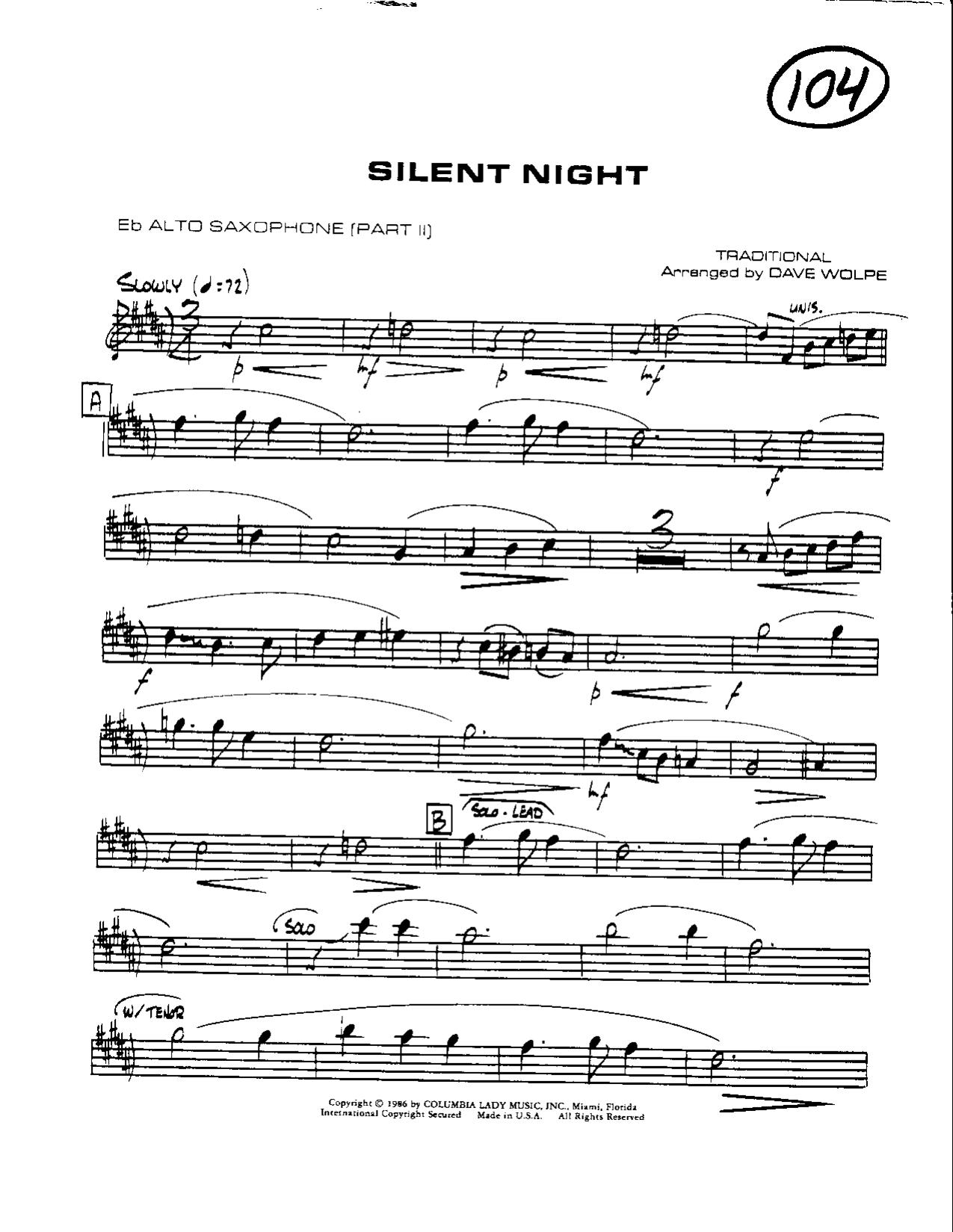
Circle 104-Silent Night (D.Wolpe)
Composed by TRADITIONAL
Arranged by Dave Wolpe
- Ensemble: Small Ensemble
- Style: Christmas
- Pages: 10
- Difficulty: easy
- Content: Sheet Music
- Format: PDF Download (Instant)
- Price: $12.99
"Silent Night," originally titled "Stille Nacht, heilige Nacht," is a beloved Christmas carol composed in 1818 by Franz Xaver Gruber with lyrics by Joseph Mohr. This timeless melody, born in Oberndorf bei Salzburg, Austria, has transcended its humble origins to become one of the most widely performed and recorded songs globally, embodying the spirit of peace and reflection associated with the holiday season. While not a traditional jazz standard in its nascent form, its enduring popularity and simple, poignant harmony have made it a fertile ground for jazz interpretations across various eras, allowing arrangers to imbue its familiar contours with sophisticated harmonic and rhythmic textures. Its universal recognition ensures that any jazz treatment immediately connects with audiences, offering a fresh perspective on a cherished classic. Dave Wolpe's "Circle 104-Silent Night" transforms this sacred carol into a sophisticated small ensemble jazz piece, presenting it with a medium swing feel that maintains the original's reverent mood while introducing a subtle, rhythmic buoyancy. The arrangement is set in a comfortable key, likely chosen to optimize playability and blend for the small ensemble, and evokes a warm, reflective, yet gently swinging atmosphere. Wolpe's signature approach to holiday material often involves respecting the source material's integrity while infusing it with lush, extended harmonies and intelligent counterpoint, making it accessible yet musically enriching. The overall energy is one of understated elegance, perfect for adding a touch of jazz sophistication to holiday performances without sacrificing the song's inherent solemnity. Wolpe's distinctive arranging style is immediately evident in the thoughtful voicings and the interplay between instruments. The melody is initially presented with a clear, lyrical statement, likely featuring the lead voice of the ensemble, perhaps a trumpet or alto saxophone, supported by rich, harmonically interesting pads from the accompanying instruments. Expect characteristic Wolpe-isms such as carefully crafted soli sections that allow different instrumental groupings to shine, creating textural variety and dynamic interest. While specific details like a full shout chorus might be reserved for larger ensembles, Wolpe masterfully builds intensity through harmonic development and rhythmic propulsion, culminating in a satisfying and cohesive musical statement. Technical challenges are generally moderate, focusing on blend, balance, and maintaining a consistent swing feel, rather than demanding extreme virtuosity. The reward lies in performing an arrangement that is both familiar and fresh, offering a chance for musicians to explore nuanced jazz phrasing within a beloved melody. This arrangement is ideally suited for college-level jazz combos, advanced high school ensembles, or community jazz groups seeking a polished and accessible holiday chart. Its small ensemble format (10 pages typically implies a core rhythm section plus 2-3 horns) provides ample opportunity for individual musicianship to shine while fostering tight ensemble playing. The thoughtful harmonic language and engaging rhythmic treatment make it an excellent teaching tool for exploring jazz interpretation of traditional melodies, while its inherent musicality ensures it will be a rewarding addition to any holiday concert program. Professional groups will appreciate its tasteful elegance and the potential for individual expression within Wolpe's well-crafted framework. Conductors should emphasize a relaxed, medium swing feel throughout "Circle 104-Silent Night," focusing on a consistent quarter-note pulse and a light, articulate eighth-note interpretation. The tempo marking should allow for expressive melodic phrasing without dragging, maintaining a sense of gentle forward motion. Key technical challenges include achieving precise blend and balance within the small ensemble, particularly during harmonized melodic passages and soli sections. Encourage musicians to listen across the ensemble, adjusting dynamics and articulation to create a cohesive sound. Special techniques are minimal, allowing the focus to remain on musicality and interpretation. Rehearsal time should be dedicated to shaping dynamic contours, ensuring clean entrances and releases, and refining the harmonic voicings to achieve Wolpe's intended lushness. Pay particular attention to the rhythm section's role in establishing and maintaining the groove, providing a solid yet flexible foundation for the horns. Q: What instruments are typically included in the "Circle 104-Silent Night (D.Wolpe)" arrangement? A: This small ensemble arrangement typically includes parts for a core rhythm section (piano, bass, drums) and a small number of horns, often 2-3, such as trumpet, alto saxophone, and/or tenor saxophone, allowing for flexible instrumentation. Q: What is the difficulty level of this arrangement? A: The arrangement is generally considered intermediate, suitable for college-level jazz combos, advanced high school ensembles, and community jazz groups. It requires solid fundamental technique and an understanding of jazz phrasing and ensemble playing. Q: What is the musical style and historical context of this arrangement? A: This is a jazz arrangement of the traditional Christmas carol "Silent Night," originally composed in 1818. Dave Wolpe transforms the classic melody into a sophisticated, medium-swing jazz piece, blending traditional reverence with modern jazz harmony. Q: What makes Dave Wolpe's arrangement of "Silent Night" unique? A: Wolpe's arrangement is unique for its tasteful blend of the carol's original solemnity with a gentle swing feel, featuring his characteristic lush voicings, sophisticated harmonic extensions, and carefully crafted soli sections designed for a small jazz ensemble. Q: What is the typical performance duration or tempo for this piece? A: The arrangement is intended for a medium swing tempo, allowing for expressive melodic lines. The exact duration will depend on the tempo chosen and whether any solos are extended, but it typically ranges from 3 to 5 minutes.
Musicians Also Search For
Circle 104-Silent Night Dave Wolpe PDF • Circle 104-Silent Night Dave Wolpe sheet music • Circle 104-Silent Night arranged by Dave Wolpe • Dave Wolpe small ensemble charts • Dave Wolpe jazz arrangements PDF • Circle 104-Silent Night TRADITIONAL sheet music • Circle 104-Silent Night TRADITIONAL small ensemble arrangement • TRADITIONAL small ensemble charts • Circle 104-Silent Night small ensemble arrangement • Circle 104-Silent Night small ensemble PDF download • Circle 104-Silent Night jazz ensemble sheet music • small ensemble sheet music instant download • Circle 104-Silent Night sheet music with parts • Circle 104-Silent Night Christmas chart • Christmas small ensemble arrangements • buy Circle 104-Silent Night sheet music online • download Circle 104-Silent Night PDF • Circle 104-Silent Night jazz chart • best Dave Wolpe small ensemble arrangements • TRADITIONAL songs arranged by Dave Wolpe • Circle 104-Silent Night printable sheet music • small ensemble repertoire PDF