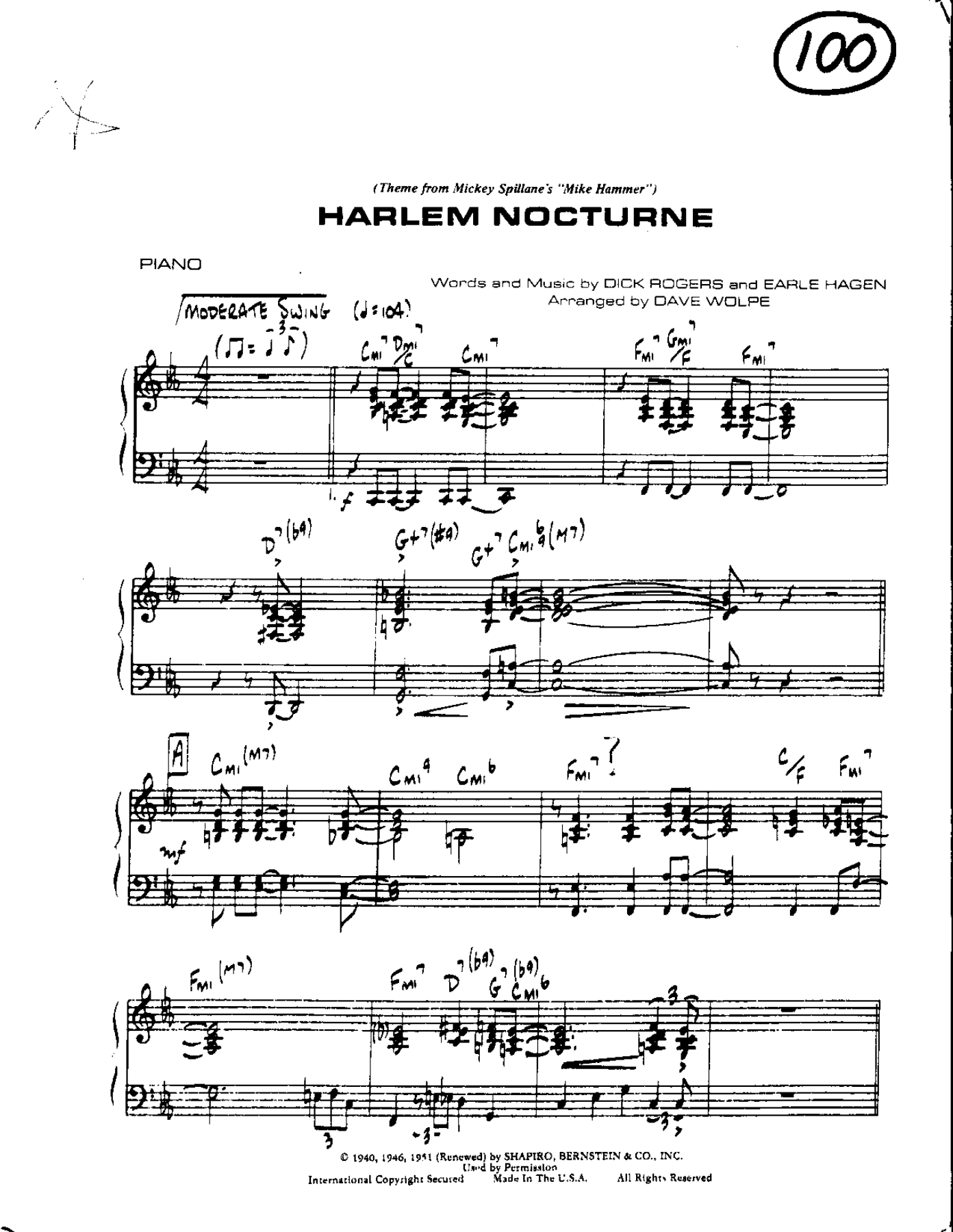
Circle 100-Harlem Nocturne-Piano (comp. Earle Hagen)
Composed by Earle Hagen
Arranged by Dave Wolpe
- Ensemble: Small Ensemble
- Style: Swing
- Pages: 4
- Instruments (1): piano
- Difficulty: easy
- Content: Individual Parts
- Format: PDF Download (Instant)
- Price: $12.99
Earle Hagen's "Harlem Nocturne" stands as an iconic pillar of the film noir and jazz landscape, originally composed in 1939. This timeless piece gained widespread fame through Randy Brooks' 1946 recording and later became synonymous with the sultry, mysterious atmosphere of late-night radio and television, most notably as the theme for "The Mike Hammer Show." Its enduring appeal lies in its evocative melody, which perfectly captures the melancholic romance and shadowy allure of the swing era. "Harlem Nocturne" is not merely a jazz standard; it's a cultural touchstone, instantly recognizable for its distinctive saxophone lead and brooding harmonic progression, making it a staple for any ensemble seeking to explore the darker, more introspective side of swing. This particular arrangement, "Circle 100-Harlem Nocturne-Piano," offers a unique and intimate interpretation of Hagen's classic, specifically tailored for a small ensemble with a prominent piano voice. The musical character is a medium-slow swing, maintaining the original's languid tempo feel, typically around 80-90 BPM. The key remains in the original's minor mode, likely C minor or a closely related key, preserving the inherent mood of introspection and subtle tension. The arrangement emphasizes a smooth, legato delivery, allowing the rich harmonies to unfold with a sense of deliberate pacing. The mood is undeniably sophisticated and slightly melancholic, evoking images of dimly lit jazz clubs and late-night musings. The Unknown Arranger's approach to "Harlem Nocturne" is characterized by a sensitive treatment of Hagen's original melody, often presenting it first in the piano, allowing its expressive qualities to shine. This version likely features carefully crafted voicings that highlight the piano's harmonic capabilities, potentially employing extended harmonies and lush chord clusters that add depth without obscuring the core melodic line. While specific soli sections or shout choruses might be less prominent in a small ensemble setting, the arrangement likely focuses on intricate interplay between the instruments, with the piano often taking a central role in both melodic statements and harmonic support. The challenge and reward lie in achieving a cohesive, nuanced performance that respects the original's emotional weight while showcasing the individual virtuosity and collective sensitivity of the small ensemble. Performance of this arrangement will demand a keen sense of balance and dynamic control. The melody, initially carried by the piano, may then be passed to other instruments in the small ensemble, creating a conversational texture. Featured solos, particularly for the piano, are highly probable, offering opportunities for lyrical improvisation over the piece's distinctive changes. Technical challenges will include maintaining a consistent, relaxed swing feel at a slower tempo, executing smooth legato lines, and navigating the potentially rich harmonic language. This arrangement is ideally suited for college-level ensembles, community jazz groups, or professional small combos seeking a sophisticated and emotionally resonant piece. Its demanding yet rewarding nature makes it an excellent choice for developing musicality, ensemble cohesion, and an appreciation for the enduring legacy of "Harlem Nocturne." This arrangement of "Harlem Nocturne" requires a sensitive, medium-slow swing feel, typically around quarter note = 80-90 BPM. Emphasize a relaxed, legato approach throughout, particularly on the melody, to capture the piece's inherent moodiness. The primary technical challenge lies in maintaining precise intonation and blend within the small ensemble, ensuring the rich harmonies speak clearly. For the piano, focus on voicing chords with warmth and clarity, utilizing a touch that allows the sustain to bloom. Articulation should be smooth and connected, avoiding any abruptness. Rehearsal should prioritize listening across the ensemble, ensuring melodic lines are passed seamlessly and rhythmic figures are synchronized with a natural, unhurried swing. Pay close attention to dynamic shaping to build and release tension effectively. Q: What instruments/parts are included in the "Circle 100-Harlem Nocturne-Piano" arrangement? A: This arrangement is specifically designed for a small ensemble with a prominent piano part. While the exact instrumentation for a "small ensemble" can vary, it typically includes piano as a lead voice, supported by bass and drums, and potentially one or two melodic instruments like saxophone or trumpet, depending on the specific chart. Q: What is the difficulty level of this arrangement? A: This arrangement is considered intermediate to advanced. It requires musicians with solid instrumental technique, a strong grasp of jazz harmony, and the ability to maintain a consistent, expressive medium-slow swing feel. It is suitable for college-level ensembles, advanced high school groups, or experienced community jazz bands. Q: What musical style and historical context does "Harlem Nocturne" represent? A: "Harlem Nocturne" is a classic swing-era piece, originally composed in 1939 by Earle Hagen. It embodies the film noir aesthetic and the sophisticated, often melancholic, mood of late-night jazz from the 1940s and 50s, making it a quintessential jazz standard. Q: What makes this specific "Circle 100-Harlem Nocturne-Piano" arrangement unique? A: This arrangement distinguishes itself by featuring the piano as a central melodic and harmonic voice within a small ensemble context. It likely emphasizes lush voicings and intricate interplay, offering a more intimate and harmonically rich interpretation compared to larger big band versions. Q: What is the typical performance duration or tempo for this piece? A: "Harlem Nocturne" is typically performed at a medium-slow swing tempo, generally around 80-90 beats per minute (BPM). The performance duration will vary depending on the number and length of improvised solos, but a typical rendition might range from 4 to 6 minutes.
Questions and answers
- What is included in the Circle 100-Harlem Nocturne-Piano (comp. Earle Hagen) PDF?
- The verified current file contains individual parts across 4 pages.
- How many instruments or parts are listed for Circle 100-Harlem Nocturne-Piano (comp. Earle Hagen)?
- The verified instrumentation list contains 1 entries for this Small Ensemble arrangement.
- Who is credited for Circle 100-Harlem Nocturne-Piano (comp. Earle Hagen)?
- Composer: Earle Hagen. Arranger: Dave Wolpe.
- What difficulty is listed for Circle 100-Harlem Nocturne-Piano (comp. Earle Hagen)?
- The verified difficulty level is easy.
- What style is listed for Circle 100-Harlem Nocturne-Piano (comp. Earle Hagen)?
- The catalog lists the style as Swing.
- Can I preview Circle 100-Harlem Nocturne-Piano (comp. Earle Hagen) before buying?
- Yes. The product page provides a preview generated from the current PDF file.
- How is Circle 100-Harlem Nocturne-Piano (comp. Earle Hagen) delivered?
- After successful payment, the digital PDF is made available for download. The displayed price is $12.99.
Musicians Also Search For
Circle 100-Harlem Nocturne-Piano Dave Wolpe PDF • Circle 100-Harlem Nocturne-Piano Dave Wolpe sheet music • Circle 100-Harlem Nocturne-Piano arranged by Dave Wolpe • Dave Wolpe small ensemble charts • Dave Wolpe jazz arrangements PDF • Circle 100-Harlem Nocturne-Piano Earle Hagen sheet music • Circle 100-Harlem Nocturne-Piano Earle Hagen small ensemble arrangements • Earle Hagen small ensemble charts • Circle 100-Harlem Nocturne-Piano small ensemble arrangements • Circle 100-Harlem Nocturne-Piano small ensemble PDF download • Circle 100-Harlem Nocturne-Piano jazz sheet music • small ensemble sheet music download • Circle 100-Harlem Nocturne-Piano individual parts download • Circle 100-Harlem Nocturne-Piano sheet music PDF • Circle 100-Harlem Nocturne-Piano Swing charts • Swing small ensemble arrangements • buy Circle 100-Harlem Nocturne-Piano sheet music • download Circle 100-Harlem Nocturne-Piano PDF • Circle 100-Harlem Nocturne-Piano jazz charts • best Dave Wolpe small ensemble arrangements • Earle Hagen arranged by Dave Wolpe • Circle 100-Harlem Nocturne-Piano printable sheet music • small ensemble repertoire PDF