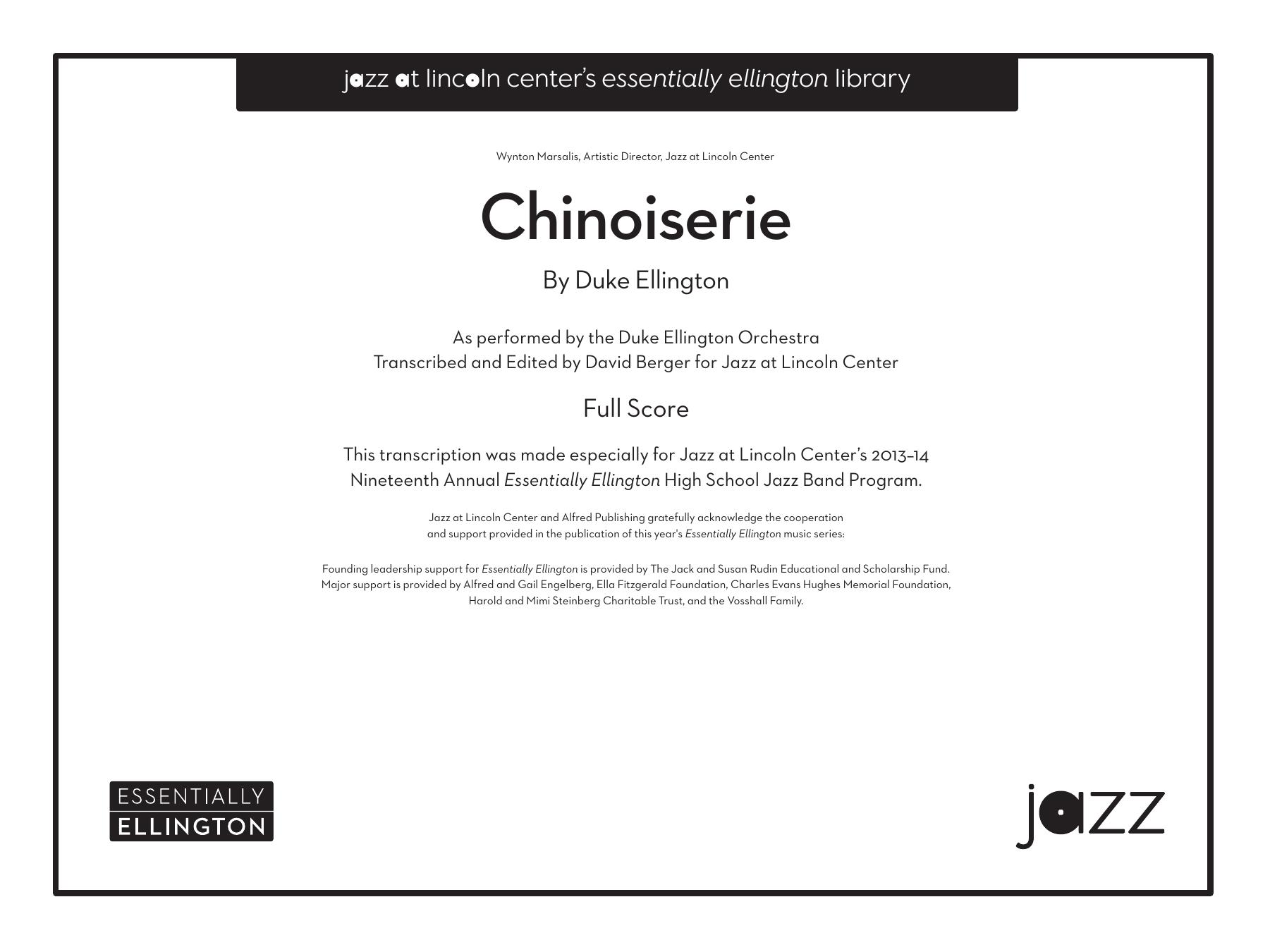
Chinoiserie (D.Ellington)
Composed by Duke Ellington
Arranged by Duke Ellington & B.Strayhorn.D.Berger
- Ensemble: Big Band
- Pages: 94
- Instruments (15): Reed 1 (Alto Sax), Reed 2 (Alto Sax), Reed 3 (Tenor Sax), Reed 4 (Tenor Sax), Reed 5 (Baritone Sax), Trumpet 1, Trumpet 2, Trumpet 3, Trumpet 4, Trombone 1, Trombone 2, Trombone 3, Piano, Bass, Drums
- Difficulty: advanced
- Content: Individual Parts
- Format: PDF Download (Instant)
- Price: $24.99
Duke Ellington’s exotic compositional palette reached one of its most fascinating peaks with "Chinoiserie," a masterwork originally recorded during the pivotal 1946–1947 era that showcased the sophisticated collaborative synergy between Ellington and Billy Strayhorn. Emerging from Ellington’s suite-style writing of the post-WWII period, the piece explores modal-sounding pentatonic motifs, sultry textures, and intricate impressionistic voicings that evoke a mysterious, cinematic atmosphere far ahead of its time. Rather than relying on standard blues or Tin Pan Alley forms, Ellington and Strayhorn constructed a hypnotic, cyclical framework that stretches the boundaries of traditional big band color, making it a treasured deep cut for connoisseurs of the Ellington orchestra's mid-century output. Driven by an undulating, sultry groove and exotic rhythmic underpinnings, the musical character of "Chinoiserie" balances an eerie, haunting tension with sophisticated urban cool. The harmonic landscape avoids straightforward functional resolutions, instead favoring suspended chords, unusual interval skips in the woodwinds, and darkly shaded low-register brass counterpoint. The mood is moody, theatrical, and hypnotic, evoking a cinematic journey through shadows and neon lights. The orchestration leverages Ellington's legendary mastery of instrumental pairing—blending muted brass with low reed flourishes—to create an eerie, seductive sonic tapestry that immediately commands an audience's attention. In this meticulous adaptation edited and prepared by David Berger alongside the foundational concepts of Ellington and Strayhorn, the score honors the original 1946 recording while offering crystal-clear modern engraving derived from the historic manuscript scores. Berger’s editorial approach preserves the dense, idiosyncratic voicings that defined the Ellington reed section—where clarinets and low saxophones intertwine in tight, pungent intervals. The arrangement highlights sectional interplay, pitting whispering, cup-muted trumpets against rich, brooding trombone sonorities. There are no wasted notes; every dynamic shift and subtle accent is designed to maximize the textural contrast between the eerie, Eastern-inspired vamp figures and the heavier, swinging ensemble outbursts. Carrying the intricate, serpentine melody requires exceptional agility from the lead alto saxophone and clarinet sections, who must navigate slippery chromatic lines with absolute precision and stylistic unity. Featured solo space allows improvisers to stretch out over modal vamps, demanding a player who can evoke the blues-inflected yet exotic language of Ellingtonians like Johnny Hodges or Jimmy Hamilton. Advanced collegiate, professional, and elite community big bands will find this chart profoundly rewarding, though it presents distinct technical challenges—particularly in maintaining intonation across extreme dynamic ranges, executing precise plunger or cup-mute effects, and sustaining a heavy, hypnotic groove without dragging the tempo. Conductors approaching "Chinoiserie" must prioritize textural balance and stylistic cohesion over sheer volume. The tempo should remain steady and deliberate, anchored by a relaxed yet driving rhythm section that locks into the sultry, hypnotic groove without rushing the downbeats. Key technical challenges lie in the reed section, where players must blend clarinets and saxophones seamlessly during fast, intricate unison and harmonized lines. Intonation on altered dominants and sharp-eleventh chords requires careful listening across the entire ensemble. Brass players should utilize standard cup mutes or explicit Ellington-style plunger techniques where indicated, ensuring that muted passages project cleanly without pinching the sound. Rehearsals should begin section-by-section, isolating the modal vamps and ensuring the rhythm section establishes a subterranean, pulsing foundation. Emphasize subtle dynamic nuances—subito pianos and swelling crescendos are vital to capturing the piece's cinematic, suspenseful character. Q: What instruments and parts are included in this arrangement? A: This 15-instrument big band arrangement includes parts for two alto saxophones, two tenor saxophones, baritone saxophone, standard brass instrumentation, and a full rhythm section, accompanied by a comprehensive 94-page conductor score. Q: What is the difficulty level of this chart? A: This arrangement is best suited for advanced high school, collegiate, professional, and elite community big bands due to its complex modal harmonies, exposed woodwind passages, and demands for mature ensemble intonation. Q: What is the historical background of "Chinoiserie"? A: Originally composed by Duke Ellington and Billy Strayhorn during their innovative late-1940s writing period, the piece represents Ellington's fascination with exoticism, modal exploration, and extended suite forms outside standard 32-bar pop song structures. Q: What makes this specific David Berger edition unique? A: This edition combines the authentic, historic genius of the original Ellington-Strayhorn manuscript with modern editorial clarity by David Berger, providing pristine, highly legible performance materials that accurately reflect the 1946 recording's dense voicings. Q: What is the recommended performance tempo and feel? A: The piece is performed at a medium, sultry tempo with a heavy, hypnotic groove and distinct swing inflections that emphasize tension, atmosphere, and theatrical dynamic contrast.
Questions and answers
- What is included in the Chinoiserie (D.Ellington) PDF?
- The verified current file contains a conductor score and individual parts across 94 pages.
- How many instruments or parts are listed for Chinoiserie (D.Ellington)?
- The verified instrumentation list contains 15 entries for this Big Band arrangement.
- Who is credited for Chinoiserie (D.Ellington)?
- Composer: Duke Ellington. Arranger: Duke Ellington & B.Strayhorn.D.Berger.
- What difficulty is listed for Chinoiserie (D.Ellington)?
- The verified difficulty level is advanced.
- Can I preview Chinoiserie (D.Ellington) before buying?
- Yes. The product page provides a preview generated from the current PDF file.
- How is Chinoiserie (D.Ellington) delivered?
- After successful payment, the digital PDF is made available for download. The displayed price is $24.99.
Musicians Also Search For
Chinoiserie Duke Ellington & B.Strayhorn.D.Berger PDF • Chinoiserie Duke Ellington & B.Strayhorn.D.Berger sheet music • Chinoiserie arranged by Duke Ellington & B.Strayhorn.D.Berger • Duke Ellington & B.Strayhorn.D.Berger big band charts • Duke Ellington & B.Strayhorn.D.Berger jazz arrangements PDF • Chinoiserie Duke Ellington sheet music • Chinoiserie Duke Ellington big band arrangements • Duke Ellington big band charts • Chinoiserie big band arrangements • Chinoiserie big band PDF download • Chinoiserie jazz sheet music • big band sheet music download • Chinoiserie conductor score PDF • Chinoiserie individual parts download • Chinoiserie sheet music PDF • buy Chinoiserie sheet music • download Chinoiserie PDF • Chinoiserie jazz charts • best Duke Ellington & B.Strayhorn.D.Berger big band arrangements • Duke Ellington arranged by Duke Ellington & B.Strayhorn.D.Berger • Chinoiserie printable sheet music • big band repertoire PDF