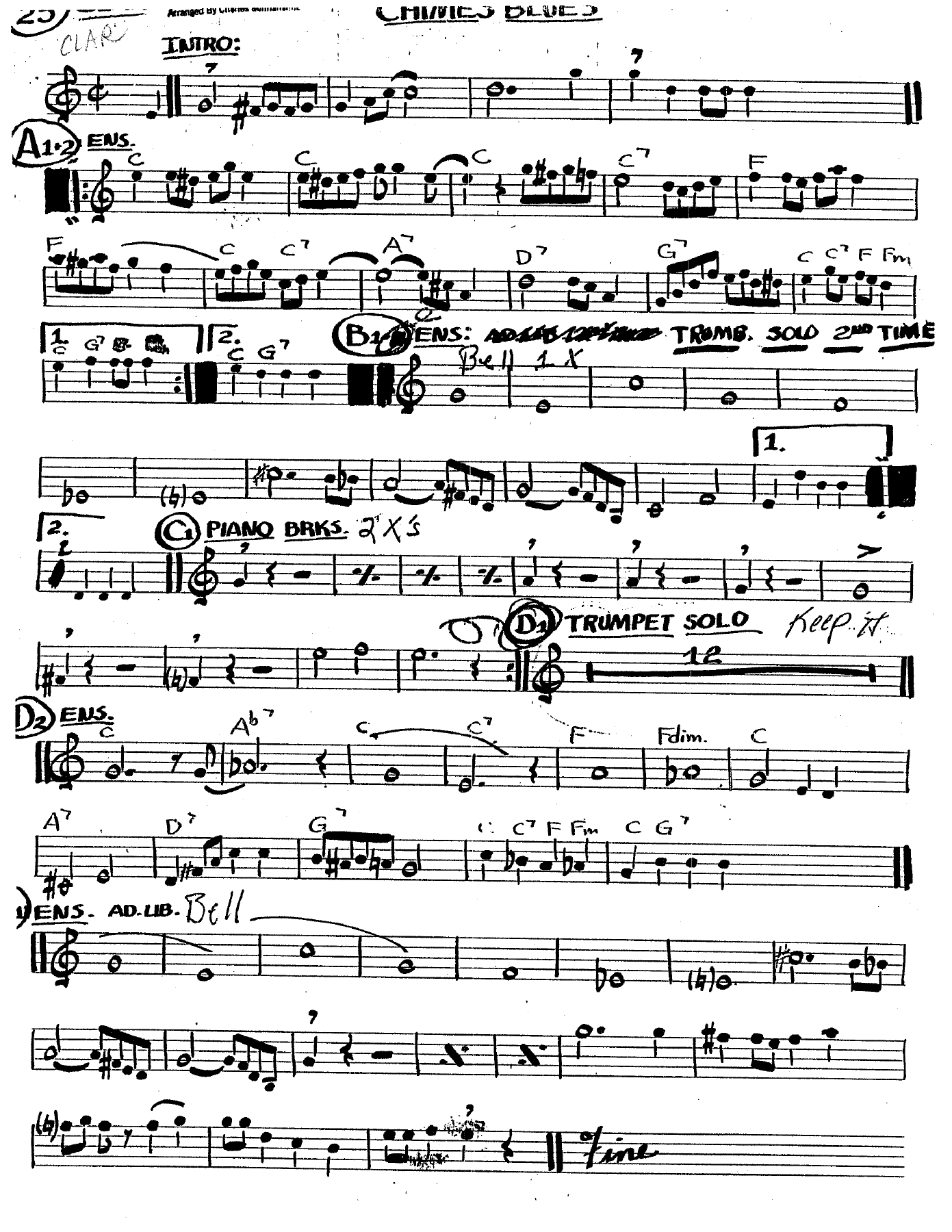
Chimes Blues - Sonnanstine & Wetterau - Handwritten (Lil)
Composed by Sonnanstine & Wetterau
Arranged by Lil
- Ensemble: Small Ensemble
- Style: Blues
- Pages: 10
- Difficulty: easy
- Content: Sheet Music
- Format: PDF Download (Instant)
- Price: $12.99
"Chimes Blues" stands as a foundational piece in the canon of early jazz, originally composed by Sonnanstine & Wetterau. However, it was the iconic 1923 recording by King Oliver's Creole Jazz Band, featuring a young Louis Armstrong, that cemented its place in history. This recording, made on April 5, 1923, at Gennett Records in Richmond, Indiana, is particularly significant as it contains Louis Armstrong's very first recorded solo, marking a pivotal moment in the shift from collective improvisation to the emergence of the jazz soloist. The piece embodies the vibrant New Orleans jazz style of the early 1920s, characterized by its collective improvisation, polyphonic textures, and a driving, even-eighth-note rhythm that evokes a "warm, happy feeling". It's a testament to the raw energy and innovative spirit of a nascent art form that would soon sweep the globe. Musically, "Chimes Blues" is a medium-tempo blues, typically performed with a relaxed, New Orleans swing feel. The original recording, for instance, clocked in at around 161 bpm. The mood is generally joyful and celebratory, reflecting the dance-oriented nature of early jazz. The harmonic structure adheres to the traditional 12-bar blues form, providing a familiar yet fertile ground for improvisation and melodic development. The piece's enduring appeal lies in its infectious rhythm and the interplay between the ensemble voices, creating a rich tapestry of sound that is both complex and accessible. It captures the essence of early 20th-century American music, blending African-American spirituals, ragtime, and blues into a distinctive new genre. Arranger Lil's "Handwritten (Lil)" treatment of "Chimes Blues" offers a unique and historically informed perspective on this classic. Given that Lil Hardin Armstrong (Louis Armstrong's wife and a brilliant pianist, composer, and arranger in her own right) was a key member of King Oliver's Creole Jazz Band and arranged for them, this arrangement likely draws directly from her deep understanding of the original performance and the stylistic nuances of the era. Her arrangements were known for their solid, four-beat piano style and her ability to organize and lead bands. This specific arrangement for small ensemble would therefore emphasize authentic voicings and the intricate melodic lines that characterized the King Oliver sound, potentially highlighting the cornet duet style that Oliver and Armstrong pioneered. Expect carefully transcribed soli sections that capture the collective improvisation feel, and perhaps a feature for a cornet or trumpet soloist to pay homage to Armstrong's groundbreaking contribution. The arrangement will likely maintain the original key and blues form, focusing on clarity and capturing the authentic spirit of the 1923 recording. Performing this arrangement is a rewarding experience that offers musicians a direct connection to the roots of jazz. The melody is typically shared, often starting with the clarinet and cornet, before moving into ensemble sections. While there are featured solo opportunities, the primary challenge and reward lie in mastering the collective improvisation feel, where each instrument contributes to the overall texture without overpowering the others. Technical challenges might include precise articulation, maintaining a consistent New Orleans swing feel, and navigating the polyphonic lines. This arrangement is ideally suited for college and community jazz ensembles looking to delve into the historical performance practices of early jazz, as well as professional small ensembles seeking an authentic and engaging rendition of a timeless classic. It provides an excellent educational tool for understanding the evolution of jazz and the role of individual voices within a collective sound. To truly capture the essence of "Chimes Blues," conductors and musicians should aim for a medium swing tempo, around 150-165 bpm, emphasizing a relaxed, even-eighth-note feel rather than a modern, hard-swinging pulse. The primary technical challenge lies in achieving a cohesive collective improvisation sound; encourage musicians to listen intently to each other, blending their individual lines into a unified polyphonic texture. Articulation should be light and buoyant, with a focus on short, detached notes for rhythmic clarity. For brass players, subtle use of plunger mutes can add authentic color to soli sections, mimicking the vocalized sounds of early jazz. Rehearsal time should be dedicated to sectional work, ensuring each voice understands its melodic and rhythmic role within the ensemble, followed by full ensemble practice to refine the interplay and balance. Emphasize the historical context to inspire an informed and spirited performance. **Q: What instruments/parts are included in this arrangement?** A: This arrangement for small ensemble typically includes parts for two cornets/trumpets, trombone, clarinet, piano, banjo/guitar, tuba/bass, and drums, reflecting the instrumentation of early jazz bands. **Q: What is the difficulty level of "Chimes Blues - Sonnanstine & Wetterau - Handwritten (Lil)"?** A: This arrangement is rated as intermediate to advanced, suitable for college, community, and professional ensembles. The primary challenges lie in achieving authentic stylistic interpretation and cohesive collective improvisation. **Q: What is the musical style and historical context of this piece?** A: "Chimes Blues" is an early jazz blues piece from the 1920s, embodying the New Orleans style with its medium swing feel and polyphonic textures. It gained fame through King Oliver's Creole Jazz Band, featuring Louis Armstrong's first recorded solo. **Q: What makes this specific arrangement by Lil unique?** A: Arranger Lil's treatment likely draws from Lil Hardin Armstrong's direct involvement with the original King Oliver recording, offering historically informed voicings and an authentic representation of early jazz performance practices. **Q: What is the typical performance duration or tempo for this arrangement?** A: The arrangement is designed for a medium swing tempo, ideally between 150-165 bpm, resulting in a performance duration of approximately 3-4 minutes, depending on the number of solo choruses.
Musicians Also Search For
Chimes Blues - Sonnanstine & Wetterau - Handwritten Lil PDF • Chimes Blues - Sonnanstine & Wetterau - Handwritten Lil sheet music • Chimes Blues - Sonnanstine & Wetterau - Handwritten arranged by Lil • Lil small ensemble charts • Lil jazz arrangements PDF • Chimes Blues - Sonnanstine & Wetterau - Handwritten Sonnanstine & Wetterau sheet music • Chimes Blues - Sonnanstine & Wetterau - Handwritten Sonnanstine & Wetterau small ensemble arrangement • Sonnanstine & Wetterau small ensemble charts • Chimes Blues - Sonnanstine & Wetterau - Handwritten small ensemble arrangement • Chimes Blues - Sonnanstine & Wetterau - Handwritten small ensemble PDF download • Chimes Blues - Sonnanstine & Wetterau - Handwritten jazz ensemble sheet music • small ensemble sheet music instant download • Chimes Blues - Sonnanstine & Wetterau - Handwritten sheet music with parts • Chimes Blues - Sonnanstine & Wetterau - Handwritten Blues chart • Blues small ensemble arrangements • buy Chimes Blues - Sonnanstine & Wetterau - Handwritten sheet music online • download Chimes Blues - Sonnanstine & Wetterau - Handwritten PDF • Chimes Blues - Sonnanstine & Wetterau - Handwritten jazz chart • best Lil small ensemble arrangements • Sonnanstine & Wetterau songs arranged by Lil • Chimes Blues - Sonnanstine & Wetterau - Handwritten printable sheet music • small ensemble repertoire PDF