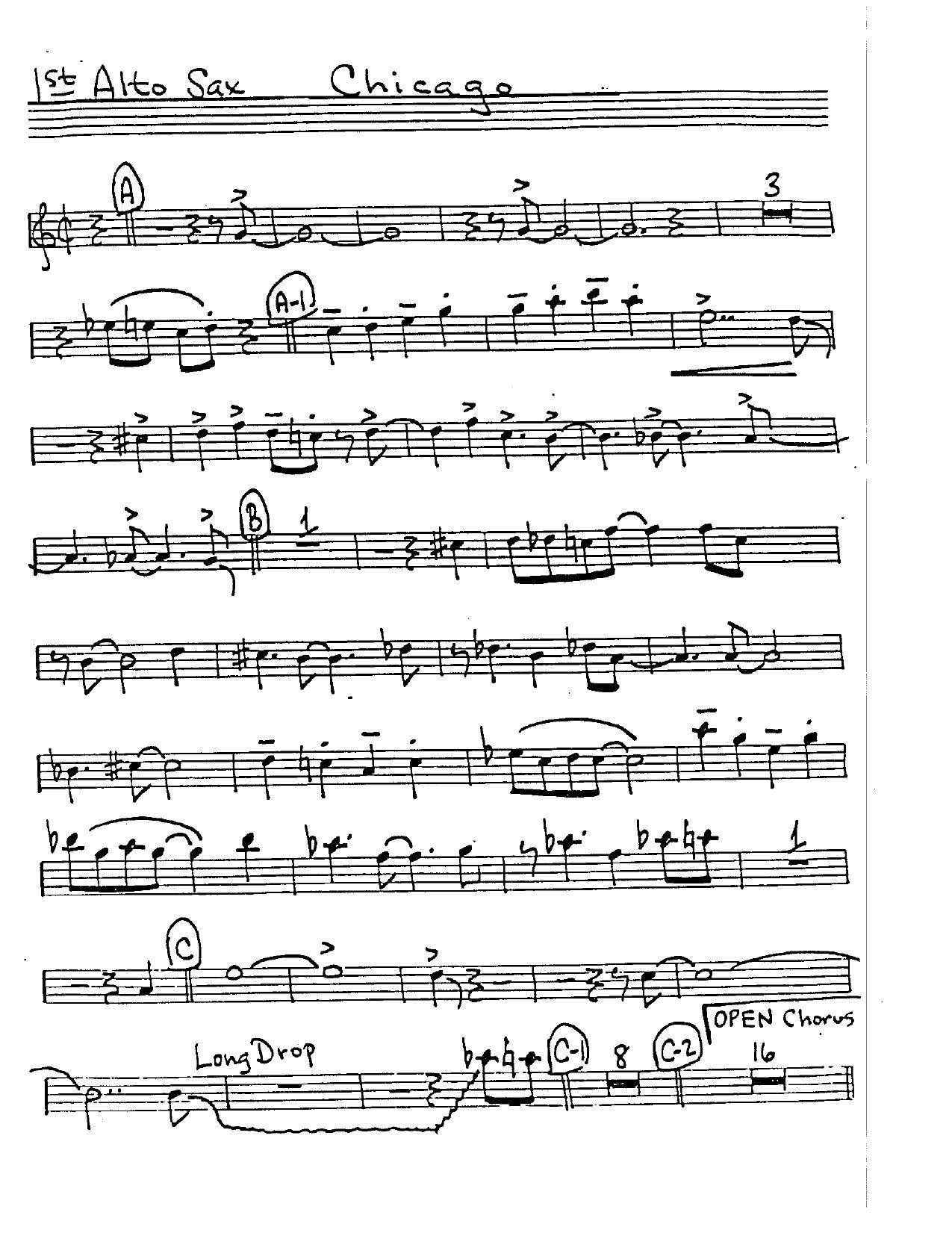
Chicago (D.Rader)
Composed by Fred Fisher
Arranged by Buddy Rich
- Ensemble: Big Band
- Pages: 46
- Instruments (17): 1st Alto Sax, 2nd Alto Sax, 1st Tenor Sax, 2nd Tenor Sax, Baritone Sax, 1st Trumpet, 2nd Trumpet, 3rd Trumpet, 4th Trumpet, 1st Trombone, 2nd Trombone, 3rd Trombone, 4th Trombone, Piano, Bass, Guitar, Drums
- Difficulty: medium
- Content: Individual Parts
- Format: PDF Download (Instant)
- Price: $24.99
Fred Fisher’s timeless 1922 Tin Pan Alley classic "Chicago (That Toddlin' Town)" underwent a ferocious, high-octane theatrical transformation when it entered the repertoire of the legendary Buddy Rich Big Band. Originally an ode to the bustling midwestern metropolis, the tune evolved under Rich’s relentless drive into a quintessential powerhouse big band vehicle. While the standard jazz idiom has embraced the song for decades—most notably immortalized by Frank Sinatra and numerous small-group swing sessions—the Buddy Rich treatment approaches the material with unmatched rhythmic intensity, blistering tempos, and a relentless demand for virtuosic precision. It represents the pinnacle of late-20th-century powerhouse big band arranging, where traditional swing vocabulary collides with aggressive, modern articulation and explosive dynamic contrasts. Driving forward with a relentless, high-velocity swing feel, this chart is engineered to capture the heart-pounding energy of a live Buddy Rich concert opener. The arrangement wastes no time establishing its high-stakes mood, exploding out of the gate with rapid-fire brass figures and breathless woodwind lines that evoke the frantic, glamorous pulse of a bustling city. Rich’s signature approach relies heavily on razor-sharp ensemble unisons, unexpected dynamic drops that build unbearable tension, and massive, brass-heavy shout choruses designed to rattle the back walls of any auditorium. The underlying harmonic language stays rooted in extended traditional swing voicings but is supercharged by chromatic passing tones, roaring plunger effects, and blistering tempo demands that keep both the performers and the audience on the edge of their seats. Commanding lead trumpet writing and hyper-articulate saxophone solis anchor the melodic heavy lifting throughout the arrangement, trading blows with aggressive trombone counterlines. The chart features high-octane solo space designed to showcase a fearless improviser—traditionally a searing tenor saxophone or blistering trumpet—capable of navigating rapid-fire changes under pressure. Technical challenges abound across every section; the brass must execute high-register flourishes and tight rhythmic punches with absolute synchronization, while the saxophones require agile fingerwork to cleanly navigate labyrinthine bebop-infused lines at breakneck speeds. The rhythm section, particularly the drummer, serves as the ultimate engine, requiring an expert grasp of Buddy Rich-style propulsion, crisp ride-cymbal definition, and explosive accent placement that drives the entire ensemble forward. Advanced college ensembles, elite community big bands, and professional-grade jazz orchestras will find this chart an exhilarating centerpiece for a competitive program or a demanding concert finale. Because of the demanding tempo, extensive brass ranges, and the sheer stamina required to sustain its high-energy arc, it sits firmly in the advanced-to-professional difficulty tier. Ensembles that invest the necessary rehearsal time to lock in the articulation and master the breakneck momentum will discover an intensely rewarding crowd-pleaser that showcases precision, power, and unbridled jazz excitement. Executing this high-velocity arrangement successfully requires meticulous attention to articulation, stamina, and rhythmic precision. The tempo must remain relentlessly driving without dragging or rushing; establish a rock-solid, metric pulse with the drummer before adding horns. Brass players should prioritize clean, crisp staccato tongue-strokes on short notes to ensure the fast-moving ensemble figures sound transparent rather than muddy. Incorporate dynamic contrasts intentionally—when the chart drops to a sudden piano, the underlying tension must feel palpable, making the eventual shout-chorus crescendos vastly more impactful. Saxophone sections need to spend dedicated sectional rehearsal time ironing out fast unison passages, ensuring that finger drops and chromatic runs line up cleanly across the desk. Finally, treat the drum chair not merely as a timekeeper, but as a dynamic co-conductor who must trade accents directly with the horn section's rhythmic hits. Q: What instruments and parts are included in this arrangement? A: This arrangement is scored for an 8-instrument core ensemble format consisting of Alto Saxophone, Tenor Saxophone, Baritone Saxophone, Trumpet, Trombone, and a standard rhythm section framework tailored for a compact, hard-hitting big band setup. Q: What is the difficulty level of this Buddy Rich chart? A: This chart is graded as advanced-to-professional, making it best suited for elite college ensembles, professional big bands, and advanced community jazz orchestras equipped with strong sight-readers and high-end stamina. Q: What is the historical and stylistic context of this piece? A: Based on Fred Fisher's 1922 standard, this specific arrangement reflects the high-octane, ferocious big band style championed by legendary drummer Buddy Rich during the height of his orchestra's touring years in the late 1960s and 1970s. Q: What makes this specific arrangement unique? A: It transforms a standard Tin Pan Alley tune into a relentless showcase of power, featuring razor-sharp unisons, aggressive brass punches, dynamic drop-outs, and a high-velocity framework that mirrors Buddy Rich’s signature concert opener style. Q: What is the performance duration and tempo feel of the piece? A: The arrangement is set at a fast, exhilarating swing tempo designed to test ensemble agility, with a typical performance duration running around 3 to 4 minutes depending on the length of the open solo sections.
Questions and answers
- What is included in the Chicago (D.Rader) PDF?
- The verified current file contains individual parts across 46 pages.
- How many instruments or parts are listed for Chicago (D.Rader)?
- The verified instrumentation list contains 17 entries for this Big Band arrangement.
- Who is credited for Chicago (D.Rader)?
- Composer: Fred Fisher. Arranger: Buddy Rich.
- What difficulty is listed for Chicago (D.Rader)?
- The verified difficulty level is medium.
- Can I preview Chicago (D.Rader) before buying?
- Yes. The product page provides a preview generated from the current PDF file.
- How is Chicago (D.Rader) delivered?
- After successful payment, the digital PDF is made available for download. The displayed price is $24.99.
Musicians Also Search For
Chicago Buddy Rich PDF • Chicago Buddy Rich sheet music • Chicago arranged by Buddy Rich • Buddy Rich big band charts • Buddy Rich jazz arrangements PDF • Chicago Fred Fisher sheet music • Chicago Fred Fisher big band arrangements • Fred Fisher big band charts • Chicago big band arrangements • Chicago big band PDF download • Chicago jazz sheet music • big band sheet music download • Chicago individual parts download • Chicago sheet music PDF • buy Chicago sheet music • download Chicago PDF • Chicago jazz charts • best Buddy Rich big band arrangements • Fred Fisher arranged by Buddy Rich • Chicago printable sheet music • big band repertoire PDF