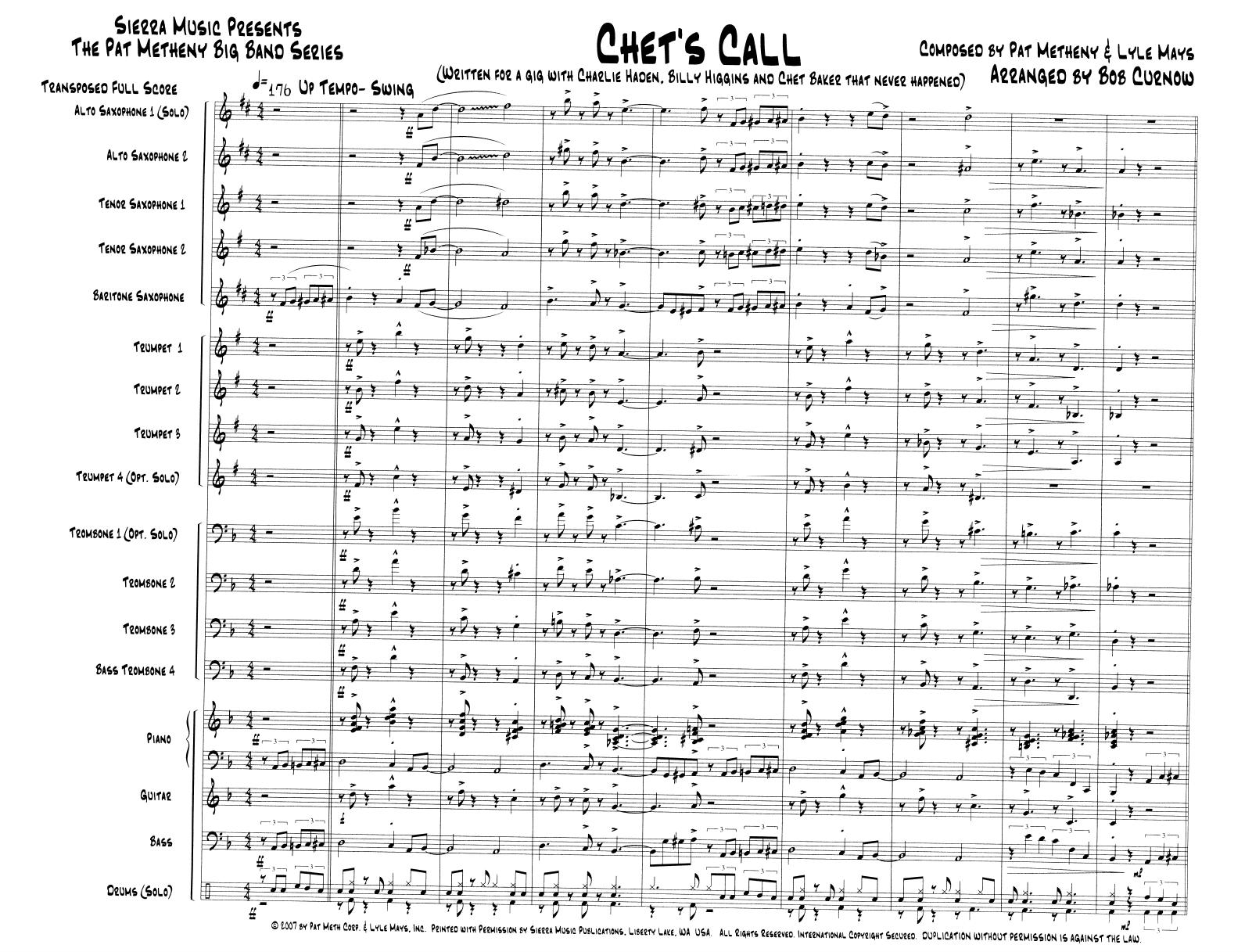
Chet's Call (B.Curnow) sheet music preview

Chet's Call (B.Curnow)

Composed by Bob Curnow

Arranged by Bob Curnow

  • Ensemble: Big Band
  • Pages: 139
  • Instruments (17): Alto Saxophone 1 (Solo), Alto Saxophone 2, Tenor Saxophone 1, Tenor Saxophone 2, Baritone Saxophone, Trumpet 1, Trumpet 2, Trumpet 3, Trumpet 4 (Opt. Solo), Trombone 1 (Opt. Solo), Trombone 2, Trombone 3, Bass Trombone 4, Piano, Guitar, Bass, Drums (Solo)
  • Difficulty: advanced
  • Content: Individual Parts
  • Format: PDF Download (Instant)
  • Price: $24.99

Bob Curnow’s "Chet's Call" stands as a brilliant homage to the cool jazz aesthetic pioneered by trumpet legend Chet Baker, filtered through the sophisticated, harmonically rich lens of modern West Coast big band writing. Composed and arranged by Curnow—a towering figure known for his masterful adaptations of Pat Metheny’s music and his own distinctive large-ensemble writing—this piece captures the melancholic beauty, lyrical introspection, and understated intensity characteristic of 1950s West Coast jazz, while utilizing a contemporary harmonic vocabulary that pushes standard chord progressions into fresh, unexpected territory. From a musical character standpoint, the composition unfolds at a relaxed, contemplative medium tempo (often anchored by a subtle, driving ECM-style or cool-jazz swing feel), established in a lush key signature that favors warm, resonant brass voicings and shimmering woodwind colors. The mood is simultaneously nostalgic and forward-looking, evoking the misty, twilight atmosphere of a late-night coastal drive. Curnow avoids high-register pyrotechnics in favor of exquisite linear counterpoint, gorgeous chordal suspensions, and a profound sense of space. The emotional trajectory builds organically from intimate, exposed melodic statements into a sweeping, harmonically dense ensemble climax that feels both inevitable and emotionally resonant. Curnow’s signature arranging approach is immediately evident in the meticulous voice-leading and the clever distribution of thematic material across the entire 17-piece ensemble. Rather than relying on standard block-chord writing, Curnow utilizes open-position voicings, subtle metric shifts, and intricate background figures that weave effortlessly behind the soloists. The melody is frequently carried by the flugelhorns or muted trumpets and alto saxophones, paying direct tribute to Baker’s iconic timbre. Featured solo sections provide ample space for expressive improvisation—ideally suited for a lyrical trumpet or flugelhorn player, as well as a thoughtful tenor saxophone or piano voice. Technical challenges lie not in blistering velocity, but in intonation, blend, stylistic restraint, and the precise execution of nuanced dynamic swells and extended tertian harmonies. Advanced high school, collegiate, and professional jazz ensembles will find this chart an exceptional vehicle for developing ensemble sensitivity, dynamic control, and sophisticated phrasing. Because it rewards subtlety and deep listening over sheer volume, it serves as an ideal programming choice for groups looking to showcase maturity, tonal beauty, and stylistic versatility beyond standard up-tempo swing or blues charts. Conductors approaching "Chet's Call" must prioritize balance, lyrical phrasing, and pristine intonation above all else. The tempo must remain steady and unhurried; dragging the groove will kill the forward momentum, while rushing will strip the piece of its characteristic cool-jazz vulnerability. The primary technical challenge involves executing Curnow’s dense, extended harmonies with flawless chordal balance, particularly in the saxophone solids and soft brass background pads. Saxophonists should focus on a warm, homogeneous tone, avoiding excessive vibrato to maintain the modern West Coast aesthetic. Trumpet players will benefit from utilizing harmon or bucket mutes where indicated to capture the authentic breathy texture associated with Chet Baker’s sound world. Rehearsal should begin by isolating the rhythm section to lock in the understated, floating pulse. Ensure the bass player maintains an acoustic, woody tone with clear note choices that ground the floating upper-structure triads in the horns. When working with the brass, rehearse chorales at a piano dynamic to build confidence in tuning complex maj7(#11) and alt chords before layering in dynamic crescendos. Q: What instruments and parts are included in this publication? A: The arrangement is scored for a standard 17-instrument big band instrumentation, comprising 2 alto saxophones, 2 tenor saxophones, 1 baritone saxophone, 4 trumpets (with doubling options for flugelhorns), 4 trombones, guitar, piano, bass, and drums, along with a comprehensive 139-page conductor score. Q: What is the difficulty level of this arrangement? A: This piece is graded as advanced, making it best suited for college, advanced high school, and professional jazz ensembles that possess strong reading skills, refined intonation, and mature stylistic awareness. Q: What is the historical style and context of "Chet's Call"? A: Written by Bob Curnow, the piece is deeply rooted in the cool jazz tradition and the West Coast jazz movement made famous by artists like Chet Baker, blending lyrical introspection with sophisticated contemporary big band orchestration. Q: What makes this specific arrangement unique within big band literature? A: Curnow avoids heavy shout-chorus clichés, instead utilizing open-position voicings, intricate counterpoint, and rich extended harmonies that evoke a moody, cinematic atmosphere rarely found in traditional dance-band charts. Q: What is the performance duration and tempo feel of the piece? A: The arrangement is structured around a relaxed, contemplative medium tempo (typically performed around a laid-back swing or ECM-style groove) with a performance duration of approximately 6 to 7 minutes, depending on the length of the improvised solos.

Questions and answers

What is included in the Chet's Call (B.Curnow) PDF?
The verified current file contains a conductor score and individual parts across 139 pages.
How many instruments or parts are listed for Chet's Call (B.Curnow)?
The verified instrumentation list contains 17 entries for this Big Band arrangement.
Who is credited for Chet's Call (B.Curnow)?
Composer: Bob Curnow. Arranger: Bob Curnow.
What difficulty is listed for Chet's Call (B.Curnow)?
The verified difficulty level is advanced.
Can I preview Chet's Call (B.Curnow) before buying?
Yes. The product page provides a preview generated from the current PDF file.
How is Chet's Call (B.Curnow) delivered?
After successful payment, the digital PDF is made available for download. The displayed price is $24.99.

Musicians Also Search For

Chet's Call Bob Curnow PDFChet's Call Bob Curnow sheet musicChet's Call arranged by Bob CurnowBob Curnow big band chartsBob Curnow jazz arrangements PDFChet's Call Bob Curnow big band arrangementsChet's Call big band arrangementsChet's Call big band PDF downloadChet's Call jazz sheet musicbig band sheet music downloadChet's Call conductor score PDFChet's Call individual parts downloadChet's Call sheet music PDFbuy Chet's Call sheet musicdownload Chet's Call PDFChet's Call jazz chartsbest Bob Curnow big band arrangementsChet's Call printable sheet musicbig band repertoire PDF

All arrangements by Bob Curnow All Bob Curnow sheet music