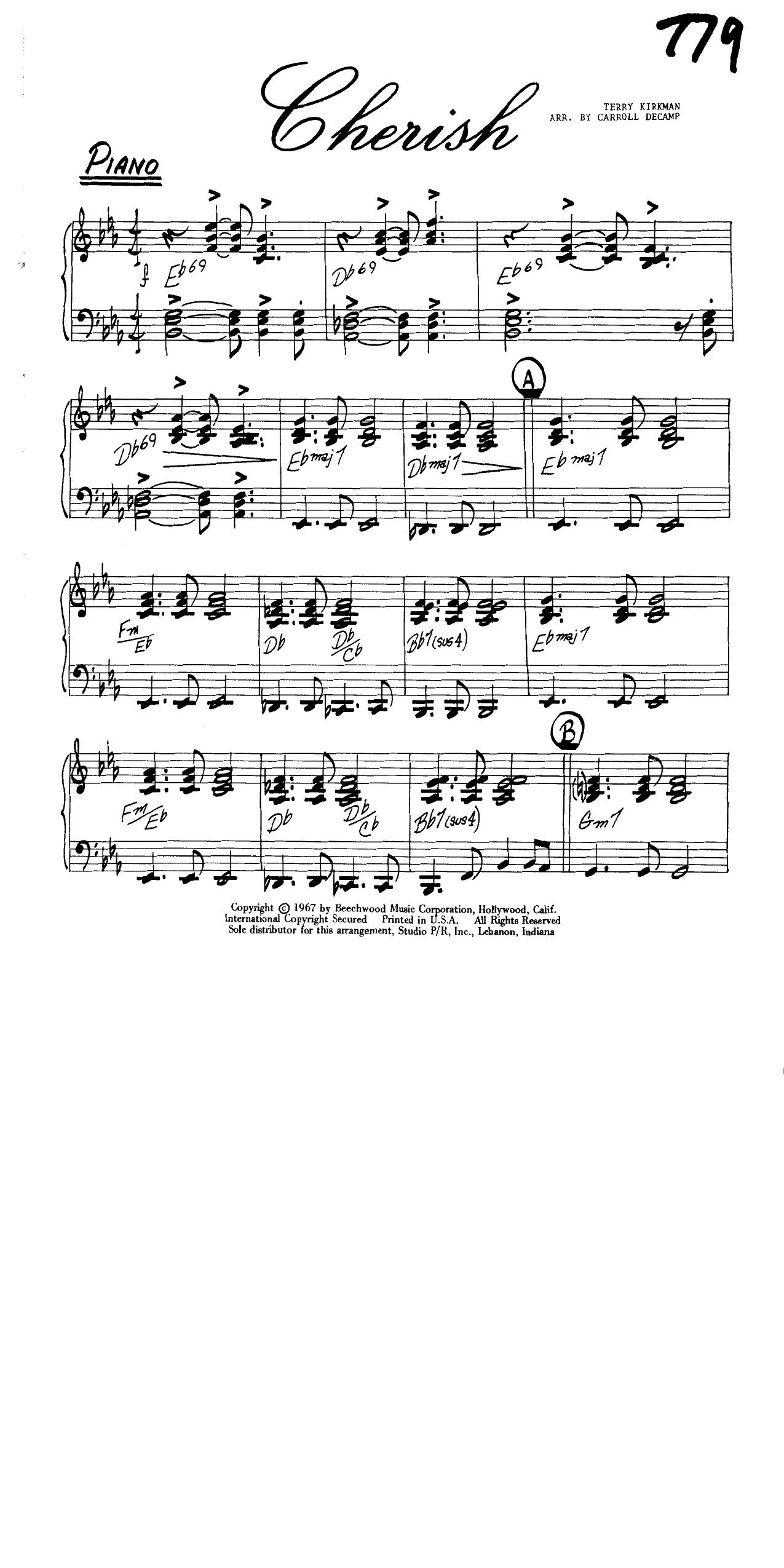
Cherish (C.DeCamp) sheet music preview

Cherish (C.DeCamp)

Composed by Terry Kirkman

Arranged by Carroll DeCamp

  • Ensemble: Big Band
  • Pages: 41
  • Instruments (17): Piano, Guitar, Bass, Drums, 1st Alto Saxophone, 2nd Alto Saxophone, 1st Tenor Saxophone, 2nd Tenor Saxophone, Baritone Saxophone, 1st Trumpet, 2nd Trumpet, 3rd Trumpet, 4th Trumpet, 1st Trombone, 2nd Trombone, 3rd Trombone, 4th Trombone
  • Difficulty: medium
  • Content: Individual Parts
  • Format: PDF Download (Instant)
  • Price: $24.99

Terry Kirkman’s timeless pop masterpiece "Cherish," originally made famous as a definitive Billboard-topping vocal ballad by The Association in 1966, undergoes a sophisticated metamorphosis in this masterful big band setting. Plucked from the golden era of sunshine pop and soft-rock harmony, the composition possesses an inherent melodic richness and cyclical chord progression that translates with remarkable fluidity into the jazz idiom. Carroll DeCamp harnesses this underlying harmonic strength, transforming a 1960s vocal classic into an emotionally resonant, textured instrumental showcase that bridges popular nostalgia with mainstream jazz sophistication. Rooted in a lush, expressive ballad feel with subtle contemporary jazz-rock undertones, the arrangement unfolds in a warm, inviting key that maximizes the resonant frequencies of the full ensemble. The emotional trajectory moves from introspective tenderness to sweeping, cinematic grandeur. DeCamp constructs an atmosphere characterized by rich, extended chord voicings in the brass and interlocking woodwind countermelodies that evoke the sophisticated arranging styles of West Coast studio jazz. The mood is simultaneously nostalgic and forward-looking, offering a masterclass in dynamic control, rubato-leaning phrasing, and sustained lyrical tension that demands deep expressive commitment from every section. DeCamp’s signature arranging approach shines through the meticulous voice-leading and the clever distribution of thematic material. Rather than relying on a predictable melody-and-accompaniment format, the chart distributes motivic fragments across contrasting sections, utilizing a lush saxophone soli to carry the secondary thematic development with fluid, modern harmonic twists. The brass section acts as both a warm pillow of sound and a potent dramatic voice, swelling through sophisticated upper-structure triads. While rhythmically accessible, the chart requires acute attention to inner-voice movement, rubato pacing, and seamless transitions between sparse, exposed textures and full-ensemble climaxes. Advanced high school, collegiate, and professional community big bands will find this chart an ideal vehicle for developing sophisticated ensemble listening, intonation, and lyrical phrasing. Because the heavy lifting lies in balance, blend, and emotional interpretation rather than breakneck technical execution, it serves as a brilliant concert-programming centerpiece that offers both players and audiences a refreshing departure from standard up-tempo swing fare. The scoring rewards a mature rhythm section capable of driving a tune with understated elegance, anchoring a chart that balances sentimental familiarity with mature jazz artistry. Executing this arrangement successfully hinges upon the ensemble's ability to maintain a seamless, flowing legato concept even during moments of dynamic expansion. The conductor should establish a relaxed, flexible tempo feel that breathes with the soloists, avoiding a rigid or mechanical metronomic pulse. A primary technical challenge involves maintaining pristine intonation within the dense, extended-harmony brass voicings; players must lock in their inner-voice pitch tendencies, particularly during the chromatic movement in the bridge. Saxophones should focus on achieving a unified, velvety tone color during the soli passages, ensuring that vibrato is matched across the section. The rhythm section needs to exercise immense restraint—the pianist should voice chords with sparse, tasteful extensions rather than heavy-handed block chords, while the drummer utilizes subtle brushwork or light ride cymbal textures to maintain forward momentum without cluttering the spacious arrangement. Rehearsals should initially focus on sectional balance, ensuring that counterlines do not inadvertently obscure the primary melodic voice. Q: What instruments and parts are included in this arrangement? A: The complete 17-instrument big band instrumentation includes a full rhythm section (Piano, Guitar, Bass, Drum Set) alongside a standard horn lineup featuring Alto Saxophone 1, and spans a comprehensive 41-page manuscript that includes a full conductor score. Q: What is the difficulty level of this chart? A: This arrangement is graded as intermediate-advanced (suitable for advanced high school, collegiate, and professional community big bands), primarily challenging the ensemble's lyrical phrasing, intonation, and dynamic control rather than technical velocity. Q: What is the musical style and historical context of the piece? A: It is a jazz ballad adaptation of Terry Kirkman’s 1966 pop hit originally recorded by The Association, reframing sunshine-pop vocal harmonies into a sophisticated, modern instrumental big band vocabulary. Q: What makes Carroll DeCamp's arrangement unique? A: DeCamp elevates the source material through lush, extended chord voicings, intricate inner-voice counterpoint, and a textural saxophone soli that reinterprets a vocal standard as a deeply expressive instrumental jazz feature. Q: What is the performance duration and tempo feel of the arrangement? A: The piece is performed at a relaxed, expressive ballad tempo with a flexible, breathing pulse that emphasizes lyrical phrasing, making it ideal as a major emotional centerpiece for a concert program.

Questions and answers

What is included in the Cherish (C.DeCamp) PDF?
The verified current file contains a conductor score and individual parts across 41 pages.
How many instruments or parts are listed for Cherish (C.DeCamp)?
The verified instrumentation list contains 17 entries for this Big Band arrangement.
Who is credited for Cherish (C.DeCamp)?
Composer: Terry Kirkman. Arranger: Carroll DeCamp.
What difficulty is listed for Cherish (C.DeCamp)?
The verified difficulty level is medium.
Can I preview Cherish (C.DeCamp) before buying?
Yes. The product page provides a preview generated from the current PDF file.
How is Cherish (C.DeCamp) delivered?
After successful payment, the digital PDF is made available for download. The displayed price is $24.99.

Musicians Also Search For

Cherish Carroll DeCamp PDFCherish Carroll DeCamp sheet musicCherish arranged by Carroll DeCampCarroll DeCamp big band chartsCarroll DeCamp jazz arrangements PDFCherish Terry Kirkman sheet musicCherish Terry Kirkman big band arrangementsTerry Kirkman big band chartsCherish big band arrangementsCherish big band PDF downloadCherish jazz sheet musicbig band sheet music downloadCherish conductor score PDFCherish individual parts downloadCherish sheet music PDFbuy Cherish sheet musicdownload Cherish PDFCherish jazz chartsbest Carroll DeCamp big band arrangementsTerry Kirkman arranged by Carroll DeCampCherish printable sheet musicbig band repertoire PDF

All arrangements by Carroll DeCamp All Terry Kirkman sheet music