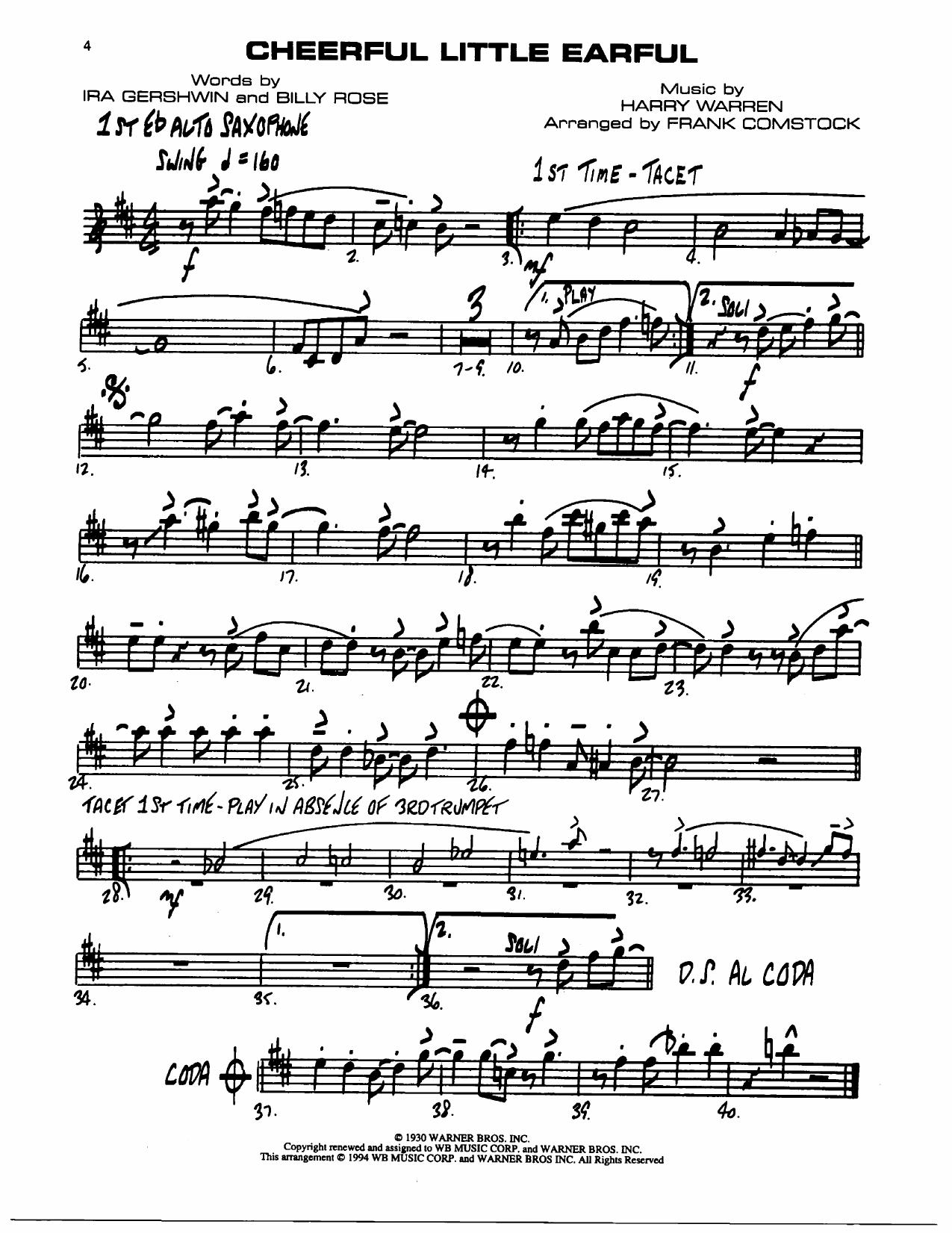
Cheerful Little Earful (F.Comstock) sheet music preview

Cheerful Little Earful (F.Comstock)

Composed by Harry Warren

Arranged by Frank Comstock

  • Ensemble: Big Band
  • Pages: 16
  • Instruments (15): 1st Eb Alto Saxophone, 2nd Eb Alto Saxophone, 1st Bb Tenor Saxophone, 2nd Bb Tenor Saxophone, Eb Baritone Saxophone, 1st Bb Trumpet, 2nd Bb Trumpet, 3rd Bb Trumpet, 1st Trombone, 2nd Trombone, 3rd Trombone, Piano, Bass, Drums, Guitar
  • Difficulty: easy
  • Content: Individual Parts
  • Format: PDF Download (Instant)
  • Price: $24.99

Harry Warren and lyricists Ira Gershwin and Billy Rose originally crafted "Cheerful Little Earful" in 1930 for the Broadway revue *Sweet and Low*, quickly propelling the tune into the American songbook as a quintessential upbeat vehicle of the early depression era. While initially introduced as a cheerful antidote to economic gloom, the composition found its true stride in the jazz world through buoyant recordings by the Ben Bernie Orchestra and later small-group interpretations. Its infectious, optimistic cadence and clever harmonic turns made it an irresistible canvas for mid-century arrangers looking to bridge early dance-band swing with more sophisticated, modern jazz counterpoint. Frank Comstock’s inspired big band setting radiates a bright, high-energy medium-swing feel in 4/4 time, driven by crisp percussion accents and a vibrant, forward-moving momentum. The mood is unabashedly joyful, evoking the sophisticated polish of 1950s West Coast studio jazz while retaining the earthy pulse of traditional swing. Comstock utilizes a tightly knit 8-instrument instrumentation—featuring a dynamic three-piece saxophone section (alto, tenor, baritone), trumpet, trombone, and a rhythm-backing framework—to achieve a surprisingly lush, full-voiced texture that punches far above its smaller ensemble footprint. His trademark writing style shines through clever chromatic voice-leading, interlocking horn counterlines, and bright, punchy harmonic stabs that keep the energy perpetually elevated. Throughout the arrangement, the melodic weight is shared fluidly between the brass and saxophones, often initiated by crisp unison statements before blooming into rich, harmonized solis. Comstock builds structural tension via clever modulation and rhythmic displacement, leading seamlessly into an exhilarating shout chorus that showcases the interplay between the trumpet and lower reeds. Technical demands center around tight rhythmic precision, clean articulation in the swing eighth-note passages, and careful dynamic control to ensure the inner harmony voices remain transparent beneath the primary melody. Solo opportunities invite featured players to stretch out over changes that honor the breezy, sophisticated optimism of Warren’s original framework. Advanced high school ensembles, collegiate studio jazz groups, and professional freelance or repertory bands will find this chart exceptionally rewarding. Because of its compressed 8-instrument scoring, it demands absolute accountability from every individual player, making it an incredible pedagogical tool for fostering section blend and rhythmic synchronization without requiring a massive 17-piece big band roster. Conductors will appreciate how naturally the chart sits on the stands, offering immediate audience appeal while providing enough harmonic and stylistic depth to satisfy discerning jazz musicians. Achieving the authentic, buoyant swing feel required for this Frank Comstock chart demands absolute precision with short, detached eighth notes and crisp articulation across all horns. The tempo should sit comfortably in a bright medium-swing groove (approx. quarter note = 160–168 BPM), avoiding any tendency to rush during the dense ensemble shout sections. Key technical challenges involve the tight dynamic balance required within the 8-instrument configuration; because there are fewer players, inner-voice harmony parts must project without overpowering the lead melody. Brass players should utilize clean, articulate tonguing with minimal use of heavy accents unless specifically marked, keeping the style sophisticated and light. Rehearsal should begin by isolating the rhythm section to lock in the driving walking bassline and crisp ride-cymbal pulse. Next, have the saxophone and brass sections rehearse their interlocking counterlines independently at a slower tempo to master the tricky chromatic voice-leading before integrating the full ensemble. Pay close attention to breath support during longer phrased solis to maintain a warm, cohesive tone. Q: What instruments and parts are included in this 8-instrument arrangement? A: The instrumentation features a compact 8-part setup comprising Alto Saxophone, Tenor Saxophone, Baritone Saxophone, Trumpet, Trombone, and a complete rhythm section framework to support the ensemble texture. Q: What is the difficulty level of this Frank Comstock chart? A: This arrangement is graded as intermediate-advanced (suitable for strong high school, collegiate, and professional small big bands), requiring solid sight-reading, tight ensemble blend, and facility with bright swing eighth-note subdivisions. Q: What is the historical style and background of "Cheerful Little Earful"? A: Originally written by Harry Warren in 1930, the tune is a classic Tin Pan Alley standard that Comstock reimagines through a sophisticated 1950s West Coast jazz and swing revival lens. Q: What makes this particular arrangement by Frank Comstock unique? A: Comstock successfully condenses the power and harmonic richness of a full 17-piece big band into an agile 8-instrument scoring, utilizing clever voice-leading and dynamic shout choruses that maximize sonic impact. Q: What is the performance duration and recommended tempo for this piece? A: The arrangement runs approximately 3 minutes in duration when performed at the recommended bright medium-swing tempo of around 160 to 168 beats per minute.

Questions and answers

What is included in the Cheerful Little Earful (F.Comstock) PDF?
The verified current file contains individual parts across 16 pages.
How many instruments or parts are listed for Cheerful Little Earful (F.Comstock)?
The verified instrumentation list contains 15 entries for this Big Band arrangement.
Who is credited for Cheerful Little Earful (F.Comstock)?
Composer: Harry Warren. Arranger: Frank Comstock.
What difficulty is listed for Cheerful Little Earful (F.Comstock)?
The verified difficulty level is easy.
Can I preview Cheerful Little Earful (F.Comstock) before buying?
Yes. The product page provides a preview generated from the current PDF file.
How is Cheerful Little Earful (F.Comstock) delivered?
After successful payment, the digital PDF is made available for download. The displayed price is $24.99.

Musicians Also Search For

Cheerful Little Earful Frank Comstock PDFCheerful Little Earful Frank Comstock sheet musicCheerful Little Earful arranged by Frank ComstockFrank Comstock big band chartsFrank Comstock jazz arrangements PDFCheerful Little Earful Harry Warren sheet musicCheerful Little Earful Harry Warren big band arrangementsHarry Warren big band chartsCheerful Little Earful big band arrangementsCheerful Little Earful big band PDF downloadCheerful Little Earful jazz sheet musicbig band sheet music downloadCheerful Little Earful individual parts downloadCheerful Little Earful sheet music PDFbuy Cheerful Little Earful sheet musicdownload Cheerful Little Earful PDFCheerful Little Earful jazz chartsbest Frank Comstock big band arrangementsHarry Warren arranged by Frank ComstockCheerful Little Earful printable sheet musicbig band repertoire PDF

All arrangements by Frank Comstock All Harry Warren sheet music