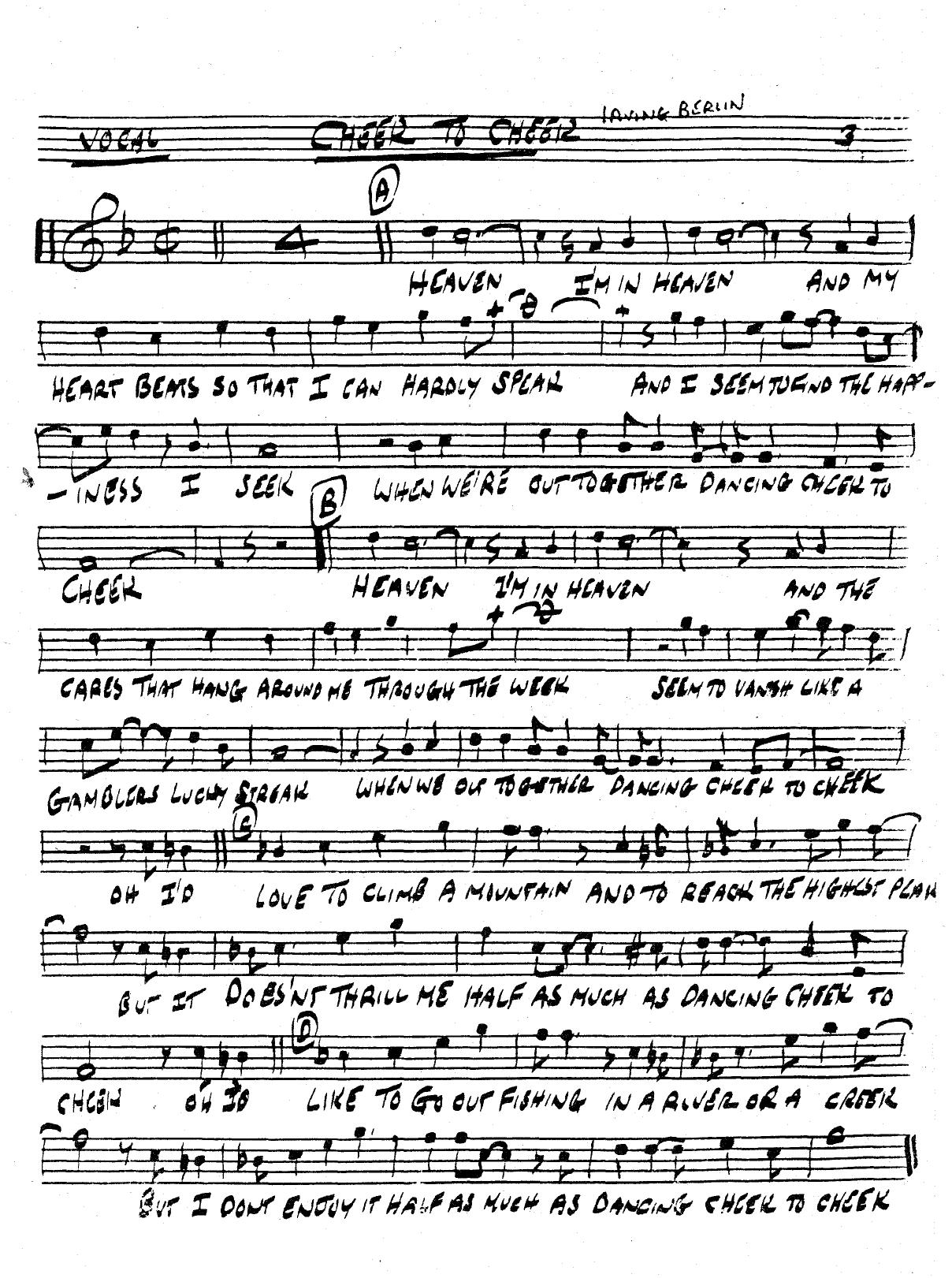
Cheek To Cheek (J.Farley) sheet music preview

Cheek To Cheek (J.Farley)

Composed by Irving Berlin

Arranged by John Farley

  • Ensemble: Big Band
  • Pages: 26
  • Instruments (17): Vocal, 1st Alto Saxophone, 2nd Alto Saxophone, 1st Tenor Saxophone, 2nd Tenor Saxophone, Baritone Saxophone, 1st Trumpet, 2nd Trumpet, 3rd Trumpet, 4th Trumpet, 1st Trombone, 2nd Trombone, 3rd Trombone, 4th Trombone, Piano/Guitar, Bass, Drums
  • Difficulty: medium
  • Content: Individual Parts
  • Format: PDF Download (Instant)
  • Price: $24.99

Irving Berlin penned "Cheek to Cheek" in 1935 for the classic RKO musical *Top Hat*, where it was immortalized by Fred Astaire and quickly transcended its cinematic origins to become a cornerstone of the Great American Songbook. Capturing the golden age of American popular song and early swing, the composition possesses an inherent melodic elegance and rhythmic suppleness that jazz musicians have reinterpreted for nearly a century. From Louis Armstrong and Ella Fitzgerald’s joyful vocal duets to instrumental treatments by giants like Oscar Peterson and Stan Getz, the tune remains a masterclass in sophisticated songwriting, utilizing internal rhyme schemes and sweeping harmonic shifts that naturally invite jazz elaboration. John Farley’s big band setting approaches this timeless standard with a vibrant, swinging momentum that balances classic 1930s elegance with the rich, expanded voicings of modern mainstream jazz. Set in a buoyant, medium-up swing tempo (around 160 BPM), the arrangement opens with a seductive, harmonized sax introduction before laying down an infectious walking bassline groove under the vocalist. The mood shifts effortlessly from sultry intimacy to high-spirited jubilation, evoking the glittering atmosphere of a premier ballroom while maintaining a sharp, modern rhythmic edge. Farley utilizes the full 18-piece big band palette to create dynamic contrast, employing lush, Ellingtonian reed colorations and crisp brass interjections that propel the form forward with irresistible momentum. The vocal lead sits comfortably at the center of the arrangement, supported by clever counter-melodies in the trumpet and trombone sections and a gorgeous four-part sax soli that pays homage to the classic swing era while introducing contemporary harmonic extensions. An open tenor saxophone or trumpet solo section provides a premier soloist the space to stretch out over standard changes before building into a roaring, high-energy shout chorus. This climactic section showcases a masterclass in section interplay, pitting soaring brass lines against aggressive rhythmic punches in the low reeds. The technical demands require tight ensemble articulation, polished section blending, and a rhythm section capable of maintaining a driving, transparent acoustic swing feel without over-driving the meter. Advanced high school ensembles with strong section leaders, collegiate jazz orchestras, and professional community big bands will find this chart to be an exceptionally rewarding centerpiece for a concert program or dance set. The arrangement strikes an ideal balance between audience accessibility and sophisticated musical craftsmanship, providing enough challenging ensemble figures to stimulate advanced players while keeping the iconic vocal line front and center. Directors will appreciate how naturally the chart rehearses, as well as its guaranteed ability to captivate an audience from the very first downbeat. Achieving success with this arrangement hinges on the rhythm section’s ability to establish a light, driving medium-swing feel right from the opening measure. The drummer should utilize a crisp ride cymbal pattern with a gentle hi-hat chick on beats two and four, avoiding heavy foot-stomping that could bog down the buoyant tempo. Horn players must pay close attention to dynamic markings, particularly during the vocal verses where accompaniment figures should remain transparent to let the singer shine. Articulation is paramount: ensure that all eighth-note lines are swung naturally with proper accents on beats two and four, and execute the written falls and doits in the brass with restraint so they enhance rather than overpower the texture. During the sax soli, the section needs to lock its intonation and balance the inner voices tightly against the lead alto. For the shout chorus, brass players should project with a warm, centered tone rather than forcing the sound, allowing Farley's upper-register extensions to ring cleanly through the ensemble. Q: What instruments and parts are included in this 18-instrument big band arrangement? A: The instrumentation features a complete modern big band lineup consisting of a Vocal lead, two Alto Saxophones, two Tenor Saxophones, a Baritone Saxophone, four Trumpets, four Trombones, Piano, Guitar, Bass, and Drums, spanning 26 total pages of score and parts. Q: What is the difficulty level of this John Farley arrangement? A: This chart is graded as advanced-intermediate to advanced, making it best suited for accomplished high school, collegiate, and professional community big bands that possess strong section cohesion and a competent featured soloist. Q: What is the historical style and musical context of this version? A: Rooted in the 1935 Irving Berlin classic popularized by Fred Astaire, this arrangement captures the traditional swing era aesthetic while incorporating sophisticated modern harmonic voicings and a dynamic structure tailored for contemporary jazz ensembles. Q: What makes this specific arrangement by John Farley unique? A: Farley elevates the standard repertoire by blending classic Ellingtonian reed colorations with a soaring, four-part sax soli, clever vocal counter-lines, and a high-energy shout chorus that bridges traditional swing with modern big band arranging sensibilities. Q: What is the performance duration and recommended tempo for this piece? A: The arrangement runs approximately 3.5 to 4 minutes and is best performed at a buoyant medium-swing tempo of around 160 beats per minute to maintain its danceable, uplifting character.

Questions and answers

What is included in the Cheek To Cheek (J.Farley) PDF?
The verified current file contains individual parts across 26 pages.
How many instruments or parts are listed for Cheek To Cheek (J.Farley)?
The verified instrumentation list contains 17 entries for this Big Band arrangement.
Who is credited for Cheek To Cheek (J.Farley)?
Composer: Irving Berlin. Arranger: John Farley.
What difficulty is listed for Cheek To Cheek (J.Farley)?
The verified difficulty level is medium.
Can I preview Cheek To Cheek (J.Farley) before buying?
Yes. The product page provides a preview generated from the current PDF file.
How is Cheek To Cheek (J.Farley) delivered?
After successful payment, the digital PDF is made available for download. The displayed price is $24.99.

Musicians Also Search For

Cheek To Cheek John Farley PDFCheek To Cheek John Farley sheet musicCheek To Cheek arranged by John FarleyJohn Farley big band chartsJohn Farley jazz arrangements PDFCheek To Cheek Irving Berlin sheet musicCheek To Cheek Irving Berlin big band arrangementsIrving Berlin big band chartsCheek To Cheek big band arrangementsCheek To Cheek big band PDF downloadCheek To Cheek jazz sheet musicbig band sheet music downloadCheek To Cheek individual parts downloadCheek To Cheek sheet music PDFbuy Cheek To Cheek sheet musicdownload Cheek To Cheek PDFCheek To Cheek jazz chartsbest John Farley big band arrangementsIrving Berlin arranged by John FarleyCheek To Cheek printable sheet musicbig band repertoire PDF

All arrangements by John Farley All Irving Berlin sheet music