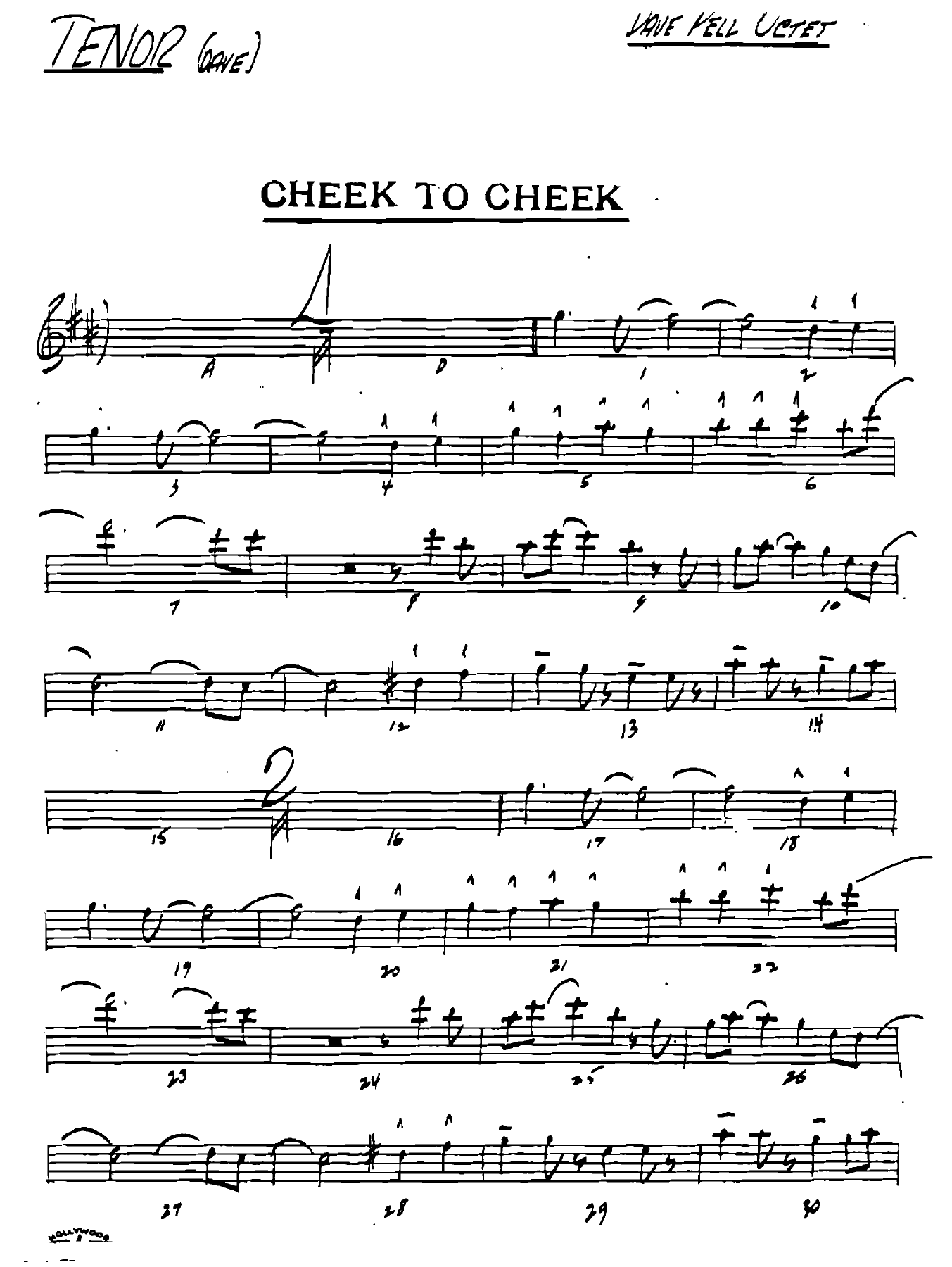
Cheek to Cheek (4.Octet)
Composed by Irving Berlin
Arranged by 4 horns + Rhythm - Paich - Dave Pell Octet
- Ensemble: Small Ensemble
- Style: Jazz Standard
- Pages: 37
- Instruments (8): Tenor Saxophone, Trumpet, Trombone, Baritone Saxophone, Piano, Guitar, Bass, Drums
- Difficulty: easy
- Content: Individual Parts
- Format: PDF Download (Instant)
- Price: $12.99
Irving Berlin's timeless classic, "Cheek to Cheek," first enchanted audiences in 1935 as a highlight of the film *Top Hat*, starring Fred Astaire and Ginger Rogers. This iconic song quickly became synonymous with the Golden Age of Hollywood musicals, its elegant melody and sophisticated lyrics capturing the romantic spirit of the era. Recognized globally as a quintessential jazz standard, its enduring popularity stems from its graceful melodic contours and its inherent swing feel, making it a favorite for both dancers and musicians alike. The original recording by Fred Astaire, accompanied by the Leo Reisman Orchestra, cemented its place in the American Songbook, and it has since been interpreted by countless jazz luminaries, evolving with each generation while retaining its core charm. This particular arrangement, crafted for 4 horns plus rhythm by Marty Paich for the Dave Pell Octet, presents "Cheek to Cheek" as a medium swing masterpiece in the key of F major. The musical character is one of understated elegance and buoyant sophistication, evoking the refined atmosphere of a 1950s West Coast jazz club. The tempo should be approached with a relaxed yet propulsive medium swing feel, allowing the melodic lines to breathe while maintaining a consistent forward momentum. The overall mood is joyful and romantic, imbued with a subtle coolness that was a hallmark of the Dave Pell Octet's sound. Listeners will be drawn into its smooth harmonies and infectious rhythm, experiencing a blend of classic songwriting with a distinctly modern jazz sensibility. Marty Paich's distinctive arranging style shines through in this treatment, characterized by his meticulous voicings and intelligent use of counterpoint within the small ensemble format. Expect lush, close-knit horn harmonies that create a rich sonic tapestry, often employing a "four-way close" or similar sophisticated voicing technique that maximizes the harmonic impact of the four horns. The arrangement features melodic statements passed between different horn voices, creating textural variety, and includes a beautifully crafted soli section where the horns move as a cohesive unit, showcasing Paich's mastery of ensemble writing. While specific shout choruses are less common in this style, the arrangement builds dynamically, culminating in a satisfying ensemble finish. The Dave Pell Octet's approach was always about precision, clarity, and swinging without excess, and this arrangement perfectly embodies that philosophy. Performance-wise, the melody is initially presented by one or two lead horns, often the trumpet or alto saxophone, before being taken up by the full horn section in various configurations. There are ample opportunities for featured solos, typically over the standard AABA form, allowing soloists to express themselves within the established harmonic framework. Technical challenges include achieving precise articulation and blend within the horn section, particularly in the tightly voiced soli passages, and maintaining the consistent, relaxed medium swing feel throughout. The rewarding aspect lies in the ensemble's ability to create a cohesive, sophisticated sound that honors both Berlin's original composition and Paich's brilliant arrangement. This arrangement is ideally suited for college-level jazz ensembles, community big bands with strong lead players, or professional small groups seeking a polished and swinging addition to their repertoire. Its detailed writing and nuanced harmonic language provide an excellent educational experience while delivering a highly satisfying performance. Conductors and musicians should prioritize achieving a relaxed yet insistent medium swing feel, avoiding any tendency to rush or drag. The key technical challenge lies in the precise balance and blend of the four horns, especially in the tightly voiced sections; encourage players to listen across the section and adjust dynamics accordingly. Articulation should be light and crisp, with a focus on shaping phrases rather than staccato attacks. There are no specific extended techniques (like plunger mutes or falls) required, allowing the focus to remain on clean execution and musicality. Rehearsal time should be dedicated to isolating the horn soli passages to ensure rhythmic accuracy and harmonic clarity. Emphasize the importance of the rhythm section maintaining a steady, supportive groove that allows the horns to float gracefully above it. Q: What instruments are included in this "Cheek to Cheek (4.Octet)" arrangement? A: This arrangement is scored for a small ensemble consisting of four horns (typically trumpet, alto saxophone, tenor saxophone, trombone) and a standard rhythm section (piano, bass, drums). Q: What is the difficulty level of this arrangement? A: This arrangement is considered intermediate to advanced. While technically accessible for most college-level musicians, it requires strong ensemble playing, precise intonation, and a mature understanding of swing feel and harmonic nuance. Q: What musical style and historical context does this arrangement represent? A: This arrangement is a classic jazz standard in a medium swing style, reflecting the sophisticated West Coast jazz sound of the 1950s, as popularized by groups like the Dave Pell Octet. The original song was composed by Irving Berlin in 1935. Q: What makes this particular arrangement by Marty Paich unique? A: Marty Paich's arrangement is distinguished by its elegant, close-knit horn voicings, intelligent counterpoint, and a refined medium swing feel that perfectly captures the cool, sophisticated sound of the Dave Pell Octet. Q: What is the typical performance duration and tempo for this piece? A: The typical performance duration for this arrangement is approximately 3-5 minutes, depending on the number and length of improvised solos. It should be performed at a consistent, relaxed medium swing tempo.
Questions and answers
- What is included in the Cheek to Cheek (4.Octet) PDF?
- The verified current file contains individual parts across 37 pages.
- How many instruments or parts are listed for Cheek to Cheek (4.Octet)?
- The verified instrumentation list contains 8 entries for this Small Ensemble arrangement.
- Who is credited for Cheek to Cheek (4.Octet)?
- Composer: Irving Berlin. Arranger: 4 horns + Rhythm - Paich - Dave Pell Octet.
- What difficulty is listed for Cheek to Cheek (4.Octet)?
- The verified difficulty level is easy.
- What style is listed for Cheek to Cheek (4.Octet)?
- The catalog lists the style as Jazz Standard.
- Can I preview Cheek to Cheek (4.Octet) before buying?
- Yes. The product page provides a preview generated from the current PDF file.
- How is Cheek to Cheek (4.Octet) delivered?
- After successful payment, the digital PDF is made available for download. The displayed price is $12.99.
Musicians Also Search For
Cheek to Cheek 4 horns + Rhythm - Paich - Dave Pell Octet PDF • Cheek to Cheek 4 horns + Rhythm - Paich - Dave Pell Octet sheet music • Cheek to Cheek arranged by 4 horns + Rhythm - Paich - Dave Pell Octet • 4 horns + Rhythm - Paich - Dave Pell Octet small ensemble charts • 4 horns + Rhythm - Paich - Dave Pell Octet jazz arrangements PDF • Cheek to Cheek Irving Berlin sheet music • Cheek to Cheek Irving Berlin small ensemble arrangements • Irving Berlin small ensemble charts • Cheek to Cheek small ensemble arrangements • Cheek to Cheek small ensemble PDF download • Cheek to Cheek jazz sheet music • small ensemble sheet music download • Cheek to Cheek individual parts download • Cheek to Cheek sheet music PDF • Cheek to Cheek Jazz Standard charts • Jazz Standard small ensemble arrangements • buy Cheek to Cheek sheet music • download Cheek to Cheek PDF • Cheek to Cheek jazz charts • best 4 horns + Rhythm - Paich - Dave Pell Octet small ensemble arrangements • Irving Berlin arranged by 4 horns + Rhythm - Paich - Dave Pell Octet • Cheek to Cheek printable sheet music • small ensemble repertoire PDF