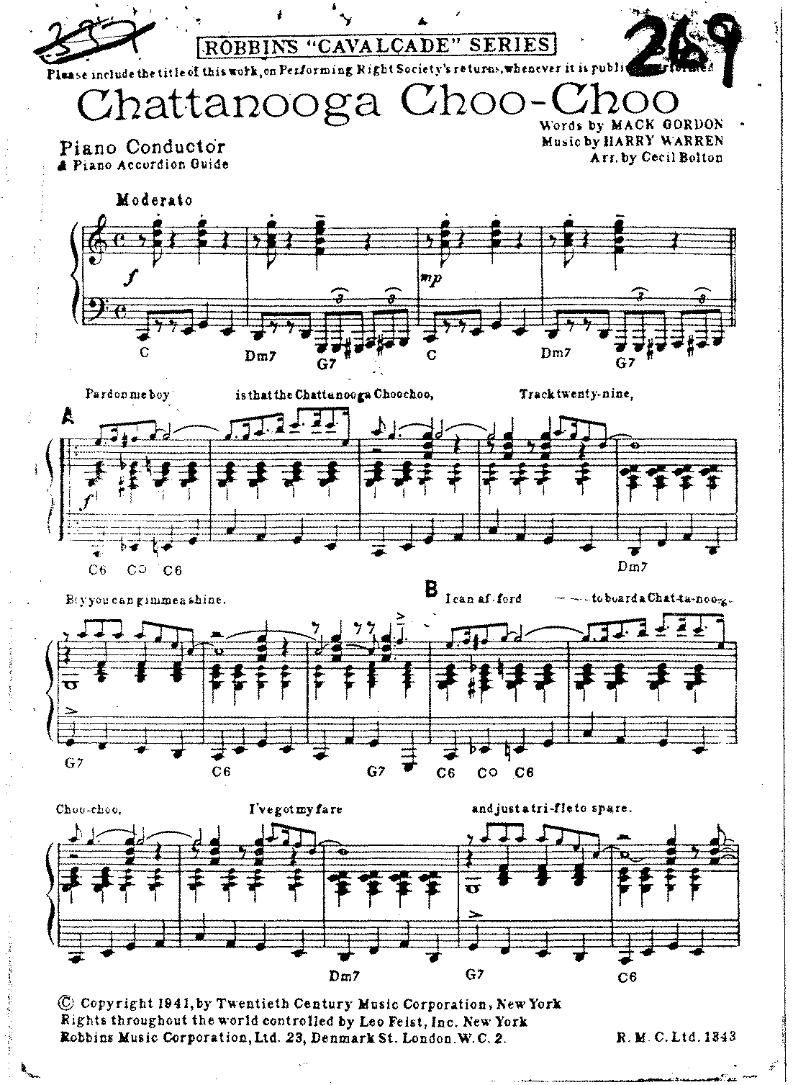
Chattanooga Choo Choo (D.Wolpe)
Composed by HARRY WARREN
Arranged by Dave Wolpe
- Ensemble: Small Ensemble
- Style: Bright Swing
- Pages: 25
- Instruments (17): Piano Conductor & Piano Accordion Guide, 1st Sax (Eb Alto), 3rd Sax (Eb Alto), 2nd Sax (Bb Tenor), 4th Sax (Bb Tenor), 5th Sax (Eb Baritone), 1st Trumpet in Bb, 2nd Trumpet in Bb, 3rd Trumpet in Bb, 4th Trumpet, 1st Trombone, 2nd Trombone, 3rd Trombone, 4th Trombone, Guitar, Bass, Drums
- Difficulty: easy
- Content: Individual Parts
- Format: PDF Download (Instant)
- Price: $12.99
First introduced to the world in 1941, "Chattanooga Choo Choo" quickly became an iconic piece of American popular music, forever associated with the golden age of big band swing. Composed by Harry Warren with lyrics by Mack Gordon, the song was a monumental hit for Glenn Miller and His Orchestra, famously featured in the film "Sun Valley Serenade." Its infectious rhythm and evocative lyrics about a train journey from New York to Chattanooga captured the public imagination, solidifying its place as a quintessential swing era standard. The original recording, which sold over a million copies, was the first ever Gold Record, marking a significant milestone in music history. The piece embodies the bright, optimistic, and highly danceable spirit of 1940s swing, characterized by its driving four-on-the-floor rhythm, call-and-response patterns, and rich harmonic language. Dave Wolpe's small ensemble arrangement of "Chattanooga Choo Choo" masterfully captures the bright swing feel of the original while tailoring it for a more compact instrumentation. Wolpe, renowned for his ability to craft arrangements that are both accessible and musically satisfying, imbues this chart with his signature clarity and drive. The arrangement is set in a vibrant, up-tempo bright swing, typically around 200-220 BPM, maintaining the exhilarating pace that made the original so popular. Wolpe's approach often features well-voiced brass and saxophone soli sections that provide a full, rich sound despite the smaller ensemble size. Expect crisp articulation, dynamic contrasts, and a buoyant rhythmic pulse that will get audiences tapping their feet. The overall mood is undeniably upbeat and celebratory, evoking the joy and energy of a bygone era. This arrangement features the melody primarily carried by the trumpet and alto saxophone in unison or octaves, ensuring a strong, clear lead voice. Wolpe skillfully intersperses these melodic statements with tightly voiced ensemble figures that provide harmonic depth and rhythmic propulsion. While specific solo sections are not explicitly detailed in the provided information, Wolpe's arrangements often include opportunities for improvised solos over standard chord changes, typically for trumpet or alto saxophone, allowing for individual expression within the ensemble framework. The technical challenges lie in maintaining the relentless bright swing tempo with precision, ensuring clean articulation in the brass and saxophone sections, and executing dynamic shifts effectively. The reward is a performance that is both historically resonant and tremendously fun to play, culminating in a powerful shout chorus that brings the piece to a thrilling conclusion. Given its small ensemble format and Wolpe's characteristic writing, this arrangement is ideally suited for college and community jazz ensembles, as well as advanced high school groups seeking to perform a classic swing standard with authentic style. The manageable instrumentation allows for greater flexibility in rehearsal and performance settings, while the musical content provides ample opportunity for developing ensemble blend, rhythmic accuracy, and stylistic interpretation. Its enduring popularity and energetic character make it an excellent choice for concerts, dances, and educational performances where a dose of classic American swing is desired. Conductors should aim for a bright swing tempo in the range of 200-220 BPM to capture the piece's authentic energy. Emphasize crisp articulation, particularly in the brass, ensuring short, punched eighth notes on swing figures. The rhythmic drive is paramount; encourage the rhythm section to maintain a strong four-on-the-floor feel with a walking bass line and a driving ride cymbal pattern. Pay close attention to dynamic contrasts, building intensity through soli sections and the shout chorus. Rehearsal should focus on precise ensemble entrances and releases, especially in the unison and octave melody lines, ensuring a unified sound. While no special techniques like plunger mutes are explicitly required, encourage brass players to use a bright, open tone, and saxophones to blend seamlessly in soli passages. Q: What instruments are included in this "Chattanooga Choo Choo (D.Wolpe)" small ensemble arrangement? A: This small ensemble arrangement typically includes parts for trumpet, alto saxophone, tenor saxophone, trombone, piano, bass, and drums, providing a compact yet full sound. Q: What is the difficulty level of this arrangement? A: This arrangement is considered to be of medium difficulty, suitable for college and community jazz ensembles, as well as advanced high school groups. Q: What is the musical style and historical context of this arrangement? A: This arrangement is a bright swing, capturing the essence of the 1940s big band era, famously popularized by Glenn Miller and His Orchestra. Q: What makes Dave Wolpe's arrangement of "Chattanooga Choo Choo" unique? A: Wolpe's arrangement maintains the original's bright swing feel and classic melodies while skillfully adapting it for a smaller ensemble with his characteristic clear voicings and driving rhythmic approach. Q: What is the recommended tempo for performing this arrangement? A: The recommended tempo for this arrangement is a bright swing, typically in the range of 200-220 BPM, to maintain its energetic and danceable character.
Questions and answers
- What is included in the Chattanooga Choo Choo (D.Wolpe) PDF?
- The verified current file contains a conductor score and individual parts across 25 pages.
- How many instruments or parts are listed for Chattanooga Choo Choo (D.Wolpe)?
- The verified instrumentation list contains 17 entries for this Small Ensemble arrangement.
- Who is credited for Chattanooga Choo Choo (D.Wolpe)?
- Composer: HARRY WARREN. Arranger: Dave Wolpe.
- What difficulty is listed for Chattanooga Choo Choo (D.Wolpe)?
- The verified difficulty level is easy.
- What style is listed for Chattanooga Choo Choo (D.Wolpe)?
- The catalog lists the style as Bright Swing.
- Can I preview Chattanooga Choo Choo (D.Wolpe) before buying?
- Yes. The product page provides a preview generated from the current PDF file.
- How is Chattanooga Choo Choo (D.Wolpe) delivered?
- After successful payment, the digital PDF is made available for download. The displayed price is $12.99.
Musicians Also Search For
Chattanooga Choo Choo Dave Wolpe PDF • Chattanooga Choo Choo Dave Wolpe sheet music • Chattanooga Choo Choo arranged by Dave Wolpe • Dave Wolpe small ensemble charts • Dave Wolpe jazz arrangements PDF • Chattanooga Choo Choo HARRY WARREN sheet music • Chattanooga Choo Choo HARRY WARREN small ensemble arrangements • HARRY WARREN small ensemble charts • Chattanooga Choo Choo small ensemble arrangements • Chattanooga Choo Choo small ensemble PDF download • Chattanooga Choo Choo jazz sheet music • small ensemble sheet music download • Chattanooga Choo Choo conductor score PDF • Chattanooga Choo Choo individual parts download • Chattanooga Choo Choo sheet music PDF • Chattanooga Choo Choo Bright Swing charts • Bright Swing small ensemble arrangements • buy Chattanooga Choo Choo sheet music • download Chattanooga Choo Choo PDF • Chattanooga Choo Choo jazz charts • best Dave Wolpe small ensemble arrangements • HARRY WARREN arranged by Dave Wolpe • Chattanooga Choo Choo printable sheet music • small ensemble repertoire PDF