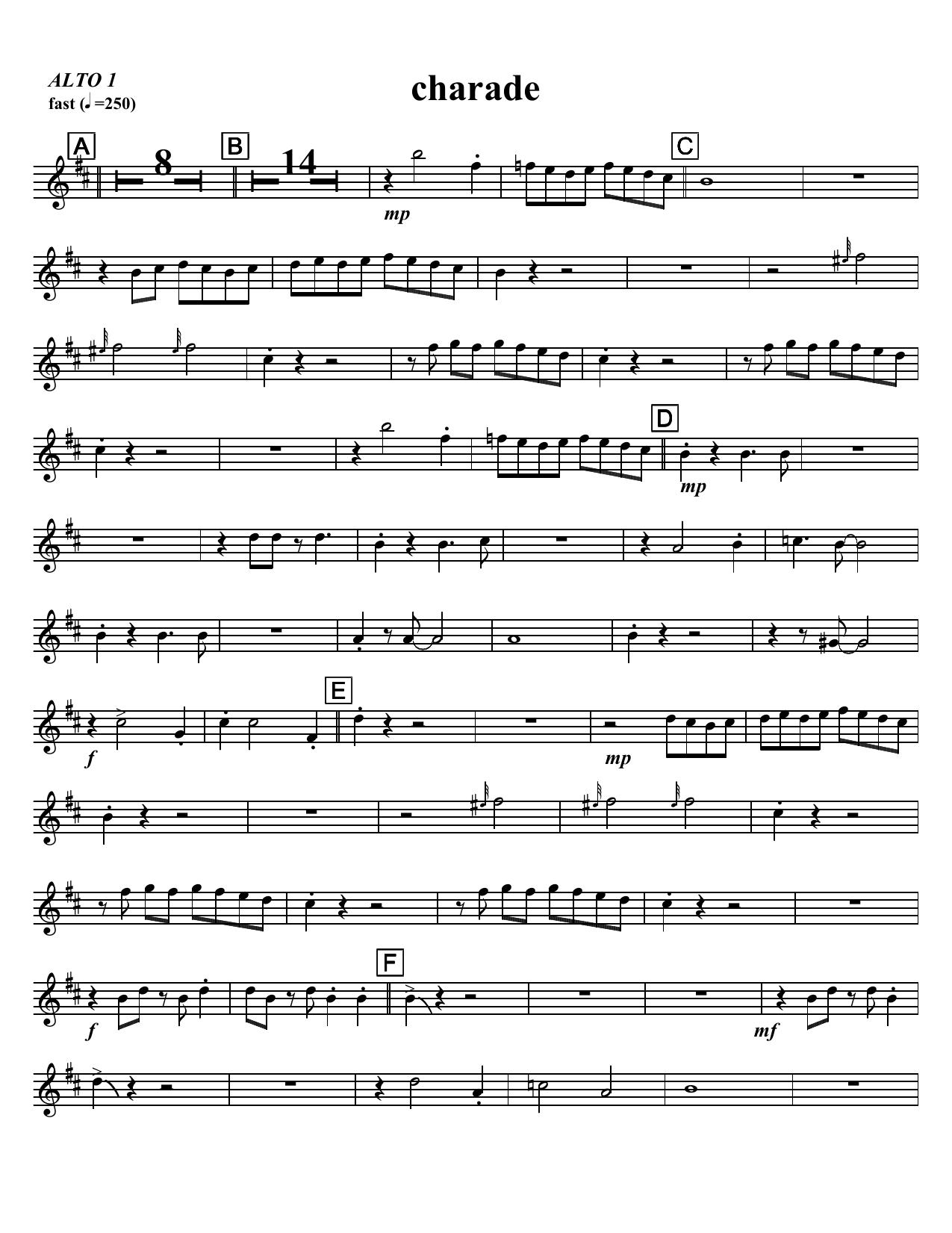
Charade (F.Sinatra) sheet music preview

Charade (F.Sinatra)

Composed by Henry Mancini

Arranged by Frank Sinatra & Nelson Riddle

  • Ensemble: Big Band
  • Pages: 44
  • Instruments (17): Alto Saxophone 1, Alto Saxophone 2, Tenor Saxophone 1, Tenor Saxophone 2, Baritone Saxophone, Trumpet 1, Trumpet 2, Trumpet 3, Trumpet 4, Trombone 1, Trombone 2, Trombone 3, Trombone 4, Bass, Guitar, Drums, Piano
  • Difficulty: medium
  • Content: Individual Parts
  • Format: PDF Download (Instant)
  • Price: $24.99

Henry Mancini’s hauntingly sophisticated melody for *Charade*, originally written for the 1963 Stanley Donen film starring Audrey Hepburn and Cary Grant, achieved true immortality when entered into the vocal and orchestral jazz canon. While the theme earned an Academy Award nomination, its smoky, enigmatic wisp of a melody naturally attracted the elite architects of mid-century cool. The definitive vocal treatment arrived when Frank Sinatra collaborated with master arranger Nelson Riddle, capturing the apex of the Capitol Records era. Riddle’s chart reframes Mancini’s cinematic tension through the lens of sophisticated West Coast orchestration, turning a suspenseful movie theme into a masterclass of atmospheric big band writing. Pervaded by a simmering, nocturnal medium-swing groove in 4/4 time, the arrangement evokes an atmosphere of late-night metropolitan romance laced with clandestine intrigue. The harmonic landscape shifts gracefully between rich minor-mode suspensions and lush major resolutions, establishing a mood that is simultaneously melancholic, suave, and driving. Riddle’s genius lies in his economy of texture; rather than over-scoring, he deploys cascading woodwind flourishes, muted brass sighs, and deep, resonant low-register counterlines that mimic the suspenseful pacing of the silver screen. The rhythm section anchors the cool aesthetic with an understated, persistent walking bassline and crisp, feather-light cymbal work that propels the underlying tension forward. Nelson Riddle’s signature styling permeates every measure of the 11-instrument orchestration, showcasing his peerless mastery of dynamic contrast and coloristic voicing. Low clarinets and velvety saxophones weave intricate, chromatic counter-melodies underneath the vocal line, while brass sections utilize subtle cup and harmon mutes to create a distant, cinematic depth. The arrangement builds organically toward a restrained yet dramatically potent shout chorus, avoiding gratuitous volume in favor of dense, lush chordal stacking that lets the upper-structure extensions bloom. Throughout the chart, the instrumental interplay acts as an active conversational partner to the soloist, echoing phrases and supplying harmonic cushions that elevate the performance beyond a standard stock arrangement. Bringing this chart to life requires a mature ensemble with a strong sense of internal time and refined stylistic subtlety. Advanced high school, collegiate, and professional big bands will find immense artistic fulfillment here, as the primary challenges center not on blazing technical velocity, but on blend, intonation, and maintaining a relaxed, driving pocket at a moderate tempo. Horn players must master delicate dynamic gradations—subito pianos and controlled crescendos—while the rhythm section must sustain a feather-light yet unyielding momentum. Rich in historical pedigree and compositional brilliance, this classic Nelson Riddle setting provides a stunning centerpiece for any serious jazz ensemble looking to master the art of vocal accompaniment and atmospheric swing. Executing this arrangement successfully demands absolute control over dynamic nuance and stylistic subtlety. The tempo should settle comfortably into a relaxed, confident medium swing; resist any temptation to rush, as the inherent tension of the chart relies on the spaciousness of the beat. The primary technical challenge lies in the brass section's execution of muted passages—ensure that cup and harmon mutes are matched for a unified timbral color that never sounds forced or shrill. Rehearsal should initially focus on the rhythm section to lock in the understated walking bass and crisp hi-hat chop, providing a steady, frictionless carpet for the horns. Balance is critical during the low-register woodwind counterlines; ensure the saxophones maintain a warm, breathy tone that supports rather than overpowers the primary thematic statements. Encourage the ensemble to listen across sections, treating every transitional figure as an extension of the vocal line. Q: What instruments and parts are included in this 11-instrument big band arrangement? A: The 44-page score and parts set is scored for a classic compact big band lineup featuring Alto Saxophone, Tenor Saxophone, Baritone Saxophone, Trumpet, Trombone, and a full rhythm section, optimized for an 11-piece ensemble texture. Q: What is the difficulty level of this arrangement? A: This chart is best suited for advanced high school, collegiate, and professional jazz ensembles due to its heavy reliance on subtle dynamic control, intonation, blend, and stylistic maturity rather than extreme technical velocity. Q: What is the style and historical context of this piece? A: The arrangement reflects the sophisticated Capitol Records sound of the 1960s, fusing Henry Mancini’s cinematic mystery from the film *Charade* with Nelson Riddle’s iconic, cool-jazz big band aesthetic popularized by Frank Sinatra. Q: What makes this specific Nelson Riddle arrangement unique? A: It distinguishes itself through its cinematic use of muted brass, lush harmonic suspensions, and intricate woodwind counter-melodies that evoke late-night intrigue while providing a masterclass in vocal accompaniment arranging. Q: What is the performance duration and tempo feel of the piece? A: The arrangement runs approximately 3 to 4 minutes and is anchored by a relaxed, driving medium-swing groove in 4/4 time that demands a steady, unhurried pocket from the rhythm section.

Questions and answers

What is included in the Charade (F.Sinatra) PDF?
The verified current file contains individual parts across 44 pages.
How many instruments or parts are listed for Charade (F.Sinatra)?
The verified instrumentation list contains 17 entries for this Big Band arrangement.
Who is credited for Charade (F.Sinatra)?
Composer: Henry Mancini. Arranger: Frank Sinatra & Nelson Riddle.
What difficulty is listed for Charade (F.Sinatra)?
The verified difficulty level is medium.
Can I preview Charade (F.Sinatra) before buying?
Yes. The product page provides a preview generated from the current PDF file.
How is Charade (F.Sinatra) delivered?
After successful payment, the digital PDF is made available for download. The displayed price is $24.99.

Musicians Also Search For

Charade Frank Sinatra & Nelson Riddle PDFCharade Frank Sinatra & Nelson Riddle sheet musicCharade arranged by Frank Sinatra & Nelson RiddleFrank Sinatra & Nelson Riddle big band chartsFrank Sinatra & Nelson Riddle jazz arrangements PDFCharade Henry Mancini sheet musicCharade Henry Mancini big band arrangementsHenry Mancini big band chartsCharade big band arrangementsCharade big band PDF downloadCharade jazz sheet musicbig band sheet music downloadCharade individual parts downloadCharade sheet music PDFbuy Charade sheet musicdownload Charade PDFCharade jazz chartsbest Frank Sinatra & Nelson Riddle big band arrangementsHenry Mancini arranged by Frank Sinatra & Nelson RiddleCharade printable sheet musicbig band repertoire PDF

All arrangements by Frank Sinatra & Nelson Riddle All Henry Mancini sheet music