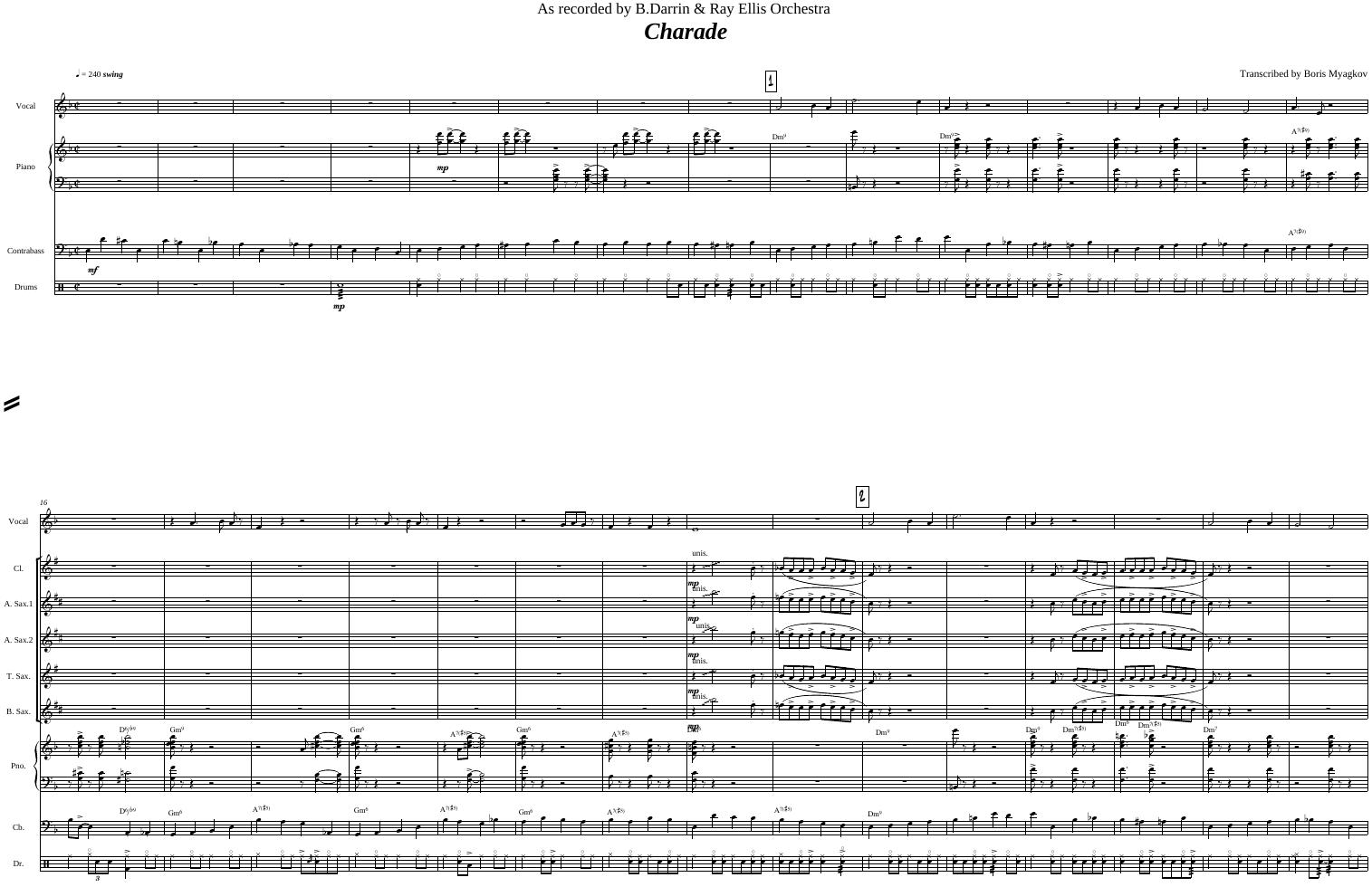
Charade B.Darin & Ray Ellis (B.Myagkov)
Composed by Henry Mancini
Arranged by Boris Myagkov
- Ensemble: Big Band
- Pages: 41
- Instruments (18): Vocal, Clarinet, Alto Saxophone 1, Alto Saxophone 2, Tenor Saxophone, Baritone Saxophone, Trumpet 1, Trumpet 2, Trumpet 3, Trumpet 4, Trombone 1, Trombone 2, Trombone 3, Bass Trombone, Guitar, Piano, Contrabass, Drums
- Difficulty: medium
- Content: Individual Parts
- Format: PDF Download (Instant)
- Price: $24.99
Henry Mancini’s timeless melody "Charade," originally penned for the 1963 Stanley Donen romantic suspense film starring Audrey Hepburn and Cary Grant, achieved legendary status in the jazz vocal canon through iconic interpretations like the swaggering, swinging version recorded by Bobby Darin with lush arrangements by Ray Ellis. This mid-1960s intersection of Hollywood sophistication and vocal jazz swagger represents a golden era where sophisticated orchestral pop met swinging, urbane jazz club energy. Boris Myagkov’s master big band adaptation captures the exact essence of this historic Darin-Ellis collaboration, translating the suave vocal delivery and cinematic, brass-driven counter-melodies into a fully realized modern chart for standard 18-piece big band instrumentation. Swinging with an infectious, driving medium-tempo groove, the chart opens with a cool, confident pulse in the rhythm section before the horns introduce the signature suspenseful chromatic lines that made Mancini’s original theme unforgettable. The harmonic language balances classic swing-era chord extensions with modern color tones, evoking an atmosphere of late-night metropolitan glamour, smoky lounges, and high-stakes intrigue. Myagkov avoids simple block harmonization, instead deploying clever counterpoint between the saxes and brass that mirrors the intricate string and horn interplay on the classic Darin recordings, while maintaining a punchy, driving momentum that keeps the ensemble engaged from the downbeat. The vocalist takes center stage throughout, supported by rich, interlocking reed solis and dynamic brass punches that accent the dramatic peaks of the lyric. Instrumental color is a primary focus of this 41-page score: the inclusion of a dedicated clarinet part alongside two alto saxophones, two tenors, and baritone saxophone provides authentic mid-century timbre, allowing for warm clarinet-lead saxophone solis reminiscent of the best 1960s studio orchestration. Technical demands center on clean articulation, stylistic uniformity in the swing eighth notes, and stylistic nuance in the vocal backing figures. The rhythm section must maintain an effortless, driving pocket—anchored by a steady, buoyant bassline and subtle ride cymbal work—while the brass section must execute crisp, dynamically controlled stabs that punctuate the vocal phrases without ever overpowering the soloist. Advanced high school ensembles, collegiate jazz orchestras, and professional community big bands will find this arrangement an exceptionally rewarding centerpiece for a concert or festival program. The chart offers enough technical substance and historical depth to challenge advanced players, yet remains entirely accessible to bands with a solid grasp of medium-swing idioms. Programming "Charade" provides a masterclass in vocal accompaniment and stylistic versatility, offering audiences a thrilling blend of cinematic nostalgia and hard-swinging big band excitement. Success with this arrangement hinges on achieving an authentic, relaxed mid-1960s vocal swing feel rather than an aggressive, up-tempo bebop attack. The rhythm section should anchor the groove with a persistent, medium-swing pulse, ensuring the quarter note feels buoyant and conversational. Drummers ought to emphasize a crisp ride cymbal pattern with light hi-hat chokes on beats two and four, while the bass player walks lines that connect chord roots smoothly without rushing. In the wind sections, precision in articulation is paramount; short notes must be clipped and uniform, and longer notes should carry a subtle, elegant vibrato appropriate for the era. The featured clarinet and saxophone sections need to balance their blend carefully during counter-melodies to ensure the vocal line remains clearly audible. Conductors should direct the brass to approach dynamic swells—especially during the dramatic transitional phrases—with controlled crescendos that build tension without cracking notes. Rehearsals should initially focus on locking in the rhythm section pocket and balancing the vocal backing figures before opening up the dynamic range. Q: What specific instruments and parts are included in the 41-page score? A: The arrangement is scored for a standard 18-piece big band plus a featured vocal line, including parts for Vocal, Clarinet, Alto Saxophone 1, Alto Saxophone 2, Tenor Saxophone 1, Tenor Saxophone 2, Baritone Saxophone, 4 Trumpets, 4 Trombones, and a full rhythm section (Piano, Guitar, Bass, Drums). Q: What is the difficulty level of this big band arrangement? A: This chart is best suited for advanced high school, collegiate, and professional community big bands, requiring a strong command of medium-swing style, tight ensemble blend, and clean section articulation. Q: What is the stylistic background and historical context of this specific version? A: The chart is modeled after the iconic mid-1960s jazz-vocal style popularized by Bobby Darin and arranger Ray Ellis, blending Henry Mancini’s cinematic film melody from the movie *Charade* with swinging, sophisticated urban jazz orchestration. Q: What makes Boris Myagkov’s arrangement unique? A: It uniquely integrates a dedicated clarinet part with a full sax section and cinematic brass writing, capturing the lush, intricate counterpoint of classic 1960s studio recordings while tailored specifically for a modern 18-piece jazz orchestra. Q: What is the recommended tempo and expected performance duration? A: The piece is set in a confident, driving medium-swing tempo (approximately 116–124 BPM) in 4/4 time, with a standard performance duration of roughly 3 to 4 minutes depending on the vocal pacing.
Questions and answers
- What is included in the Charade B.Darin & Ray Ellis (B.Myagkov) PDF?
- The verified current file contains a conductor score and individual parts across 41 pages.
- How many instruments or parts are listed for Charade B.Darin & Ray Ellis (B.Myagkov)?
- The verified instrumentation list contains 18 entries for this Big Band arrangement.
- Who is credited for Charade B.Darin & Ray Ellis (B.Myagkov)?
- Composer: Henry Mancini. Arranger: Boris Myagkov.
- What difficulty is listed for Charade B.Darin & Ray Ellis (B.Myagkov)?
- The verified difficulty level is medium.
- Can I preview Charade B.Darin & Ray Ellis (B.Myagkov) before buying?
- Yes. The product page provides a preview generated from the current PDF file.
- How is Charade B.Darin & Ray Ellis (B.Myagkov) delivered?
- After successful payment, the digital PDF is made available for download. The displayed price is $24.99.
Musicians Also Search For
Charade B.Darin & Ray Ellis Boris Myagkov PDF • Charade B.Darin & Ray Ellis Boris Myagkov sheet music • Charade B.Darin & Ray Ellis arranged by Boris Myagkov • Boris Myagkov big band charts • Boris Myagkov jazz arrangements PDF • Charade B.Darin & Ray Ellis Henry Mancini sheet music • Charade B.Darin & Ray Ellis Henry Mancini big band arrangements • Henry Mancini big band charts • Charade B.Darin & Ray Ellis big band arrangements • Charade B.Darin & Ray Ellis big band PDF download • Charade B.Darin & Ray Ellis jazz sheet music • big band sheet music download • Charade B.Darin & Ray Ellis conductor score PDF • Charade B.Darin & Ray Ellis individual parts download • Charade B.Darin & Ray Ellis sheet music PDF • buy Charade B.Darin & Ray Ellis sheet music • download Charade B.Darin & Ray Ellis PDF • Charade B.Darin & Ray Ellis jazz charts • best Boris Myagkov big band arrangements • Henry Mancini arranged by Boris Myagkov • Charade B.Darin & Ray Ellis printable sheet music • big band repertoire PDF