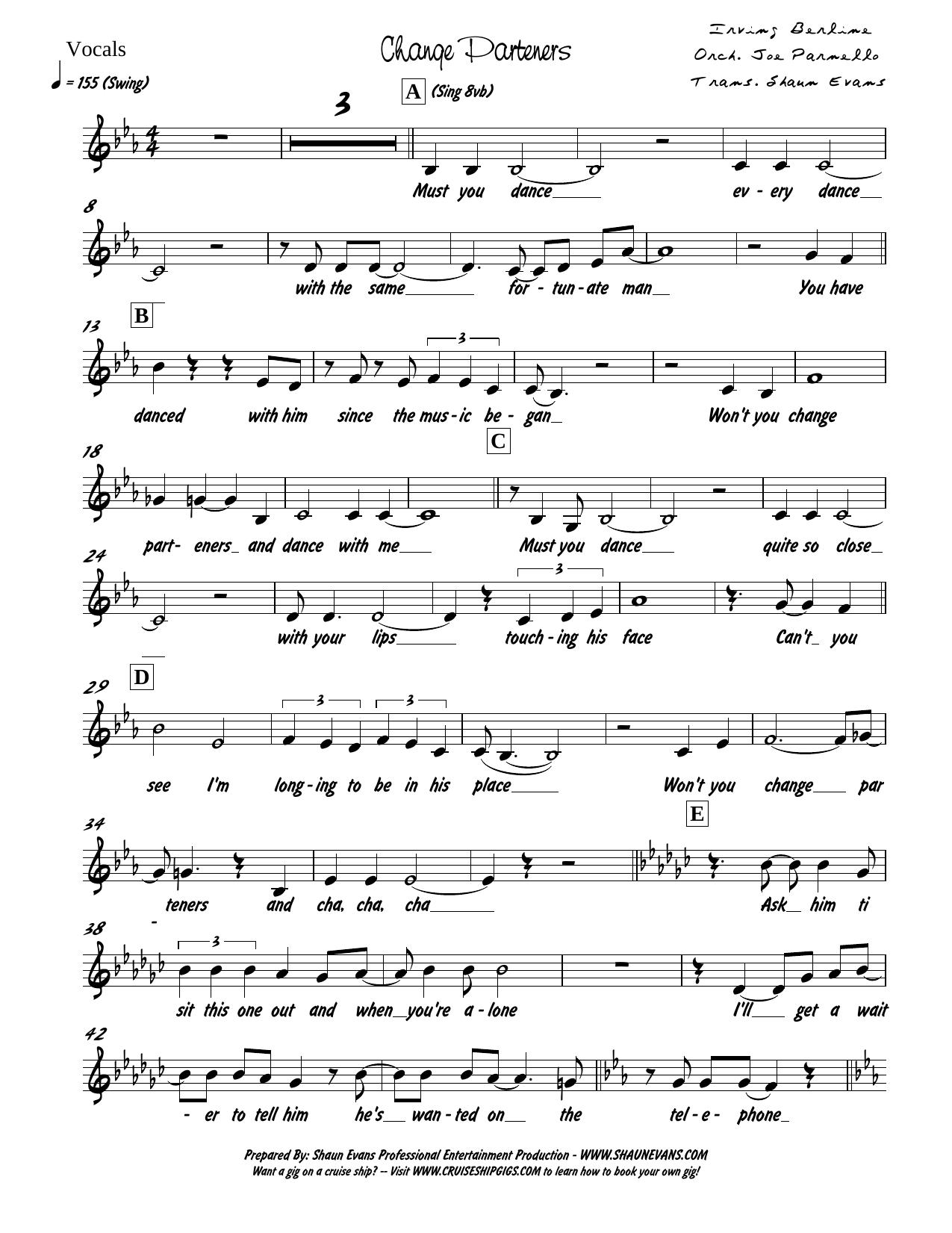
Change Partners (S.Evans) sheet music preview

Change Partners (S.Evans)

Composed by Irving Berlin

Arranged by Frank Sinatra & Nelson Riddle

  • Ensemble: Big Band
  • Pages: 45
  • Instruments (18): Vocals, Tenor Saxophone I, Tenor Saxophone II, Alto Saxophone I, Alto Saxophone II, Baritone Saxophone, Trumpet I, Trumpet II, Trumpet III, Trumpet IV, Trombone I, Trombone II, Trombone III, Bass Trombone, Bass, Guitar, Drums, Piano
  • Difficulty: medium
  • Content: Individual Parts
  • Format: PDF Download (Instant)
  • Price: $24.99

Irving Berlin originally penned "Change Partners" for the 1938 Fred Astaire and Ginger Rogers RKO film *Carefree*, establishing it immediately as a sophisticated entry in the Great American Songbook. While conceived as a graceful cinematic waltz, the composition underwent a transformative metamorphosis during the golden era of mid-century vocal jazz. The definitive paradigm shift occurred when Frank Sinatra recorded the tune with master arranger Nelson Riddle, translating Berlin's triple-meter elegance into a swinging, buoyant 4/4 medium-tempo groove. This Sinatra-Riddle pairing represents the pinnacle of Capitol Records' sophisticated aesthetic, capturing a breezy, playful narrative about romantic pursuit and playful evasion through an orchestral lens that blends effortless charm with razor-sharp harmonic sophistication. Riddle’s treatment opens with an iconic, cascading brass flourish before settling into a relaxed, forward-driving medium swing anchored by a walking bassline and crisp hi-hat pulse. The arrangement exudes a suave, urbane mood characterized by clever counterpoint and tongue-in-cheek dramatic tension, mirroring the lyrical themes of romantic musical chairs. Riddle utilizes a classic 10-instrument big band instrumentation, deploying the woodwinds and brass in tightly-knit voicings that evoke classic swing-era textures while maintaining a modern, West Coast cool restraint. The harmonic landscape features lush extended chords, signature trombone smears, and chromatic passing tones that elevate the standard into an orchestral masterclass of vocal accompaniment style. Throughout the chart, the melodic weight shifts fluidly between the vocal soloist and the instrumental sections, featuring sophisticated woodwind solis and punchy brass interjections that punctuate the lyric lines. The rhythm section is tasked with maintaining an impeccable, unhurried pocket, allowing the horns to float effortlessly behind the vocal phrasing with precise articulation. While the technical demands are moderate in terms of extreme ranges, the chart requires advanced ensemble sensitivity; achieving the correct stylistic balance between relaxed, behind-the-beat phrasing and crisp, synchronized ensemble hits is paramount. The standout musical moment arrives during the turnaround into the final vocal chorus, where Riddle deploys a brilliant modulation and a playful shout chorus that builds theatrical momentum before resolving into a signature understated finish. Advanced high school ensembles, collegiate jazz orchestras, and professional freelance big bands will find this arrangement an invaluable showcase for a guest vocalist. Its sophisticated orchestration demands mature listening skills and stylistic awareness, making it an ideal vehicle for teaching authentic swing feel, dynamic control, and the delicate art of vocal accompaniment. Performing this Nelson Riddle masterpiece provides an authentic taste of the Capitol Records Sinatra sessions, guaranteeing a sophisticated highlight for any serious concert program. Executing this Nelson Riddle arrangement successfully requires a disciplined focus on stylistic subtlety and dynamic restraint. The tempo should sit comfortably in a relaxed medium swing (around 116–120 BPM); pushing the tempo destroys the effortless, conversational elegance that defines the Sinatra-Riddle collaboration. Rhythm section players must prioritize a feather-light touch, with the drummer utilizing a classic ride-cymbal "spang-a-lang" pattern and crisp Charleston-style hi-hat closures on beats two and four. Horn players should pay meticulous attention to dynamic markings, ensuring that background figures never overpower the soloist or vocalist. Articulation is key: quarter notes in the brass must be played with a warm, sustained length rather than a clipped staccato, while eighth-note lines require a relaxed, traditional swing subdivision. In rehearsal, conductors should isolate the dynamic swells and ensure seamless transitions during the modulation passages, focusing heavily on ensemble blend across the 10-piece texture. Q: What instruments and parts are included in this 10-instrument arrangement? A: The chart is scored for a specialized 10-piece ensemble featuring Alto Saxophone, Tenor Saxophone, Baritone Saxophone, Trumpet, Trombone, and a full rhythm section, balancing full big-band voicings with chamber-jazz transparency. Q: What is the overall difficulty level of this arrangement? A: This chart is graded as intermediate-advanced (Level 4), primarily due to the requirement for mature ensemble blend, subtle dynamic control, and authentic swing phrasing rather than extreme technical speeds. Q: What is the historical and stylistic context of this specific version? A: This arrangement adapts Irving Berlin's 1938 waltz into a quintessential 4/4 swing chart modeled after the iconic collaborative style of Frank Sinatra and arranger Nelson Riddle during their landmark Capitol Records years. Q: What makes this Nelson Riddle arrangement unique compared to standard big band charts? A: It features Riddle's signature sophisticated harmonic voicings, clever woodwind counterlines, and theatrical orchestral colors designed specifically to complement vocal delivery while maintaining deep jazz credibility. Q: What is the performance duration and recommended tempo for this piece? A: The arrangement runs approximately 3 minutes and 15 seconds at its recommended medium-swing tempo of roughly 118 beats per minute.

Questions and answers

What is included in the Change Partners (S.Evans) PDF?
The verified current file contains individual parts across 45 pages.
How many instruments or parts are listed for Change Partners (S.Evans)?
The verified instrumentation list contains 18 entries for this Big Band arrangement.
Who is credited for Change Partners (S.Evans)?
Composer: Irving Berlin. Arranger: Frank Sinatra & Nelson Riddle.
What difficulty is listed for Change Partners (S.Evans)?
The verified difficulty level is medium.
Can I preview Change Partners (S.Evans) before buying?
Yes. The product page provides a preview generated from the current PDF file.
How is Change Partners (S.Evans) delivered?
After successful payment, the digital PDF is made available for download. The displayed price is $24.99.

Musicians Also Search For

Change Partners Frank Sinatra & Nelson Riddle PDFChange Partners Frank Sinatra & Nelson Riddle sheet musicChange Partners arranged by Frank Sinatra & Nelson RiddleFrank Sinatra & Nelson Riddle big band chartsFrank Sinatra & Nelson Riddle jazz arrangements PDFChange Partners Irving Berlin sheet musicChange Partners Irving Berlin big band arrangementsIrving Berlin big band chartsChange Partners big band arrangementsChange Partners big band PDF downloadChange Partners jazz sheet musicbig band sheet music downloadChange Partners individual parts downloadChange Partners sheet music PDFbuy Change Partners sheet musicdownload Change Partners PDFChange Partners jazz chartsbest Frank Sinatra & Nelson Riddle big band arrangementsIrving Berlin arranged by Frank Sinatra & Nelson RiddleChange Partners printable sheet musicbig band repertoire PDF

All arrangements by Frank Sinatra & Nelson Riddle All Irving Berlin sheet music